Architectural Engineering MEng
COURSE INFORMATION (2013 ENTRY)
5 years sandwich or 4 years full-time
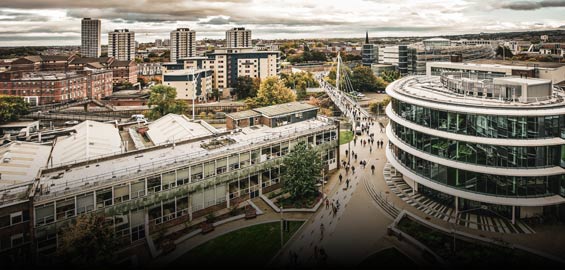
Engineering and EnvironmentEllison Building, Newcastle City Campus
Once you have read this page and its associated tabs please click here for access to more detailed information about Architectural Engineering at Northumbria.
- Would you like to have a career designing low and zero carbon buildings?
- Are you naturally interested in how things work?
If the answer to both these questions is yes then you may well love to study on this course and develop a career as an Architectural Engineer; please read on.
The threat posed by the risk of climate change has prompted governments around the world to take action to significantly reduce carbon emissions. Buildings are recognised to be a key target where very significant reductions in carbon emissions can and should be delivered. The UK the government has set a target date of 2016 for new housing (domestic) developments and 2019 for new commercial (non domestic) buildings to be zero carbon. This is creating exciting opportunities for those able to exploit them; building a career to play a part in reducing global warming.
This course is specifically designed to equip our graduates with the understanding and skills necessary to take a leading role in designing the buildings of the future and also to actively contribute to the refurbishment of our existing building stock; much of which will still be in use forty years from now and so must be significantly improved. The following paragraphs aim to give you a taste of what you will learn in each year of the course.
In year one you will cover the key fundamentals of construction technology in order to understand how buildings are typically put together. Time will also be dedicated to improving your numeracy skills and setting out the key engineering principles on which the latter years of the course will be built. In addition you will gain early experience using industry leading specialist software for building information modelling (BIM) and thermal analysis.
Year two is your opportunity to gain further experience of predicting and improving building energy consumption using specialist software with expert tuition from the teaching team. You will also learn about the process of proving a buildings compliance with Part L of the UK Building Regulations which deals with the conservation of fuel and power and see if your year 2 building model would pass. (Part L is the tool the UK government is using to drive reductions in building carbon emissions as part of a wider drive to meet its national carbon emission reduction targets.) Additionally you will also learn about a range of commonly applied systems for lighting, ventilating, heating and where necessary cooling buildings.
Year three is the optional industrial (paid) placement year which provides you with the experience of writing your CV and covering letter and applying for work. You will also benefit from the time working within in the industry which will be overseen by a placement tutor from the University who will encourage you to record your experience appropriately. In order to become a Chartered Engineer you will need to fulfil specific competency criteria and your placement year can form part of your recorded experience.
Year four is your opportunity to demonstrate understanding regarding passive design options and virtually model the effectiveness of your proposals. The project in this year of the course is designed to offer potential investigation into a wide range of different technologies and solutions giving you the freedom to focus attention on the ideas which interest you the most. Two specialist modules in this year give you an in depth insight into a wide range of low carbon and renewable energy systems and how to model them to predict their performance, now and in a warming climate.
Year five is dedicated to exploring deeper issues of policy and professional practice required under the list of competencies for Chartered Engineer registration. You will also gain experience of using Computational Fluid Dynamic (CFD), Matlab and Design Builder (utilising ASHRAE 90.2) software in order to study particular building physics issues. In this year the project and dissertation models continue the theme of providing flexibility for you to focus attention on the key engineering ideas which personally interest you.
The programme is an integrated masters degree of between 4 and 5 years duration depending upon whether the industrial placement is taken or not, and is accredited as meeting in full the academic requirement for CEng (Chartered Engineer) by the Chartered Institution of Building Services Engineers (CIBSE).
The accreditation of this course enables our graduates to work in most countries around the world and make a significant contribution to the sustainability of any project be it assessed under the UK BREEAM or the US developed LEED assessment methodologies.
LEARNING AND TEACHING METHODS
The curriculum is designed to meet the academic requirements for Chartered Engineer (CEng) status under the Engineering Council. The programme will equip you with specialist knowledge of current commercial practice.
You will be taught through lectures, seminars, tutorials and laboratory experimentation, which provide a rounded learning experience with opportunity for discussion, exploration and analysis.
Your first year of study will focus upon Engineering fundamentals to provide a foundation to develop your vocational skills. In the second year you will learn about applied design analysis, application to system design techniques and management skills.
You will be encouraged to take a year-long placement in year 3 which will build confidence in your abilities and knowledge, engage with the workplace, build networking relationships and enhance your employability within the profession. You will be supported throughout by tutor visits and your placement learning is mapped against the initial professional development requirements of the CIBSE.
The fourth year of study, will provide you with challenging and further individual development at an appropriate level with experience of design practice.
The final year explores deeper issues of policy and professional practice required under the competences for Chartered Engineer registration.
You will be able to apply for membership of the Chartered Institution of Building Services Engineering (CIBSE) once you begin the programme. Given the networking opportunities and resources it provides, students are encouraged to become CIBSE members and local CIBSE events are publicised. Many of the programme team are active in CIBSE, sitting on the regional committee and a Northumbria University students’ presentation evening is in the CIBSE regional calendar.
ASSESSMENT METHODS
You will be assessed through coursework, examination and the development of design projects.
Formative assessment will happen in laboratory, seminar and tutorial situations where working in groups means you will be able to consider and discuss the subject matter.
Each module will also have a piece of formal assessed work. 20% of the total summative assessment will be based on the development of design projects.
ACCREDITATION
The curriculum is designed to meet the academic requirements for a membership of the Chartered Institution of Building Services Engineering (CIBSE).
Accredited as meeting the academic requirements for registration to CEng with Engineering Council (Washington and Sydney Accords) under license of CIBSE.
Chartered Institution of Building Services Engineers - www.cibse.org/
Engineering Council - www.engc.org.uk/
CAREERS
The demand for Architectural Engineering graduates continues to rise and is expected to outstrip supply. Graduates are employed throughout the world with consulting engineers, architectural practices, contractors, public authorities and manufacturers.
The growing worldwide concern over the use and control of energy is driving governments to impose strict legislation and taxation. The increased and broader awareness for an energy efficient built environment has ensured continued employment of graduates around the world. Professional accreditation allows our graduates to register as practising engineers in all countries providing them with the opportunity for a global career.
OTHER INFO
Students may join the course either in year 1 or year 2, depending on their qualifications and prior experience (please see the 'Requirements' tab).
Please note that we also run a shorter BEng (Hons) Architectural Engineering course which you may like to read about. Note that you would normally need to do further accredited study after any BEng (Hons) in order to achieve Chartered Engineer status.
People who looked at this course also looked at:
Back to Previous Page | Advanced Course Search | Browse All Courses
Northumbria University has taken reasonable care to ensure that the information published is accurate at the time of publication. However, the University gives no warranty or representation as to the quality, accuracy or completeness of the information.