Read this page aloud What is Recite? skip to content
Quick Links Hints


Biotechnology BSc (Hons)

What is Unistats?


Image: Biotechnology COURSE INFORMATION (2013 ENTRY)

3 years full-time or 4 years sandwich

Health and Life Sciences
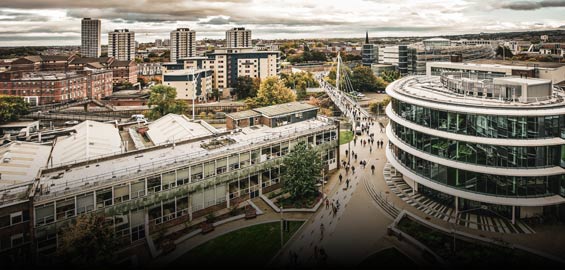
Ellison Building, Newcastle City Campus

Biotechnology is one of the most rapidly growing applied sciences, having applications from the diagnosis and treatment of disease to the enhancement of food production.

The Biotechnology BSc (Hons) degree is designed to provide you with the knowledge and practical skills to enable you, upon graduation, to take full advantage of the opportunities for employment or further research in the forefront of this exciting and continuously evolving discipline.

This course will help you to understand the role of scientific research in the advancement of biotechnology and the potential economic, ethical and political impacts of modern biotechnology on society.

The main focus of the course will be on molecular biotechnology, which includes the themes of molecular biology, immunology, and bioinformatics. Although there will be an emphasis on laboratory-scale biotechnology, the course will foster an awareness of its applications e.g. food production, livestock breeding, medicine and production of renewable fuel.

The practical skills you develop include information technology that will enable you to pursue careers in the biotechnology industry. You will also prepare for employment by developing transferable skills including: self- management and reflective practice, independence, communication, IT, numeracy, data analysis, interpersonal and teamwork skills, alongside an awareness of current issues within the taught programme.

You may wish to apply for an optional work placement in your third year and gain valuable work experience. Some of our previous students have been successful in gaining placements at national UK Biotechnology companies or Government Laboratories, including: Avecia Billingham, Pfizer Kent and Veterinary Laboratories Agency.

In your final year, you will undertake a research project in an area of biotechnology relating to your area of interest. Strong links to local and national industries and research organisations offer ideal opportunities for collaborative final year projects.


LEARNING AND TEACHING METHODS

Our programme and student experiences facilitate the transition from dependent to independent learning and as you progress you will find there is less reliance on formal scheduled teaching and more on guided independent study. The three year programme is designed to enable the progressive development of cognitive, intellectual, practical and transferable skills. 

You will be encouraged to take on a work placement, providing an opportunity to develop more work based skills and giving you an insight into a particular industry, profession or career. While on placement you will submit a monthly log book entry, which will monitor how well you have adjusted to the environment and how happy your industrial supervisors are with your performance and progress.

During the final year you will carry out an individual research project in an area of interest. This is usually a laboratory based investigation and allows you to draw on all of the skills acquired over the degree course. The project is scheduled for one day per week, when all laboratories and academic tutors are available for practical project work. 


ASSESSMENT METHODS

Over the course of the three year programme you will be assessed by a variety of methods, becoming more demanding as you progress. Multiple choice exams and assessed practical exercises in the early stages of the course will progress to a project dissertation and extended exam essays in the final year.

Your assessments will aid your motivation by providing vital ongoing feedback on your performance and progress.

During the programme your teaching team will use a broad range of assessment methods including in-class tests and longer formal examinations, written assignments and essays, data analysis, practical reports, workbooks and case studies, oral and poster presentations (group and individual). In many modules, formative assessment will provide you with feedback in advance of the end assessment. In addition, comprehensive feedback given on written assignments and examinations will allow you an opportunity to improve your performance in subsequent assessments. 


ACCREDITATION

All students are encouraged to become Student Affiliate Members of the Society of Biology, the leading professional body for biosciences.


CAREERS

Biotechnology is an amazingly diverse subject area which allows you to learn many practical and intellectual skills that will be valuable for many career paths. Some biotechnology graduates go on to carry out research, many in the biomedical area, researching into specific areas such as cancer, gene manipulation, bioinformatics, metabolomics or drug design. Pharmaceutical companies also employ biotechnology graduates in similar and often more commercial areas and projects. Another very large sector is the food and drink industries, with brewing, diary and baking all being traditional biotechnological industries. There are also opportunities within the environmental management area, with waste water treatment and biodegradation being traditional and new areas with the biotechnological disciplines.


OTHER INFO

Course Facilities
Course facilities include well-equipped and refurbished laboratories and teaching rooms as well as School-specific IT facilities. You will also have access to general university facilities.

Course Staff
Staff expertise covers all aspects of the programme; practising biomedical scientists from hospital laboratories teach many topics in pathological sciences.

Further Study
Upon successful completion of your degree, you may wish to consider further study. Examples of postgraduate courses include: MSc in Biomedical Sciences, PhD in Bioscience and Postgraduate Certificate in Education.


 Back to Previous Page   |   Advanced Course Search   |   Browse All Courses


Was this page useful to you?

Northumbria University has taken reasonable care to ensure that the information published is accurate at the time of publication. However, the University gives no warranty or representation as to the quality, accuracy or completeness of the information.