
The figures below are for Northumbria University and NUSL combined gaps measured as hourly equivalent pay [1]
| Year | Median % | Mean % |
| 2021 | 16.0 | 12.3 |
| 2022 | 15.2 | 11.4 |
| 2023 | 15.3 | 13.7 |
Whilst there had been a decrease in both mean and median pay gaps in previous years, in 2023 there has been a 0.1% increase in the median pay gap and 2.3% increase in the mean gap. The median hourly pay was £23 for men and £19.48 for women in 2023, compared to £21.51 for men and £18.24 for women in 2022. The increases result from changes in the proportions of men and women employed in each of the pay quartiles, and the difference between median Professional Support pay of £15.28 and median Academic pay of £28.19.
In both 2022 and 2023, the gender ratio in full-pay relevant role was 1 man to 1.6 women for Professional support, compared to approximately 1.2 men to 1 woman in Academic roles. As there are more female colleagues in professional support roles, which tend to be in lower grades, this results in a greater proportion of women than men in the lower and lower middle quartiles (shown below).
Although the numbers of women in the upper pay quartile increased, from 380 in 2022 to 426 in 2023, the number of men in this quartile also increased, resulting in a decline in the percentage of women in the quartile from 46.2% to 43.3%. The proportion of women in the lower quartile remained the same compared to 2022, at 65%. The pay gap reflects that almost two thirds of the group with the lowest hourly rate of pay are women, and more than half of the group with the highest hourly rate are men.

1. Gender Quartiles by Year 2021 - 2023 (Full-pay equivalent employees, Northumbria University and Northumbria University Services Limited)
View the gender pay gap images in an accessible format.
The gender differences between quartiles are reflected in the proportions of women and men at different grades (shown below). For academic roles, the proportion of women decreases by an average of ten percentage points for every increase in grade. Although less pronounced for Professional Support roles, there is also an inverse relationship between the proportion of women and grade at the most common grades 3, 5, 6 and 7.
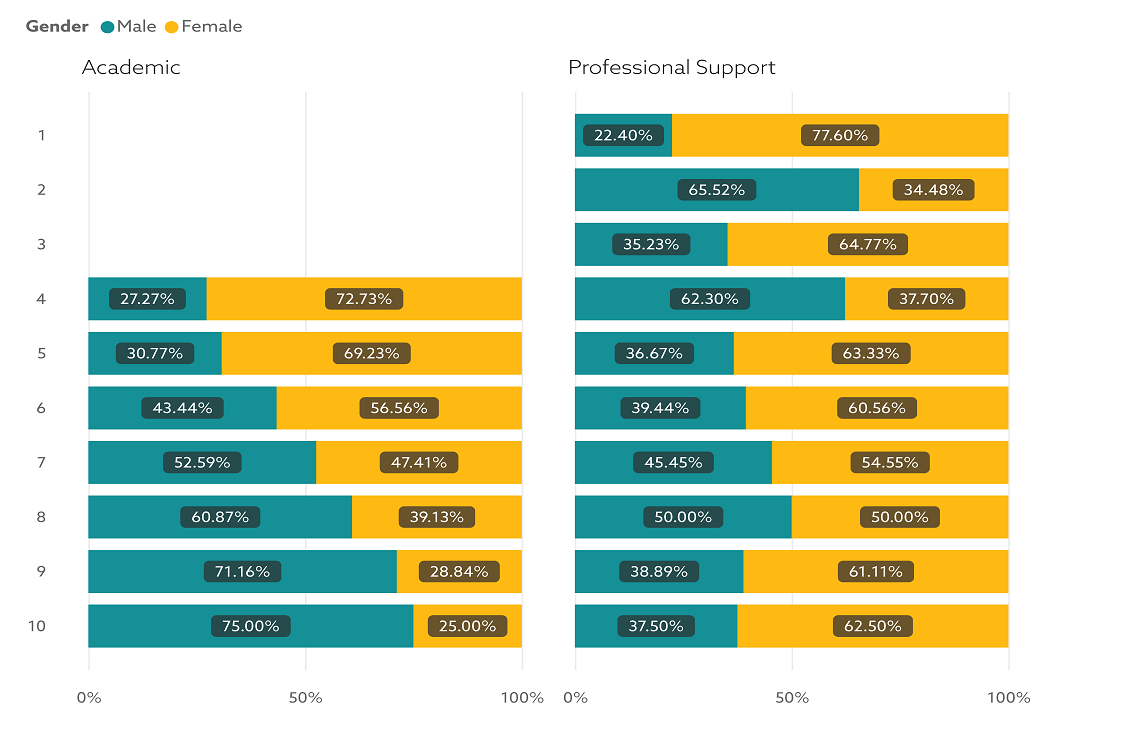
2. Gender by Grade and Employee Type, 2023 (Full-pay equivalent employees, Northumbria University and Northumbria University Services Limited includes Grades 1 - 10, excluding KTPs and other grades outside of main pay spine).
View the gender pay gap images in an accessible format.
For the third successive year, the median pay gap for Academic staff was zero, meaning that median pay was the same for men and women. This is in part because Grade 7 is the most common grade for Academic staff with 384 women and 426 men at this grade, a ratio of 1 to 1.1. The mean gap across all academic staff grades was 6.7%, reflecting the greater proportion of men at grades 8 and above.
In 2022, the University increased pay at grades 1 and 2 beyond the national pay award. This was expected to have an impact on the Gender Pay Gap given that approximately three-quarters of employees at these grades are women. When Northumbria University and Northumbria University Services Limited (NUSL) are considered together, the effect of the changes to pay at grades 1 and 2 is balanced out by changes in average pay at higher grades. When NUSL is considered separately, these changes have contributed to the elimination of the median and mean pay gaps, reducing them from 7.6% and 3.9% to -3.5% and -1.7% (i.e. women’s average pay is higher.) In addition, in 2023 the University has committed to paying the Voluntary Living Wage as its lowest salary point The VLW of £12.00 per hour was paid from November 2023 and resulted in the removal of Grade 1 which is predominately female. The impact of this change will be reported in the snapshot data next year.
Gender Bonus Pay Gap
As part of the University’s commitment to be an employer of choice, colleagues may be recognised for outstanding performance via the payment of GEM (Going the Extra Mile Awards) or one-off payments, as well as payments to recognise long service. In addition, up until 2022 a Strategic Performance Incentive Scheme was in place for University Executive colleagues.
| Year | Median % | Mean % |
|
2021 |
80.0 | 15.9 |
| 2022 | 33.3 | -10.9 |
| 2023 | 0.0 | 30.01 |
The gender pay bonus gap and percentage of colleagues receiving bonus payments is as follows:
| Gender | Number of Gender | Number awarded bonus | % of Gender awarded bonus |
| Female | 2145 | 67 | 3.1 |
| Male | 1787 | 64 | 3.6 |
The substantial year on year changes evident in the bonus gap result from the small number of bonuses made. In 2023 131 bonus payments were made. The median bonus amount was £50, which is the amount of a “Going the Extra Mile” award, the University’s most frequently awarded bonus payment which is received predominantly by Professional Support staff. The mean bonus amount was £1,547.41 for men and £1,082.19 for women, which is reflective of the higher bonus payments made via the Strategic Performance Incentive Scheme, which was withdrawn with effect from October 2022.
[1] The statutory gender pay gaps for Northumbria University and NUSL are reported to the government inclusive of salary sacrifice arrangements (such as nursery fees), in accordance with the government guidance as revised in 2023.
Return to Main Pay Gap Reporting page.
Page last updated 28/03/25
