
A major investigation into the impact of thawing permafrost and the subsequent release of frozen carbon on coastlines in the Siberian Arctic has been announced today (Tuesday 3 July).
The UK Natural Environment Research Council and Germany’s Federal Ministry of Education and Research have joined forces for the first time to launch their £8 million Changing Arctic Ocean research programme. The programme aims to investigate how climate change is affecting the Arctic Ocean. It has funded twelve projects to carry out crucial research in one of the most inhospitable regions on the planet to better understand, and predict, changes to the Arctic marine environment.
As part of this international project, Dr Paul Mann from Northumbria University’s Department of Geography and Environmental Sciences has been named as the lead on the €800,000 CACOON project; Changing Arctic Carbon Cycle in the Coastal Ocean Nearshore.
The Arctic region houses enormous quantities of carbon locked away in frozen soil and ice, known as permafrost. The quantity of carbon in permafrost far exceeds the amount held in forests or in the atmosphere, so any change in the amount of carbon released in this area is of huge global concern.
When permafrost in soil and ice thaws, it leads to changes in the type of organic matter that finds its way into rivers. This changes the amount and type of carbon and nutrients that flow from the major Arctic rivers into the ocean. The CACOON project aims to assess how these changes will impact on biology across the East Siberian coast.
The Arctic Ocean plays a crucial role in the storage and cycling of carbon, through the uptake of CO2 by marine plants and the export of carbon to the deep ocean. This effectively disconnects it from the atmosphere. However, the ocean also plays host to bacteria and other biological and physical processes, such as solar radiation, can release carbon back into the atmosphere. Understanding the current and future balance between carbon delivery and loss from the ocean is needed to improve our projections of global climate change.
Northumbria’s research team will study river estuaries, deltas and continental shelf environments where fresh waters from the massive Arctic Kolyma and Lena rivers meet the sea. They will examine how thawing permafrost is leading to changes in the type and fate of river-borne matter that flows from land to Arctic coastal waters, as well as the processes that can release this as greenhouse gases to the atmosphere.
Fieldwork measurements will be used to create a model that can project the impact of thawing permafrost and increasing freshwater runoff on the Arctic Ocean in the future.
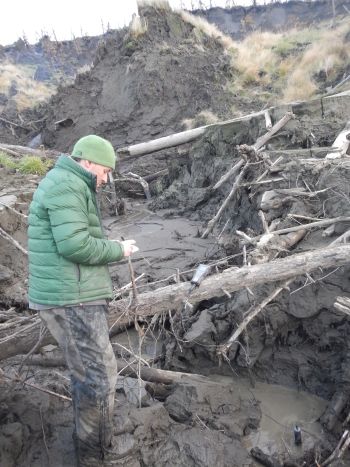
Dr Mann explained: “When people think of big carbon stores
they usually consider forests or maybe atmospheric CO2, yet these
pools are absolutely dwarfed by the amount of carbon in soil, most of which is
frozen and therefore not contributing to the modern ‘C cycle’. But as the Earth
warms up, it is defrosting.
“Arctic rivers are also delivering greater amounts of freshwater from land to the ocean, due to changes in weather patterns and thawing ice on the land. This speeds up the transport of material from land to the ocean, which is hugely important as this can lead to changes in the amount of greenhouse gases being emitted into the atmosphere. This could ultimately impact upon patterns of global climate change.
“While the Arctic Ocean is relatively small in terms of ocean size, it has a huge amount of freshwater input from rivers in the region, making it much more susceptible to impact from changes in freshwater content. We are seeing some of the fastest rates of change in freshwater runoff in Siberia, which is why we are studying this area in particular.
“The region is also very carbon rich with some of the world’s oldest carbon frozen – and now thawing – in permafrost beneath the soil. We want to know what will happen to this carbon when it gets out into the ocean and how this will impact on our future climate.”
Dr Mann added: “We have recently seen some interesting and significant impacts from thawing of permafrost. It has led to the release of bacteria causing diseases that we had previously believed to be extinct.
“In 2016, for example, Siberia was hit by an outbreak of anthrax which is believed to stem from the thawing of a carcass of a reindeer which had died in the plague. As the old flesh thawed, the bacteria once again became active. This is unlikely to be an isolated incident and could become much more prevalent in future, so it is imperative that we have a better understanding of the impact permafrost thaw might have.”
Dr Paul Mann - CACOON project (Changing Arctic Carbon Cycle in the Coastal Ocean Nearshore) from Northumbria University on Vimeo.
Dr Mann’s work falls under the University’s Extreme Environments multidisciplinary research theme, which brings together groups of academics who are working to understand the impact of environmental change on the Earth’s surface, subsurface, oceans and atmosphere, as well as within the solar system.
Northumbria’s team of earth and atmospheric scientists are using novel techniques and approaches to shed new light on the impact of climate change on our planet’s natural systems. Through their multidisciplinary research, they are seeking to answer fundamental global questions, such as “How would we survive in a world without ice?” and “Can we forecast space weather?” The University’s work in these areas led to it ranking top 30 in the UK for research power in the Research Excellence Framework, which measures the quality of research in universities.
For more information visit www.northumbria.ac.uk/extremeenvironments
Latest News and Features
New platform maps charity support for the Armed Forces community
Pioneering data platform maps where the Armed Forces community receive support from charities

Northumbria co-leads study on fairer support for families
A major study co-led by Northumbria University will test whether attachment assessments lead…

New AHRC research shows how community innovation can power the next phase of devolution.
New research published today by the AHRC Creative Communities programme provides fresh evidence…

Free sessions to help families navigate the SEND system
Northumbria University's award-winning Student Law Office is launching SEND Decoded, a series…

New Doctoral Training Programme will tackle key polar science questions with a reduced carbon footprint
The Net Zero Polar Science (NZPS) Doctoral Training Programme (DTP) has welcomed its first…

New Student Health Hub brings joint health and wellbeing support
A new drop-in service is bringing health and wellbeing support for students at both Newcastle…

Researchers aim to grow optical fibres using biology instead of machinery
A new project led by Northumbria University aims to grow optical fibres using proteins, mimicking…

Training the next generation of space scientists
Northumbria University has hosted a major international workshop, bringing together leading…
More events
Upcoming events

Next Stop Northumbria
Europa Hotel
-
The Past We Inherit. The Future We Build: Better Decisions Happen Together
The Great Hall, Sutherland Building
-
Next Stop Northumbria
Manchester Marriott Hotel Piccadilly
-
