
Rodrigo Ledesma Aguilar, Senior Lecturer in Physics and Electrical Engineering at Northumbria, writes about a new state of matter for The Conversation.
One of the most basic things we are taught in school science classes is that water can exist in three different states, either as solid ice, liquid water, or vapour gas. But an international team of scientists have recently found signs that liquid water might actually come in two different states.
Writing in an experimental paper, published in the International Journal of Nanotechnology, the researchers were surprised to find a number of physical properties of water change their behaviour between 50℃ and 60℃. This sign of a potential change to a second liquid state could spark a heated discussion in the scientific community. And, if confirmed, it could have implications for a range of fields, including nanotechnology and biology.
States of matter, also called “phases”, are a key concept in the study of systems made from atoms and molecules. Roughly speaking, a system formed from many molecules can be arranged in a certain number of configurations depending on its total energy. At higher temperatures (and therefore higher energies), the molecules have more possible configurations and so are more disorganised and can move about relatively freely (the gas phase). At lower temperatures, the molecules have a more limited number of configurations and so form a more ordered phase (a liquid). If the temperature goes down further, they arrange themselves in a very specific configuration, producing a solid.
This picture is common for relatively simple molecules such as carbon dioxide or methane, which have three clear, different states (liquid, solid and gas). But for more complex molecules, there is a larger number of possible configurations and this gives rise to more phases. A beautiful illustration of this is the rich behaviour of liquid crystals, which are formed by complex organic molecules and can flow like liquids, but still have a solid-like crystalline structure
Because the phase of a substance is determined by how its molecules are configured, many physical properties of that substance will change abruptly as it goes from one state to another. In the recent paper, the researchers measured several telltale physical properties of water at temperatures between 0℃ and 100℃ under normal atmospheric conditions (meaning the water was a liquid). Surprisingly, they found a kink in properties such as the water’s surface tension and its refractive index (a measure of how light travels through it) at around 50℃.
Special structure
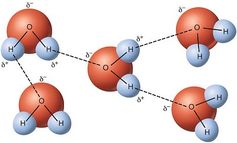
This gives water properties that, in many cases, break the trends observed for other simple liquids. For example, unlike most other substances, a fixed mass of water takes up more room as a solid (ice) than as a (liquid) because of the way it molecules form a specific regular structure. Another example is the surface tension of liquid water, which is roughly twice that of other non-polar, simpler, liquids.
Water is simple enough, but not too simple. This means that one possibility for explaining the apparent extra phase of water is that it behaves a little bit like a liquid crystal. The hydrogen bonds between molecules keep some order at low temperatures, but eventually could take a second, less-ordered liquid phase at higher temperatures. This could explain the kinks observed by the researchers in their data.
If confirmed, the authors’ findings could have many applications. For example, if changes in the environment (such as temperature) cause changes in a substance’s physical properties, then this can potentially be used for sensing applications. Perhaps more fundamentally, biological systems are mostly made of water. How biological molecules (such as proteins) interact with each other likely depends on the specific manner in which water molecules arrange to form a liquid phase. Understanding how water molecules arrange themselves on average at different temperatures could shed light on the workings of how they interact in biological systems.
The discovery is an exciting opportunity for theorists and experimentalists, and a beautiful example of how even the most familiar substance still has secrets hiding within.
This article was originally published in The Conversation. Read the original article here.
Latest News and Features
UK network to accelerate the development of sustainable surface technologies
A new national network led by Newcastle University and Northumbria University, in partnership…

Criminologist wins acclaimed Philip Leverhulme Prize to pioneer a new criminology of the offshore world
A Northumbria University criminologist has been awarded a Philip Leverhulme Prize, one of the…

New platform maps charity support for the Armed Forces community
Pioneering data platform maps where the Armed Forces community receive support from charities

Northumbria co-leads study on fairer support for families
A major study co-led by Northumbria University will test whether attachment assessments lead…

New AHRC research shows how community innovation can power the next phase of devolution.
New research published today by the AHRC Creative Communities programme provides fresh evidence…

Free sessions to help families navigate the SEND system
Northumbria University's award-winning Student Law Office is launching SEND Decoded, a series…

New Doctoral Training Programme will tackle key polar science questions with a reduced carbon footprint
The Net Zero Polar Science (NZPS) Doctoral Training Programme (DTP) has welcomed its first…

New Student Health Hub brings joint health and wellbeing support
A new drop-in service is bringing health and wellbeing support for students at both Newcastle…
More events
Upcoming events

Next Stop Northumbria
Manchester Marriott Hotel Piccadilly
-

-
Magnetospheric Multiscale Science Working Team Meeting
Sutherland Building

Christmas Market and Tree lighting
Northumbria University
-
