
Fashion Design BA student Poppy Griffiths’ final major project is inspired by feminism and women’s safety in society, a concept that evolved as the investigation into then missing Sarah Everard was starting to unfold. Poppy became very emotionally affected by what happened and the statistics that 97% of women in the UK have experienced sexual harassment, turning her project into a form of therapy to work through her emotions and past experiences. She is using her collection ‘Men Don’t Protect Us Anymore’ as a platform to bring awareness, to continue the conversation and promote positive change to women’s safety.
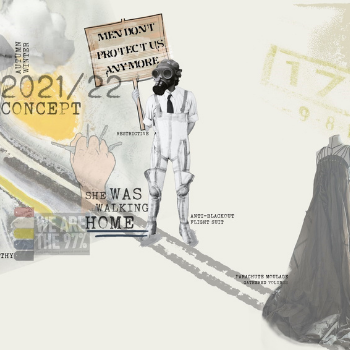
Combining this very personal and deep narrative with a passion for historical military garments, Poppy visited the Eden Camp Military Museum in Yorkshire to begin her research into archive clothing and the role of women in war. She said: “1940’s British society deemed men as strong, powerful protectors and the garments I was studying represented this stereotype." She was inspired by an anti-blackout suit worn by pilots to protect them from the effects of G-force, which includes a built-in boot. “This is where the influence for the stiletto comes from and what led me to designing a full footwear range for this collection, alongside the compression suit and compression trousers with shoes built in”. Poppy takes ideas to the extreme limits of their possibilities, eliminating ‘what ifs’ and fully exploring all options.
As a pattern cutting specialist, Poppy enjoys working on the stand with fabrics to create a silhouette, to understand the fit, structure and drape of a fabric to compliment the technical pattern cutting side. She gravitates to pattern cutting as a way to develop designs and understand technical processes in an organic and thorough way, enjoying the problem-solving aspect of turning complex designs into flat patterns, and creating a clear strategy within tech packs of how a garment will be constructed.
Sustainability runs though Poppy’s collection, and is a key part of her ethos as a designer. She believes it should be standard practice rather than something brands are forced to do. The fabrics sourced for her final collection all come from deadstock companies, and other projects she is working on use hemp-based fabrics, sustainable linens, Econyl, Tencel and other GOTS-certified fabrications. The research and design process is an experimental time, and can create a lot of waste – for her sampling and toile making, Poppy used leftover fabrics and second-hand bedding to avoid unnecessary fabric waste. The source and history of second-hand fabrics is an important aspect, for example a 1943 British parachute repurposed for one of Poppy’s dresses was traced back to the 174 RAF Squadron via the original military stamps.
She added: “There is a really interesting generation of designers emerging that are going to change how the industry uses sustainable practices.” She is one of those designers championing the cause and encouraging sustainable design as a base standard in the fashion industry.
Northumbria’s alumni include Apple’s Sir Jonathan Ive, principal designer of the iPad, iPhone and iMac. Our School of Design covers the discipline areas of Industrial Design, Fashion Design and Innovation Design.
This is the place to find all the latest news releases, feature articles, expert comment, and video and audio clips from Northumbria University
Latest News and Features

New Student Health Hub brings joint health and wellbeing support
A new drop-in service is bringing health and wellbeing support for students at both Newcastle…

Researchers aim to grow optical fibres using biology instead of machinery
A new project led by Northumbria University aims to grow optical fibres using proteins, mimicking…

Training the next generation of space scientists
Northumbria University has hosted a major international workshop, bringing together leading…
.png?modified=20261006102851)
International design competition to grow the colour of the future
Researchers at Northumbria University and Imperial College London have launched an international…

Northumbria graduates celebrated at North East Business Awards
Graduate entrepreneurs from Northumbria University are celebrating after winning recognition…

How facial recognition failures harm people with facial differences
Researchers at Northumbria University's Centre for Responsible AI are working with Face Equality…

New Master Research Agreement strengthens commitment to cutting-edge research and innovation
Northumbria University and Lockheed Martin Space UK have signed a new Master Research Agreement,…

Speeding glaciers drive half a century of polar ice loss
The longest satellite record ever assembled shows that Greenland and Antarctica have lost 11.3…
More events
Upcoming events

Next Stop Northumbria
Europa Hotel
-
The Past We Inherit. The Future We Build: Better Decisions Happen Together
The Great Hall, Sutherland Building
-
Next Stop Northumbria
Manchester Marriott Hotel Piccadilly
-
