
The clearest and most detailed images of the Sun have been captured by the largest telescope in the world.
Just-released first images and videos from the National Science Foundation’s (NSF) Daniel K. Inouye Solar Telescope reveal unprecedented detail of the Sun’s surface, with experts saying it will enable a new era of solar science and a leap forward in understanding the Sun and its impacts on our planet.
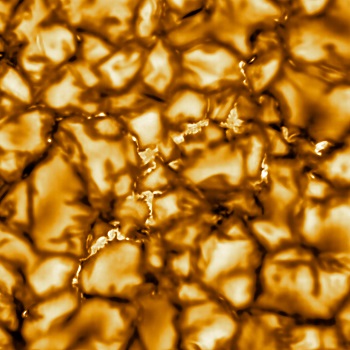 The new images from NSF’s Inouye Solar Telescope 4-meter solar telescope, which sits near the summit of Haleakalā in Hawaiʻi, show a close-up view of the Sun’s surface including a pattern of turbulent “boiling” plasma that covers the entire Sun. The images also show cell-like structures – each about the size of France – which are the signature of violent motions that transport heat from inside the Sun to its surface.
The new images were taken with cameras developed and supplied to the project by a UK consortium, of which Northumbria University is playing a key part. Members of Northumbria’s world-class Solar & Space Physics research group, including Dr Eamon Scullion, Dr Richard Morton and Professor James McLaughlin, have played a leading role in developing software to extract data from the telescope, providing insight into the physical mechanisms responsible for energy transfer in the Sun's atmosphere and how this relates to solar variability.
Dr Eamon Scullion is one of only eight European members in the Inouye Solar Telescope Science Working Group and said the images were an exciting first step towards understanding the physics taking place within the Sun’s surface.
As he explains: “Seeing is believing. We can simulate solar activity and make predictions using data and computers, but this is the first time we have been able to see high resolution images of the activity taking place on the surface of the Sun. For the team here at Northumbria the real excitement will come in a few months’ time. Once we have a series of images taken over several weeks and months, we can use the software we have developed to track the changes taking place on the Sun’s surface. This will really allow us to look at the Sun in ways we simply haven’t been able to before now.”
The UK consortium is led by Queen’s University Belfast and involves seven other UK institutes and industry including Andor Technology, Armagh Observatory, University of Glasgow, Mullard Space Science Laboratory, University of Sheffield, St. Andrews University, University of Warwick, and Northumbria University, with funding provided by UK Research and Innovation’s Science and Technology Facilities Council.
Experts say the telescope will play a critical role in better understanding the Sun and space weather, and provide important details for scientists.
NSF Director, France Córdova, said: “NSF’s Inouye Solar Telescope will be able to map the magnetic fields within the Sun’s corona, where solar eruptions occur that can impact life on Earth. This telescope will improve our understanding of what drives space weather and ultimately help forecasters better predict solar storms.”
Activity on the Sun, known as space weather, can affect systems on Earth. Magnetic eruptions on the Sun can impact air travel, disrupt satellite communications and bring down power grids, causing long-lasting blackouts and disabling technologies such as GPS.
Finally resolving these tiny magnetic features is central to what makes the Inouye Solar Telescope unique. It can measure and characterize the Sun’s magnetic field in more detail than ever seen before and determine the causes of potentially harmful solar activity.
“It’s all about the magnetic field,” said Thomas Rimmele, director of the Inouye Solar Telescope. “To unravel the Sun’s biggest mysteries, we have to not only be able to clearly see these tiny structures from 93 million miles away but very precisely measure their magnetic field strength and direction near the surface and trace the field as it extends out into the million-degree corona, the outer atmosphere of the Sun.”
Better understanding the origins of potential disasters will enable governments and utilities to better prepare for inevitable future space weather events. It is expected that notification of potential impacts could occur earlier – as much as 48 hours ahead of time instead of the current standard, which is about 48 minutes. This would allow for more time to secure power grids and critical infrastructure and to put satellites into safe mode.
NSF’s new ground-based Inouye Solar Telescope will work with space-based solar observation tools such as NASA’s Parker Solar Probe (currently in orbit around the Sun) and the European Space Agency/NASA Solar Orbiter (soon to be launched). The three solar observation initiatives will expand the frontiers of solar research and improve scientists’ ability to predict space weather.
“These first images are just the beginning,” said David Boboltz, program director in NSF’s division of astronomical sciences and who oversees the facility’s construction and operations. “Over the next six months, the Inouye telescope’s team of scientists, engineers and technicians will continue testing and commissioning the telescope to make it ready for use by the international solar scientific community. The Inouye Solar Telescope will collect more information about our Sun during the first 5 years of its lifetime than all the solar data gathered since Galileo first pointed a telescope at the Sun in 1612.”
Photo credit for all images: NSO/NSF/AURA
Inouye First Light - credit: NSO/NSF/AURA from Northumbria University on Vimeo.

Department of Mathematics, Physics and Electrical Engineering
This department encompasses all of our work in Mathematics, Statistics and Physics including Astrophysics, Electrical and Electronic Engineering, Energy, Smart Materials, Microelectronics and Communications.

This is the place to find all the latest news releases, feature articles, expert comment, and video and audio clips from Northumbria University
Department of Mathematics, Physics and Electrical Engineering
This department encompasses all of our work in Mathematics, Statistics and Physics including Astrophysics, Electrical and Electronic Engineering, Energy, Smart Materials, Microelectronics and Communications.
This is the place to find all the latest news releases, feature articles, expert comment, and video and audio clips from Northumbria University
Latest News and Features

Northumbria co-leads study on fairer support for families
A major study co-led by Northumbria University will test whether attachment assessments lead…

New AHRC research shows how community innovation can power the next phase of devolution.
New research published today by the AHRC Creative Communities programme provides fresh evidence…

Free sessions to help families navigate the SEND system
Northumbria University's award-winning Student Law Office is launching SEND Decoded, a series…

New Doctoral Training Programme will tackle key polar science questions with a reduced carbon footprint
The Net Zero Polar Science (NZPS) Doctoral Training Programme (DTP) has welcomed its first…

New Student Health Hub brings joint health and wellbeing support
A new drop-in service is bringing health and wellbeing support for students at both Newcastle…

Researchers aim to grow optical fibres using biology instead of machinery
A new project led by Northumbria University aims to grow optical fibres using proteins, mimicking…

Training the next generation of space scientists
Northumbria University has hosted a major international workshop, bringing together leading…
.png?modified=20261006102851)
International design competition to grow the colour of the future
Researchers at Northumbria University and Imperial College London have launched an international…
More events
Upcoming events

Next Stop Northumbria
Europa Hotel
-
The Past We Inherit. The Future We Build: Better Decisions Happen Together
The Great Hall, Sutherland Building
-
Next Stop Northumbria
Manchester Marriott Hotel Piccadilly
-
