New AHRC research shows how community innovation can power the next phase of devolution.
New research published today by the AHRC Creative Communities programme provides fresh evidence…

Emily Stollery is an artist based in Nottingham, soon to graduate with a BA(hons) from the Fine Art course at Nottingham Trent University. Her sculptural practice is led by the seductive properties of materials. Where materials meet instinct to create forms born out of spontaneity; the in the moment to and fro of maker and material. Surfaces not quite right, imperfections showcased. These forms, in their purity, reference the struggle of the processes they were born from. A not so perfect form, formed perfectly. Allowing chance and indeterminacy to exist as a parameter for making.
Emily choose to shift, and reappropriate the natural associations we have with these materials, in a way that somewhat goes against the ‘rules’ of the chosen medium. Breaking them out of the confines of what we know they are capable of, and perhaps suggesting an alternative. Their materiality exploited. Seemingly hard transformed into fluid form. Softness frozen solidly in a fixed state. Alluding to many things leaves you suspended in a state of unknowingness. For why should you need to know everything?
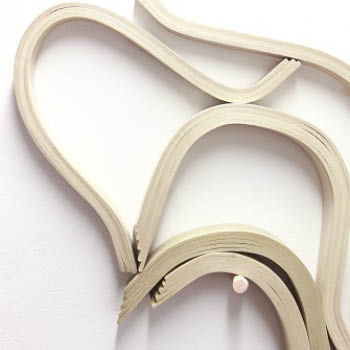
Emily's recent body of work brings together two very different strains of making; steam bent wood and ceramic forms.
When one thinks about ceramic as a material, the immediate response is to associate it as something fragile, delicate and decorative. What happens when this is flipped on its head? This is something I playfully explore in works such as ‘Sharing is Caring’. Ceramic pegs act as support for wooden objects; when the perception of such suggests this should be the reverse. Observe how the wood bends, flows gesturally in a way that seems wrong. The structural, angular aspects of wood as a material have been transformed into something other. Seductive objects, in their curvature, visually translate to become seduced by that material.
Whilst these objects allude to many things, they are at the same time non-representational. No one set answer, nor reading.
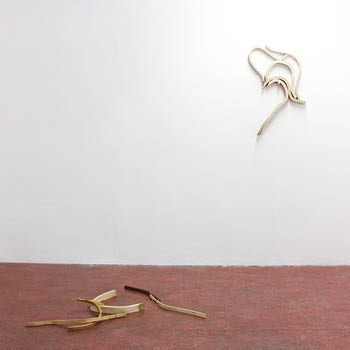
There’s a constant remaking,
reworking,
reinventing.
Iteration after iteration
not once existing in the same configuration.
A practice that sits in a constant state of flux.

New research published today by the AHRC Creative Communities programme provides fresh evidence…

Northumbria University's award-winning Student Law Office is launching SEND Decoded, a series…

The Net Zero Polar Science (NZPS) Doctoral Training Programme (DTP) has welcomed its first…

A new drop-in service is bringing health and wellbeing support for students at both Newcastle…

A new project led by Northumbria University aims to grow optical fibres using proteins, mimicking…

Northumbria University has hosted a major international workshop, bringing together leading…
.png?modified=20261006102851)
Researchers at Northumbria University and Imperial College London have launched an international…

Graduate entrepreneurs from Northumbria University are celebrating after winning recognition…

Europa Hotel
-
The Great Hall, Sutherland Building
-
Manchester Marriott Hotel Piccadilly
-
Page last reviewed: 25 January 2024
