
Policymakers have adopted research recommendations to boost political and economic collaboration across the England-Scotland border. The Borderlands Initiative and the Borderlands Growth Deal are supported by five councils in the region, who have pledged to work together to attract infrastructure investment, create jobs and address local challenges. By joining forces, the authorities aim to strengthen lobbying and marketing activities, giving them a more prominent voice with the UK and Scottish Governments.
The Borderlands Initiative and Growth Deal were recommendations put forward in two reports commissioned by the Association of North East Councils (ANEC) and the Institute of Local Government (ILG) conducted by Professor Keith Shaw, Professor of Politics at Northumbria University. The reports investigated how the North East and Cumbria could maximise the benefits of Scottish devolution.
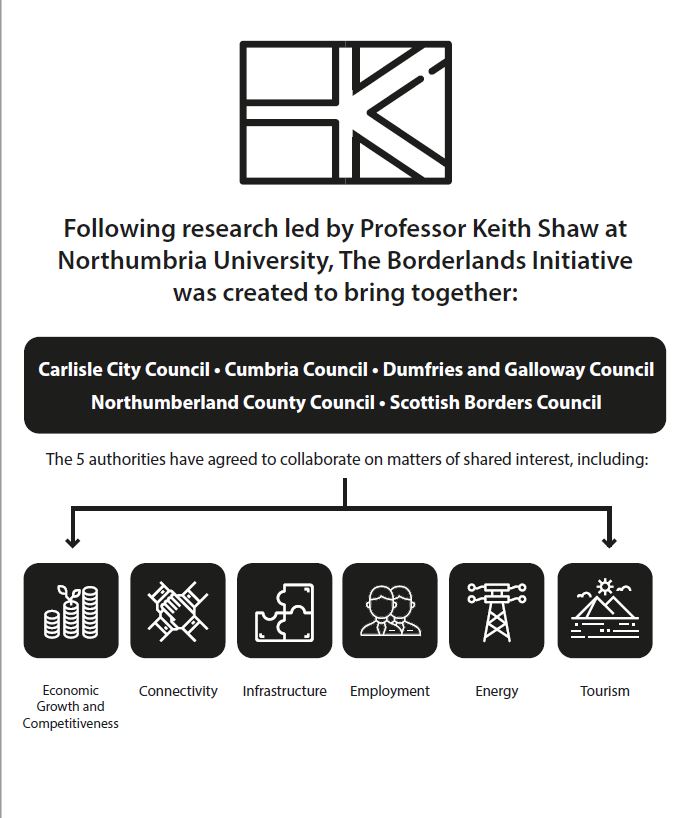
There has been considerable progress following the 2013 and 2015 reports, including the establishment of priorities and terms of governance, the allocation of resources and staff and the development of a Borderlands Inclusive Growth Initiative. The five authorities of Cumbria Council, Carlisle City Council, Dumfries and Galloway Council, Northumberland County Council and Scottish Borders Council have signed a declaration committing themselves to collaborate on various matters of shared interest, such as economic development, connectivity, infrastructure, employment, energy and tourism. They have also established a Steering Group to oversee the development of The Borderlands Initiative and the creation of a unified Framework. In addition, the Borderlands Growth Deal has been backed by the Conservatives in their 2017 Manifesto (page 33).
Since the 2013 and 2015 reports, Professor Shaw has conducted further research into collaboration and competition across the England-Scotland border, taking into consideration recent developments on devolution and Brexit. This latest work also builds on extensive research into deliberative democracy, inclusive governance, and the implications of the abolition of regions and regionalism, conducted by Professor Shaw at the Northumbria University since 1999. He has recently (2017) also been jointly-awarded a project by Northumberland County Council to examine the implication of Brexit for Northumberland and the rural North of England, which includes a wider Borderlands focus.
Professor Shaw’s research is based on analysis of new and existing data and feedback from central stakeholders. Key findings from this work call for The Borderlands Initiative to operate as a flexible network that shares intelligence and good practices, improves co-ordination, and provides one voice on issues of common concern. Authorities are recommended to move towards co-optition, an approach whereby neighbouring areas no longer compete against each other, but collaborate to compete externally. The report also highlights the need for awareness of the challenges of a collaborative approach, particularly as devolution and Brexit progress.
The recommendations are based on detailed analysis of quantitative and qualitative data collected through studies funded by Research Councils UK and public organisations. Quantitative data was gathered on economic change, employment, population, investment and key industrial sectors within the five local authority areas straddling the England-Scotland border. Qualitative data was collected following the engagement of policy-makers, public and private stakeholders, academics and researchers through various roundtables and seminars.
Recommendations from the two reports have been adopted by the five authorities across the England-Scotland border and this momentum led to the 2019 UK Spring Budget announcement declaring the Borderlands Inclusive Growth deal including £260,000,000 from the UK Government and £85,000,000 from the Scottish Government to promote economic development and collaboration for the council areas of Dumfries and Galloway, Scottish Borders, Northumberland, Cumbria, and Carlisle City.
In July 2019, a business plan was agreed by the five councils and included an additional £45,000,000 from them for shared projects in the Borderlands area – taking the total investment to over £390,000,000. The five Borderlands Council Leaders signed a Collaboration Agreement at the end of January 2020 to coordinate delivery of the Borderlands Inclusive Growth deal and established, in March 2020, a new Project Management Office with a team of seven people in newly created positions.
By June 2020 confirmed projects included:
- £31,000,000 in green energy projects,
- £7,000,000 to develop key skills needs to boost the visitor economy in the south of Scotland,
- £19,000,000 for the Biking Innovation Centre in the Scottish Borders,
- £65,000,000 for Carlisle Station and tourist hotspot ‘The Citadels’, in Cumbria,
- £8,000,000 for a Dairy Innovation Centre in Dumfries and Galloway,
- £10,000,000 to support natural capital innovation across the Borderlands region, and
- £5,000,000 for Alnwick Garden in Northumberland.
In November 2020 the UK Government announced that the Borderlands project would be accelerated so that all investment is delivered within ten rather than fifteen years, prompting positive responses from the local councils for extra economic uplift this will create and the greater security and crucial resources for the region to recover from the Covid outbreak.
Since these two initial reports, Professor Shaw has conducted further research into collaboration and competition across the England-Scotland border. In 2018, he was the co-author of a major report commissioned by Northumberland County Council to examine the implication of Brexit for Northumberland and the rural North of England, which includes a wider Borderlands focus. Taking into consideration his recent research on devolution he has published a chapter in an edited collection entitled, 'The North East after Brexit': A view from North of Tyne and the Anglo-Scottish Borderlands (Emerald Publishing, 2020).

Latest News and Features

New platform maps charity support for the Armed Forces community
Pioneering data platform maps where the Armed Forces community receive support from charities

Northumbria co-leads study on fairer support for families
A major study co-led by Northumbria University will test whether attachment assessments lead…

New AHRC research shows how community innovation can power the next phase of devolution.
New research published today by the AHRC Creative Communities programme provides fresh evidence…

Free sessions to help families navigate the SEND system
Northumbria University's award-winning Student Law Office is launching SEND Decoded, a series…

New Doctoral Training Programme will tackle key polar science questions with a reduced carbon footprint
The Net Zero Polar Science (NZPS) Doctoral Training Programme (DTP) has welcomed its first…

New Student Health Hub brings joint health and wellbeing support
A new drop-in service is bringing health and wellbeing support for students at both Newcastle…
Social
More events
Upcoming events

Next Stop Northumbria
Europa Hotel
-
The Past We Inherit. The Future We Build: Better Decisions Happen Together
The Great Hall, Sutherland Building
-
Next Stop Northumbria
Manchester Marriott Hotel Piccadilly
-
