
Display technology has revolutionised the way we experience and handle our devices. Whether a smartphone, computer, camera or television, all rely on sophisticated screen technology to enhance the contrast, sharpness and brightness of images, as well as the overall robustness, durability and portability of the device itself. To date, manufacturers predominantly use liquid crystal displays (LCDs), but research into luminescent molecules has far-reaching consequences for organic light-emitting diode (OLED) technology, paving the way for high tech, power-saving displays and other important technologies.
Dr Valery Kozhevnikov is a synthetic chemist, whose research focuses on luminescent metal complexes for applications in chemical sensing, liquid crystals and new photonic materials. His most recent project, in collaboration with Durham University, is delving into polymetallic Pt(II) and Ir(III) complexes, light-emitting molecules that show promising characteristics for OLED screens and other non-OLED technologies.
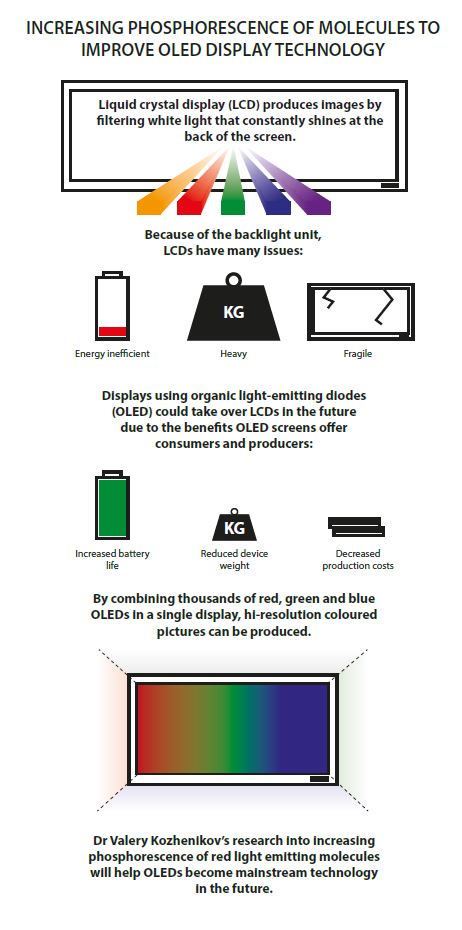
All displays, whether for mobile phones, cameras or laptops, only need red, green and blue (RGB) lights to create an array of colours for each pixel. LCD displays use a backlight to illuminate their pixels, whereas pixels in OLED displays are emissive, in that they produce their own light. Dr Kozhevnikov and his team are mainly focusing on red emitters, luminescent molecules that produce red light.
By harnessing the power of heavy metals such as platinum to promote phosphorescence within rigid molecular architectures, the researchers have successfully developed highly efficient triplet emitters that present quantum yields of nearly 100%. These results are significant for OLED technology, as well as other non-OLED technologies.
The high level of efficiency means that devices using this compound will have a longer battery life; for example, mobile phones would not need to be recharged as often and manufacturers would be able to create lighter phones with smaller batteries. Moreover, the compound is soluble, making it compatible with new ‘inkjet printing’ methods used for producing OLED screens, which would dramatically reduce production costs for OLED manufacturers.
Armed with a patent, Kozhevnikov’s team has embarked on a successful commercial collaboration with Merck KGaA, a substantial supplier of chemicals in the LCD market and now a major player in the OLED market. The company works with many of the top screen and device manufacturers.
While LCD displays currently dominate the market, OLED offers device designers more flexibility, efficiency and potential energy saving features. Samsung and Google are already producing devices with OLED displays, and other brands are following suit. Apple, for example, recently announced that the new iPhone X is its first to feature an OLED screen, boasting “stunning colours, true blacks, high brightness, and a 1,000,000 to 1 contrast ratio”.
In 2017 alone, the OLED market grew by 57%. It is estimated that the market share will continue to grow, increasing by 50% in 2018 (from $23.2 billion to $34.9 billion). In 2022, the market is expected to surpass $60 billion. Considering the projected increase in OLED technologies, Dr Kozhevnikov’s work with colleagues will have significant bearing worldwide; red pixels in every OLED display could contain the researchers’ multimetallic emitters.
In addition to this, further collaboration with the universities of Sheffield and Newcastle is investigating the use of new red and near infrared emitters in the spectral region of 650-900 nm, which have important applications in bioimaging (The University of Sheffield) and cell-nucleus and DNA visualisation (Newcastle University).

Latest News and Features

UK network to accelerate the development of sustainable surface technologies
A new national network led by Newcastle University and Northumbria University, in partnership…

Criminologist wins acclaimed Philip Leverhulme Prize to pioneer a new criminology of the offshore world
A Northumbria University criminologist has been awarded a Philip Leverhulme Prize, one of the…

New platform maps charity support for the Armed Forces community
Pioneering data platform maps where the Armed Forces community receive support from charities

Northumbria co-leads study on fairer support for families
A major study co-led by Northumbria University will test whether attachment assessments lead…

New AHRC research shows how community innovation can power the next phase of devolution.
New research published today by the AHRC Creative Communities programme provides fresh evidence…

Free sessions to help families navigate the SEND system
Northumbria University's award-winning Student Law Office is launching SEND Decoded, a series…
Social
More events
Upcoming events

Next Stop Northumbria
Manchester Marriott Hotel Piccadilly
-

-
Magnetospheric Multiscale Science Working Team Meeting
Sutherland Building

Christmas Market and Tree lighting
Northumbria University
-
