Finance and Investment Management BSc (Hons)
 Option for Placement Year
Option for Study Abroad

Option for Placement Year
Option for Study Abroad

Master the art and science behind the financial markets and develop a deep understanding of the wider business world.
Our BSc (Hons) Finance and Investment Management course lays the foundations for a range of rewarding careers in this fascinating industry.
The core focus of our teaching is about preparing you for employment. Key modules include Careers in Accounting, Economics and Finance, and Professional Practice – all designed to build practical knowledge of working in the industry. And you won’t just be learning about investing in the classroom. You’ll also be putting your skills into practice in our on-site trading room, complete with industry-standard professional Bloomberg terminals that reflect live, real-life market developments. Before your final year, you can choose to deepen your understanding even further through a year-long work placement – gaining valuable hands on experience within financial organisations including the Royal Bank of Scotland or the Bank of England.
Recent graduates are now working for some of the biggest names in the industry, including Bloomberg, Deloitte and Brewin Dolphin.
See other similar courses you may be interested in: Accounting Bsc (Hons), Marketing BA, Economics and Finance BSc, Economics BSc
You can also check out all of our other Accounting and Finance Courses and find that one that suits you.

Master the art and science behind the financial markets and develop a deep understanding of the wider business world.
Our BSc (Hons) Finance and Investment Management course lays the foundations for a range of rewarding careers in this fascinating industry.
The core focus of our teaching is about preparing you for employment. Key modules include Careers in Accounting, Economics and Finance, and Professional Practice – all designed to build practical knowledge of working in the industry. And you won’t just be learning about investing in the classroom. You’ll also be putting your skills into practice in our on-site trading room, complete with industry-standard professional Bloomberg terminals that reflect live, real-life market developments. Before your final year, you can choose to deepen your understanding even further through a year-long work placement – gaining valuable hands on experience within financial organisations including the Royal Bank of Scotland or the Bank of England.
Recent graduates are now working for some of the biggest names in the industry, including Bloomberg, Deloitte and Brewin Dolphin.
See other similar courses you may be interested in: Accounting Bsc (Hons), Marketing BA, Economics and Finance BSc, Economics BSc
You can also check out all of our other Accounting and Finance Courses and find that one that suits you.
UCAS Code
N395
Level of Study
Undergraduate
Mode of Study
3 years Full Time or 4 years with a placement (sandwich)/study abroad
School
Newcastle Business School
Location
City Campus, Northumbria University
City
Newcastle
Start
September 2027
Fees
Fee Information
Modules
Module Information
At NBS we’re Business, but not as usual. Discover more.

Newcastle Business School

Real-World Learning: Consultancy Project
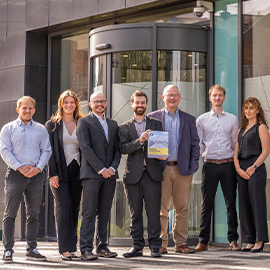
Students gain invaluable work experience with EY Newcastle, helping to drive apprentice recruitment
Read More
Northumbria business students develop branding strategy for OddBalls Apparel.
Read the news story.
Team Northumbria Wins the 12th Greggs Marketing Challenge.
Read the news story.
Northumbria named as a Principles for Responsible Management Education Champion.
Read the news story.
Entrepreneurial student launches marine-based skincare products.
Read the news story.Highly acclaimed by clients as successful, as students get to the root of the problem, and results in a detailed report and presentation of their recommendations.
Newcastle Business School delivers first class teaching in a world class environment.
You can boost your CV and develop your experience whilst studying at Northumbria.
From first year through to final year and beyond graduation, we are here to help.
Visit an Open Day to get an insight into what it's like to study Finance. Speak to staff and students from the course and get a tour of the facilities.
96 to 112 Tariff Points
From a combination of acceptable Level 3 qualifications which may include: A-level, T Level, BTEC Diplomas/Extended Diplomas, Scottish and Irish Highers, Access to HE Diplomas, or the International Baccalaureate.
Find out how many points your qualifications are worth by using the UCAS Tariff calculator: www.ucas.com/ucas/tariff-calculator
Northumbria University is committed to supporting all individuals to achieve their ambitions and we understand that every applicant’s circumstances can be different, which is why we take a flexible approach when making offers for this course. We have a range of schemes and alternative offers to make sure as many individuals as possible are given an opportunity to study at our university regardless of personal circumstances or background. Typically, offers range from 96 to 112 UCAS tariff points, but we’ll assess your individual circumstances and potential when reviewing your application
To find out more, review our Northumbria Entry Requirement Essential Information page for further details www.northumbria.ac.uk/entryrequirementsinfo
Subject Requirements:
There are no specific subject requirements for this course.
GCSE Requirements:
Applicants will need Maths, Statistics, or Physics and English Language at minimum grade 4/C, or equivalents.
Additional Requirements:
There are no additional requirements for this course.
International Qualifications:
We welcome applicants with a range of qualifications which may not match those shown above.
If you have qualifications from outside the UK, find out what you need by visiting www.northumbria.ac.uk/yourcountry
English Language Requirements:
International applicants should have a minimum overall IELTS (Academic) score of 6.0 with 5.5 in each component (or an approved equivalent*).
*The university accepts a large number of UK and International Qualifications in place of IELTS. You can find details of acceptable tests and the required grades in our English Language section: www.northumbria.ac.uk/englishqualifications
UK Fee in Year 1: £9,790
The UK tuition fee for 26/27 is £9,790 and is set in line with the UG Government's tuition fee cap. The University may increase this fee in subsequent years in line with any changes to the tuition fee cap. Students will be notified of any increase ahead of it taking effect. The remaining fees relate to the International Soccer Academy and accommodation fees. Accommodation fees may increase in subsequent years. Students will be notified of any increase ahead of the re-issuing of tenancy agreements. Tuition fees in the academic year 2027/28* will be £10,050. Fees are set in line with the UK Government's tuition fee cap. The University may increase fees in subsequent years in line with any changes to the tuition fee cap. Increases will be linked to inflation. For example, increases may be linked to RPIX (Retail Price Index excluding mortgage interest payments) Students will be notified of any increase ahead of it taking effect. Student fee loans rise in line with the tuition fees cap. *if your course is longer than one year
* Fees subject to annual increases over the course of the period of study. Students will be liable for payment of any/all tuition fees which are not sponsored by their employer or other third party.
International Fee in Year 1:
This is the tuition fee for your first year of study. You should expect to pay tuition fees for every year of study. The University may increase fees in the second and subsequent years of your course at our discretion in line with any inflationary or other uplift. Students will be notified of any increase ahead of it taking effect.
Tuition fees in the academic year 2027/28* will be £10,050. Fees are set in line with the UK Government's tuition fee cap. The University may increase fees in subsequent years in line with any changes to the tuition fee cap. Increases will be linked to inflation. For example, increases may be linked to RPIX (Retail Price Index excluding mortgage interest payments) Students will be notified of any increase ahead of it taking effect. Student fee loans rise in line with the tuition fees cap.
This is the programme fee for your first year of study. The programme fee includes the international tuition fee, International Soccer Academy and accommodation fees. Accommodation fees may increase in subsequent years. Students will be notified of any increase ahead of the re-issuing of tenancy agreements.
ADDITIONAL COSTS
Optional text book costs - Whilst books are available via the University Library, there are various advised/recommended books you may wish to purchase throughout the duration of the course, costs are approximately £1,080.00 (£60 per module, 6 modules per year). Optional overseas field trip £1350 approximately. CISI registration fee £60 approx (optional membership of professional body). CISI exams at end of years 2 and 3 (2 exams in total). Cost includes workbooks and exams approx.£250
* At Northumbria we are strongly committed to protecting the privacy of personal data. To view the University’s Privacy Notice please click here
Please use the Apply Now button at the top of this page to submit your application.
Certain applications may need to be submitted via an external application system, such as UCAS, Lawcabs or DfE Apply.
The Apply Now button will redirect you to the relevant website if this is the case.
You can find further application advice, such as what to include in your application and what happens after you apply, on our Admissions Hub Admissions | Northumbria University
Module information is indicative and is reviewed annually therefore may be subject to change. Applicants will be informed if there are any changes.
AF4030 -
Introduction to Mathematics and Statistics (Core,20 Credits)
This module will introduce you to general mathematical and statistical methods used to analyse and interpret accounting, financial and economic data. The module will address and review essential preliminaries of algebra and mathematical functions, such as linear, polynomial, exponential, and logarithmic functions; expanding on numerical series as well as context- based optimisation problems. These topics will be complemented with a comprehensive review of descriptive statistics and an introduction to the normal distribution function, the process of statistical estimation, and hypothesis testing carried out by means of both parametric and non-parametric tests. Key-topics included in this module:
1. Review of Basic Algebra for accounting, Finance and economics;
2. Introduction to Differentiation;
3. Introduction to Numerical Series;
4. Constrained and Unconstrained Optimisation;
5. The Normal Distribution Function in the financial world;
6. Introduction to Statistical Estimation;
7. Hypotheses Testing of accounting, financial and economic data.
AF4031 -
Accounting, Economics and Finance in a Global Business Environment (Core,20 Credits)
This module will enable you to better understand the economic, institutional, accounting and financial forces influencing the development of markets and exchanges and interactions within the global business environment. This module will introduce you to analytical models and principles that will help you understand and analyse the global environment in which business decisions are made. You will develop an
appreciation for the variety of factors that influence the choices and compromises that are made in international business and the implications of these choices on businesses.
This module will help you to understand and critically evaluate globalisation, its different dimensions and the surrounding theoretical debates. The module will equip you with real-world, problem-solving skills and an understanding of academic theory that underpins professional accounting, finance and economics practice. The module will place emphasis on real-life examples and case studies to position the subjects
within the realm of professional accounting, international finance and economic studies. This will enable you to develop your entrepreneurialmindset by developing your problem solving and analytical skills.
You will study and analyse the business environment at a global level, with a focus on how this impacts the national business environment. On completion of this module you will be able to analyse the consequences of changing regulatory and cultural environments for business within the context of professional accounting, international finance and economics. Throughout the module you will develop a deep understanding of the modern economy and the role that accounting and finance play within organisations.
You will explore basic economic theories around international trade and multinational corporations. You will also gain an understanding of elementary concepts of accounting (internal and external) and auditing and how these support global capital markets. You will also learn about the financial decision-making processes at the company level in the context of the analysis of financial performance measures.
You will use this knowledge to explore the scale, scope and trends in international business activity and evaluate various methods that firms use to assess, enter and develop domestic and non-domestic markets. The module will develop your multicultural awareness and knowledge, to introduce you to fundamental principles for purposive ethical decision making.
Finally, you will explore the wider concept of accountability, for example, sustainability reporting and the “Triple Bottom Line”. You will explore issues of financial literacy and the impact of global poverty, the digital divide and the economic and social consequences of global uneven income distribution.
AF4032 -
Careers in Accounting, Economics and Finance (Core,20 Credits)
This module provides you with the skills and knowledge you need to successfully secure a relevant undergraduate placement and/or a graduate-level role in your chosen discipline of Accounting, Finance and Economics.
You will cover a number of key topics including career planning, writing CVs, cover letters and application forms, psychometric testing, competency-based interviews, assessment centres and current trends in recruitment and selection practice in accounting, finance and economics.
On completion of this module, you will be equipped with the skills and confidence to make an impactful application to any employer.
AF4036 -
Principles and Theories of Finance (Core,20 Credits)
This module provides you with an introduction to underpinning financial concepts upon which your degree will be based. You will learn about the financial system; interest rate theory; foreign exchange rate dynamics and the operation of the money, fixed income and equity markets. You will be introduced to a range of financial instruments including collective investments and socially responsible investments. You will learn about the concepts of utility, stock market efficiency, portfolio theory and the capital asset pricing model (CAPM). To apply the knowledge acquired in this module you will use real-time financial data extracted from leading financial software located in the NBS Trading Room. You will be required to use real-world data to enhance your skills in Microsoft Excel which are essential for both placement and graduate employability.
More informationAF4037 -
Business and Financial Analysis (Core,20 Credits)
You will learn practical methods of analysing and comparing businesses and effectively interpret their financial results, in doing so you will be introduced to critical thinking skills. The module introduces you to the skills and techniques required to analyse and interpret financial statements and related information. This provides a framework within which you will be introduced to the concepts used in business valuations. You will be encouraged to consider the limitations of business and financial statement analysis as applied in different decision contexts, such as investment and lending decisions.
More informationAF4038 -
Financial Decision Making (Core,20 Credits)
You will learn how financial information can be used to assist managers and external user groups in their decision-making processes. You will initially look at the informational needs of outside user groups, the nature of the information they are provided with, and how this information can be analysed and interpreted in order to enhance the effectiveness of their decision making.
Topic areas will include:
• The reporting frameworks and ethical principles that underpin financial reporting
• The nature of international financial reporting standards
• Format and content of the statement of profit or loss and statement of financial position
• The statement of cash flows
• Analysis and interpretation of financial statements using ratio analysis
You will then examine how financial information can facilitate managers in making operational decisions in relation to planning and control.
Topic areas will include:
• Costing (full and variable costing)
• Cost, volume, profit analysis
• Relevant costs for decision making
• Budgeting and variance analysis
• Balance scorecards
• Working capital management
Finally, you will explore the motivations for entrepreneurial activity and techniques that can be used to appraise investment decisions.
Topic areas will include:
• Investment appraisal techniques (payback, accounting rate of return, net present value and internal rate of return)
• Practical aspects of investment appraisal (inflation and capital rationing)
• Risk and uncertainty
SC5000 -
Skills for Academic Success in a UK University (Core – for International and EU students only,0 Credits)
You will develop your understanding of academic conventions in UK higher education aligned to your level of study, including expectations around critical analysis, structure, argumentation, evidencing, and referencing. The module focuses on developing communication strategies that will help you express your ideas clearly and coherently in written assignments and spoken activities. You will also reflect on your current academic and language skills and develop strategies for development ahead of your assessments.
More informationAF5030 -
Financial Markets and Institutions (Core,20 Credits)
You will learn the key aspects of the regulations, ethics and professional body requirements that define the ‘rules’ for the financial sector. You will draw from a range of historical case studies to see how regulation within the financial system has transformed. You will be encouraged to discuss and critique the latest regulation changes using academic literature to back up your arguments. You will explore the main financial instruments that are issued and traded including: money market instruments; bonds; equities; foreign exchange; and Insurance. You will learn about these instruments in the context of risk taking and the worldwide markets in which they are traded as well as the principal institutions that use these instruments. To apply the knowledge acquired in this module, you will be using real-time financial information. Therefore, throughout the module you will be required to keep up to date with the latest developments within the financial markets and sector commercial awareness to enable you to contribute to this module.
More informationAF5031 -
Professional Practice in Accounting, Economics and Finance (Core,20 Credits)
The word professional means slightly different things to different people, however it is commonly used to describe someone who has acquired and uses a high level of technical knowledge and has the ability to judge the manner of how, when and where to use this knowledge. But the business environment has changed dramatically over the last twenty years, increased regulation, globalisation, more complex financial transactions, the opportunities provided by big data and analytics as well as the demand of good corporate governance and improved corporate social responsibility. These changes have meant that the professional can no longer rely on expert knowledge and needs to develop skills and abilities to help them manage the dynamic environment in which they operate.
This innovative module attempts to provide students with a range of skills and practices, taught in the context of the particular functional specialism, which will prepare the student for a range of future opportunities. This module aims to prepare you for your future studies at Level 6 and work-based learning. It focuses on developing your skills and abilities to critically assess, analyse and manage business-based problems and projects, with emphasis on a range of business models.
The module will focus on accounting, finance or economics to support demonstration of understanding and application of relevant theory from your professional/academic area as appropriate. There also will be opportunities to consider broader contemporary challenges for organisations in responding to changing practices of responsible and sustainable management.
On completion of the module you will have enhanced your problem-solving skills and will be able to manage complex projects. By focusing on advanced group and team working skills, research and complex problem solving skills, project management, communication skills, report writing skills and self-directed learning, you will also develop employability and leadership attributes, including set direction, engage, drive, collaborate, learn, innovate and act ethically.
AF5036 -
Mathematics and Statistics for Economics and Finance (Core,20 Credits)
Building on knowledge gained at level 4, you will continue to learn and increase your skills in applying a variety of practical mathematical and statistical methods specific to the disciplines of finance and economics. On the side of mathematics, this module will expand on geometric series, optimisation methods and techniques, differentiation and integration. On the side of statistics, you will review the derivation of probability distribution and introduce basic principles for machine learning. The module will address formal derivations of mathematical and statistic functions by applying theories and techniques to practical economic and finance cases and examples. Topics in this module include:
1. Review of Mathematical Functions;
2. Mathematics of Financial Returns;
3. Optimisation Methods: Linear Programming;
4. Differentiation of functions of two or more variables
5. Optimisation methods: Maxima and minima of a function of two variables
6. Integration: primitive of a function and Riemann integral;
7. Linear Algebra and Portfolio Theory
8. Probability Distributions;
9. Maximum likelihood principle and elements of Machine Learning.
AF5037 -
Personal Finance and Wealth Planning (Core,20 Credits)
You will learn about personal finance and wealth planning with a view to understanding how different financial products can be used to satisfy different client needs and circumstances. You will learn about client appraisal; personal taxation (to include income tax, capital gains tax and inheritance tax); building an investment portfolio; mortgage finance; the handling of personal debt; insurance planning; retirement planning and estate planning in the financial planning process.
More informationAF5038 -
Derivatives and Risk (Core,20 Credits)
On this module you will be introduced to complex financial instruments, derivatives. You will learn about the features of derivatives, the risks they are often designed to manage or speculate upon and the ways that money flows ‘through’ the transactions they create. You will learn how to calculate profits and losses resulting from transactions involving derivatives. The module specifically introduces you to Futures, Forwards, Options, and Swaps, as well as examples of exotic derivative types (such as carbon derivatives).
In respect of each type of derivative, you will learn trading strategies specific to each, across three distinct approaches (hedging, arbitraging, speculating). You will study the factors that determine the performance of these trading strategies and how derivatives transform financial and non-financial risks. You will also learn how to apply various valuation techniques to derivatives. You will learn about these instruments and contextualise your knowledge using practical tasks and real-time data extracted from financial trading software.
AF5039 -
Econometrics (Core,20 Credits)
Building on mathematical and statistical prior knowledge, the module introduces students to the theory and application of econometrics. You will learn classical econometric models such as simple and multiple regression analysis, assumptions and properties of statistical estimators, and the reasoning for violating these assumptions in specific cases. The module covers modelling and statistical inference techniques for single and multi-equation systems, and the use of these techniques with regard to data prediction, model evaluation and forecasting.
Outline Syllabus:
1. Review of Basic Statistics;
2. Simple Regression Analysis;
3. Properties of Regression Coefficients;
4. Inference Testing;
5. Multiple Regression Analysis;
6. Specification of Regression Variables;
7. Violations and Solutions of Classical Linear Assumptions;
8. Time Series Analysis;
9. Panel Data Models;
10. Forecasting Techniques.
You will develop skills that can be applied more widely, such as problem solving and data analysis skills, through writing of workshop questions and assessments; you will gain analytical academic writing skills relevant to the world of economics and finance.
NX9527 -
Newcastle Business School Study Abroad Semester (Optional,60 Credits)
The Study Abroad Semester module is a semester long 60 credit module which is available on degree courses which include the option to study abroad in Semester 2 of Year 2. You will undertake a semester abroad at a partner university equivalent to 60 UK credits.
The study abroad placement is an important element of your course structure and gives you access to modules from your discipline taught in a different learning culture and so broadens your overall experience of learning.
When taken and passed the study abroad semester will be recognised in your transcript as a 60 credit Study Abroad Module. The learning and teaching on your study abroad placement will be dependent on the partner and will be recorded in the learning agreement signed by you, the host University, and the University.
NX9525 -
Newcastle Business School Work Placement Year (Optional,120 Credits)
The Work Placement Year module is a full year 120 credit module available on degree courses which include a work placement year which is taken as an additional year of study between levels 5 and 6. The placement consists of 48 weeks of full time work experience in a host organisation which is relevant to your studies.
The placement is an important element of your course structure and it will provide you with the opportunity to:
• Experience the environment of a real workplace which will help you decide the type of career you would like to follow after graduation
• Develop your organisational and interpersonal skills required to enable you to work efficiently as a member of a team
• Acquire and develop relevant technical skills associated with the nature of your work
• Identify, analyse and discuss with experienced practitioners how theoretical concepts are adapted and applied to suit practical requirements
• Apply knowledge that will help you to plan and evaluate future study and career development.
This is a Pass/Fail module and so does not contribute to your degree classification. When taken and passed, however, the Placement Year is recognised in your transcript as a 120 credit Work Placement Module and on your degree certificate in the format “Degree title (with Work Placement Year)”. The learning and teaching on your placement will be recorded in the training agreement signed by you, the placement provider, and the University.
NX9526 -
Newcastle Business School Study Abroad Year (Optional,120 Credits)
The Study Abroad Year module is a full year 120 credit module which is available on degree courses which include a study abroad year which is taken as an additional year of study between levels 5 and 6. You will undertake a year abroad at a partner university equivalent to 120 UK credits.
The study abroad placement is an important element of your course structure and gives you access to modules from your discipline taught in a different learning culture and so broadens your overall experience of learning. At the end of the module you will have adapted to and appreciated a different cultural and learning environment and developed ability. You will have developed your interpersonal and intercultural communication skills as a result of your learning in an international environment.
This is a Pass/Fail module and so does not contribute to your degree classification. When taken and passed, however, the Study Abroad Year is recognised in your transcript as a 120 credit Study Abroad Module and on your degree certificate in the format “Degree title (with Study Abroad Year)”. The learning and teaching on your study abroad placement will be dependent on the partner and will be recorded in the learning agreement signed by you, the host University, and the University.
NX9528 -
Newcastle Business School Blended Placement Year: Work Placement Semester (Optional,60 Credits)
The Work Placement Semester module is a semester long 60 credit module which is available on degree courses which include the option to take a blended placement year of Work and Study Abroad which is taken as an additional year of study between levels 5 and 6.
On this module you will undertake a semester long work placement. The placement consists of a period of full time work experience in a host organisation equivalent to a full semester of study which is relevant to your studies.
The placement is an important element of your course structure and it will provide you with the opportunity to:
• Experience the environment of a real workplace which will help you decide the type of career you would like to follow after graduation
• Develop your organisational and interpersonal skills required to enable you to work efficiently as a member of a team
• Acquire and develop relevant technical skills associated with the nature of your work
• Identify, analyse and discuss with experienced practitioners how theoretical concepts are adapted and applied to suit practical requirements
• Apply knowledge that will help you to plan and evaluate future study and career development.
This is a Pass/Fail module and so does not contribute to your degree classification. When taken and passed, however, the Placement Year is recognised in your transcript as a 60 credit Work Placement Module. The learning and teaching on your placement will be recorded in the training agreement signed by you, the placement provider, and the University. Combining this with the study abroad semester as part of the third year out of the University, this will be recognised on your degree certificate in the format “Degree title (with Study Abroad and Work Placement Year)”.
NX9529 -
Newcastle Business School Blended Placement Year: Study Abroad Semester (Optional,60 Credits)
The Study Abroad Semester module is a semester long 60 credit module which is available on degree courses which include the option to take a blended placement year of Work and Study Abroad which is taken as an additional year of study between levels 5 and 6.
You will undertake a semester abroad at a partner university equivalent to 60 UK credits.
The study abroad placement is an important element of your course structure and gives you access to modules from your discipline taught in a different learning culture and so broadens your overall experience of learning. When taken and passed the study abroad semester will be recognised in your transcript as a 60 credit Study Abroad Module. The learning and teaching on your study abroad placement will be dependent on the partner and will be recorded in the learning agreement signed by you, the host University, and the University. Combining this with the work placement semester as part of the third year out of the University, this will be recognised on your degree certificate in the format “Degree title (with Study Abroad and Work Placement Year)”.
AF6030 -
Sustainable Development and Responsible Business (Core,20 Credits)
This module aims to provide students with a comprehensive understanding of key literature, research and economic policy debates in the area of environmental sustainability and responsible business. The objective of the module is to provide students with appropriate tools and technical know-how to critically discuss the trade-offs between economic development and environmental protection and moving capitalism towards a
wider sense of accountability. The module will explore and examine the linkages between economic policies and environmental sustainability, the effects of international trade and globalisation on environmental resources, the role of international environmental agreements and the emergence of new forms of financial reporting centred on the principles of sustainability and social accountability.
Key topics covered in this module include:
• Fundamentals of Environmental Economics and Sustainable Development
• Economic Growth and Environmental Conflicts
• Measuring Sustainable Economic Welfare
• Contingent Valuation and Revealed Preference Methods
• Alternative Concepts of Capital: Environmental Accounting, Integrated Reporting, and the Triple Bottom Line
• International Trade and Environmental Protection
• Stakeholder Activism and Social Responsibility
• Political Ecology: Challenging Narratives of Environmental Degradation
• Financial Reporting and Climate Change.
• The Circular Economy
• The Role of Social and Solidarity Economies
AF6036 -
Risk in Financial Institutions I (Core,20 Credits)
In this module you will learn about the capital risks faced by financial institutions. These include credit risk, risks from securitisation exposure, market risk and liquidity risk. You will study the specific areas of credit, market and liquidity risk in the context of the relevant regulatory framework (The Basel Accords) and draw on case study material provided by high profile banks and financial institutions. You will be expected to develop an understanding of the nature of these interlinked risks as well as to understand how they are measured and managed in line with regulations. The module will cover topics such as:
• A typology of risk in banking and financial institutions: definitions; types; and importance.
• International banking regulation and capital adequacy.
• Credit, market and liquidity risk regulatory framework under the Basel Accords.
• Credit Risk: Consumer/commercial credit risk and credit decision making; Measuring credit risk through credit scoring models and modern advanced techniques; counterparty credit risk using examples of the loan and derivative networks, including how to calculate counterparty credit risk via the credit valuation adjustment.
• Market Risk: Measuring market risk through Value-at-Risk models (variance-covariance, historical simulation and Monte-Carlo simulation models); the move toward expected shortfall; other contemporary regulatory models.
• Liquidity Risk: Market and balance sheet sources; measurement techniques; stored vs purchase management styles.
AF6037 -
Risk in Financial Insitutions II (Core,20 Credits)
In this module you will focus on the specific area of treasury risk arising from interest rate and foreign exchange rate risk. You will also explore the ever-changing world of operational risk within financial institutions. You will investigate how the risks faced by financial institutions are linked via systemic risk and learn which institutions may be more susceptible to shocks. You will also learn how to measure and manage aspects of these banking risks with the help of case studies set within banking and finance institutions. Further, a key aspect of the module is to determine why an effective fraud risk assessment framework is essential to financial institutions to avoid financial Loss and reputational damage. Prominent real-life financial disasters will be examined to demonstrate how these issues can impact upon banking and financial institutions. The module will cover topics such as:
• Interest rate risk: the level and movement of interest rates; term structure theory; sources of interest rate risk to the banking book; measurement models (repricing gap, maturity and duration models); asset and liability management; Regulatory requirements.
• The impact of foreign exchange rate on financial institutions.
• Operational risk: sources; measurement models; operational risk management policies and procedure; regulatory implications.
• How to develop a Fraud risk assessment and execute it within the global and digital banking environment.
• The concept of systemic risk within the financial system and the macroprudential regulations developed to mitigate such a risk.
AF6038 -
Investment Management (Core,20 Credits)
This module aims to provide you with the knowledge and skills to apply a variety of quantitative and financial tools to construct, rebalance and evaluate a portfolio consisting of financial assets, mainly equities (including collective investments including SRI funds). The module is organised within the themes of rational and behavioural decision making in relation to investments. You will learn the about the psychological influences on decision making as well as the principles of market efficiency in the context of investment in real world financial assets. You will be exposed to a wide range of techniques for use in rebalancing, comparing, analysing and evaluating portfolios made up of financial assets. Furthermore, you will gain a practical understanding of various aspects of asset allocation, portfolio management strategies and important behavioural issues affecting portfolio choice.
Outline syllabus:
• Investment Process and Asset Allocation
• Portfolio Theory and Diversification
• CAPM and other asset pricing models
• Efficient Market Hypothesis
• Equity Valuation
• Portfolio Evaluation
• Behavioural Finance
• Irrationality Biases, Bubbles and Herd behaviour
AF6042 -
Dissertation (Optional,40 Credits)
The Dissertation module aims to equip you with the necessary intellectual and practical skills for undertaking an individual student-led, ethical investigation into an accounting, economics or finance (AEF) related problem or issue. In addition, the Dissertation aims to equip you with key transferable, employability skills, time management, project management, communication (written and verbal), negotiation, persuasion and influence, discovery, initiative, creativity and innovation in problem-solving and analysis.
The module is student-led but you are supported by, introductory lectures and workshops as well as guest lectures which introduce undertaking AEF research followed by one-to-one or small-group supervision meetings with an academic from the AEF subject discipline.
The lectures and IT workshops will provide a thorough grounding into undertaking an extended piece of researching, focusing on:
• Refining a research aim/question (focusing and scoping the research) and project proposal
• Developing a literature review
• Researching ethically
• Quantitative research and analysis techniques
• Qualitative research and analysis techniques
Upon completion of the AFM Dissertation module you will be able to:
• Conduct independent and ethical academic research involving the application and critical evaluation of appropriate theories and models.
• Engage critically with relevant literature to establish a framework in which to analyse and synthesise the results of your primary or secondary research.
• Generate / collect relevant primary or secondary data using an appropriate and justified method.
• Analyse your data using an appropriate and justified method of analysis.
• Recognise the ethical implications of your work.
• Critically evaluate the source of your data and the method you adopted.
AF6043 -
Management Enquiry (Optional,40 Credits)
The Management Enquiry module is a student-led individual project that enables you to undertake a significant piece of assessed work commensurate with a capstone module. The module aims to provide you with an opportunity to demonstrate an authentic engagement with managers and/or professionals from the Accounting, Economics or Finance (AEF) discipline, and to integrate the knowledge you have developed during your programme to explore the theory in practice. The learning on this module is experiential and problem based, where the focus is upon you discovering, probing, and questioning key practice-based issues. Through the module you will be offered the opportunity to develop and enhance key transferable employability skills; time management, project management, communication (written, aural and verbal), negotiation, persuasion and influence, discovery, initiative, problem-solving and analysis.
The module has five thematic areas; explore, review, engage, reflect, and connect. These form the key elements of the assessed submission.
Part A (35%, 3,500 Words)
• Explore: Interviewing a manager and/or professional from the AEF discipline. In this interview you will either explore a key issue which you feel AEF is facing or, alternatively, explore with the manager or professional the key issues that they feel they are facing in practice. It is expected that you will apply appropriate interview methods and provide evidence of the interview within the submitted enquiry report (e.g. within the appendices).
• Review: Critically examining the appropriate literature to support the exploration, displaying an ability to critically assess and appraise the AEF knowledge related to a specific key issue arising from your exploration.
Part B (65%, 6,500 Words)
• Engage: Displaying an authentic engagement with the AEF problem/issue identified in Part A, by collecting/generating and analysing further live data (beyond the initial interview) regarding the AEF problem/issue. This live data may be primary data (e.g. further interviews with, or questionnaire to, managers and/or professionals in practice) or secondary data (e.g. industry data). Application of appropriate, ethically-considered, research methods and appropriate qualitative or quantitative data analysis.
- Reflect and Connect: Demonstrating an ability to critically evaluate and reflect on the issues arising from the Management Enquiry. Demonstrating how you have connected and fed-back to the participants of the Enquiry (usually the manager and/or participants) your key findings to provide clear prioritised, well-justified, practical, and actionable recommendations for change/enhancement/improvement to existing AEF practice to show how the recommendations would potentially affect workplace professional decision making.
NX9626 -
Undergraduate Consultancy Project (Optional,40 Credits)
The module aims to provide you with an opportunity to integrate the knowledge acquired during the programme and apply this to a consultancy project for a real organisation. This consultancy project provides a vehicle for participants to develop and demonstrate key employability skills, to relate theory to practice, and to undertake a significant piece of assessed work commensurate with a capstone module.
You will work on behalf of an external organisation, which has identified a business problem or question, requiring a solution, working in small group of typically 4 individuals (you will select their own team members), participating in group and individual activities. The host organisation will provide a project briefing, and review; students will be supported by appropriate academic input and guidance from Newcastle Business School in the form of a mentor and via the Business Clinic.
To start your application, simply select the month you would like to start your course.
Our Applicant Services team will be happy to help. They can be contacted on 0191 406 0901 or by using our Contact Form.
All information is accurate at the time of sharing.
Full time Courses are primarily delivered via on-campus face to face learning but could include elements of online learning.
Most courses run as described on our website and in our marketing materials. Occasionally we may need to make changes, for example due to a change in the law or regulatory requirements, requirements of a Professional, Statutory or Regulatory Body, or our quality assurance processes. Where a change is significant (in line with the Competition and Markets Authority's guidance on "substantial changes"), we will consult with affected students in advance where the change is being decided, and will explain the reason for the change and inform you at the earliest opportunity.
If we make a significant variation to your programme, you are entitled to: request a transfer to an alternative, appropriate programme; withdraw and have your tuition fees adjusted; or raise a complaint through the Student Complaints Procedure.
Optional modules listed on course pages may be subject to change depending on uptake numbers each year. Where a module you selected is withdrawn, the options above apply.
Contact time is subject to increase or decrease in line with possible restrictions imposed by the government or the University in the interest of maintaining the health and safety and wellbeing of students, staff, and visitors if this is deemed necessary in future.
The photography and video on this page are used for illustration. They may have been taken at different times and in different parts of the University, and may show facilities, equipment, staff, students or activities that are not part of this course. They are not a guarantee of the specific facilities or equipment you will use.
The course content, entry requirements and fees sections of this page, together with the Programme Specification, set out what this course includes. Our facilities are updated over time and may change during your studies.
Northumbria University is committed to developing an inclusive, diverse and accessible campus and wider University community and are determined to ensure that opportunities we provide are open to all.
We are proud to work in partnership with AccessAble to provide Detailed Access Guides to our buildings and facilities across our City, Coach Lane and London Campuses. A Detailed Access Guide lets you know what access will be like when you visit somewhere. It looks at the route you will use getting in and what is available inside. All guides have Accessibility Symbols that give you a quick overview of what is available, and photographs to show you what to expect. The guides are produced by trained surveyors who visit our campuses annually to ensure you have trusted and accurate information.
You can use Northumbria’s AccessAble Guides anytime to check the accessibility of a building or facility and to plan your routes and journeys. Search by location, building or accessibility feature to find the information you need.
We are dedicated to helping students who may require additional support during their student journey and offer 1-1 advice and guidance appropriate to individual requirements. If you feel you may need additional support you can find out more about what we offer here where you can also contact us with any questions you may have:
Page last reviewed: 3 October 2026