April 2023 - Santander Scholarship Recipient Toni
What is it like to be a Master of Research Psychology student?
When I first came back to study in 2018, I had never heard of a Master of Research qualification. I had heard of people studying for “Master’s” degrees but had little idea what they entailed, and as I was only studying on a Foundation Year in Psychology, it wasn’t something that really weighed too much on my mind. But after passing my Foundation Year with flying colours and then continuing on to study a BSc in Psychology, I started to consider what my future options may be. To begin with, I had just thought that I might leave university after completing my undergraduate studies and go back to working in retail, but then my final year supervisor had a chat with me about post-graduate study and academic progression as a research psychologist and having found that I enjoyed research practice more than I had ever imagined (to be quite honest, I didn’t even think about research being a part of psychology when I first began studying) I thought that this may be a career path for me. It was at this time that I first heard about a Master of Research, also affectionately known as the “MRes”.
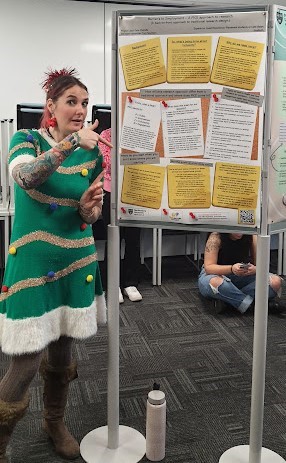
An MRes is a little different to some of the other Master’s courses on offer, as it specifically focuses on the skills required to become an academic researcher, and the first semester was quite the culture shock and was quite unexpected for a course that I thought would focus solely on academic skills. One of the first things we were asked to do was to set up our own blog, sharing publicly our first semester’s experiences of what it was like to be an MRes Psychology student. We were also required to meet and discuss academic papers, giving our opinions on both papers that related to our research interests and that of others, and we also had to create academic posters, which not only were expected to contain information about our research but also be easy to read, accessible and nice to look. These posters were then displayed at a pre-Christmas poster presentation which academics from across the psychology department were invited to attend, and we were quizzed about both our posters and the research that they discussed. Not only that but all of these things were assessed as part of the course content and contributed towards our final award. This blew my mind somewhat but was easily explained as part of the day-to-day life of an academic researcher. It isn’t all sitting at a desk chewing data and compiling reports and journal articles, researchers need to communicate their findings and have the ability to reach out to the wider public and communication skills are a must.
Another shock to the system was that we were tasked with learning how to use computer coding. Up until that point, I had just plugged my numbers into a nice computer package, and it spat out the results. All I needed to do was input them correctly and know what the results were telling me. Not anymore. Now I was expected to tell my laptop how to do the calculations required to produce those results, and it was really rather terrifying. But as it turned out, I quite liked the process, and much as it was difficult, I got a bit of a buzz when the lines of coding all ran, giving me the output I wanted. But one of my favourite parts of the Psychology MRes is that you also have a placement module to complete. For this module, I was given a list of available projects to be involved in. We had to express a preference for three projects, stating our suitability for our first choice, from which we were assigned to the academics responsible for the research and we then work alongside them as a research assistant on the active research project they are conducting, gaining real-world research experience, and allowing us to build connections with researchers and academics within the department.
Semester two is a whole different beast, and we’re now back to a structure much more reminiscent of my undergraduate course. We have a critical essay to write, a couple of small-scale studies to run, and let’s not forget my thesis. This is where I get to really spread my wings and research an area that sparks my interest, and that should take me right through the summer when the course ends at the end of August. What next after that? Well, I’m delighted to say that as a result of the experience gained through my placement module, I have been successful in securing a conditional offer for a fully funded research studentship, which will allow me to study towards a Doctor of Philosophy (PhD) in Psychology upon successful completion of my MRes. This PhD is going to allow me to continue to build my skills as a researcher in the field of psychology, and I couldn’t be more excited.
The money received from the Santander Scholarship fund has undoubtedly helped me achieve this. As a mature student and single mother of three children, I have financial responsibilities that were making me question whether studying at Master’s level would be achievable for me. The extra money I received from the scholarship helped alleviate some of those concerns and allowed me to pursue a career I hadn’t even dreamed of five years ago.