
Young children are being inspired to learn more about space exploration, thanks to a new book written by a Northumbria University lecturer.
Dr Carol Davenport, a senior lecturer in Physics at Northumbria University, has long been at the forefront of encouraging more children to consider STEM subjects as a possible future career. Having worked as an educator, curriculum designer, and textbook author, she is also the director of the University’s award-winning NUSTEM team, which works with schools across the North East to nurture a passion for science from an early age. NUSTEM provides a wide range of resources, workshops, events and courses on science, technology, engineering and maths topics for pupils, teachers and families.
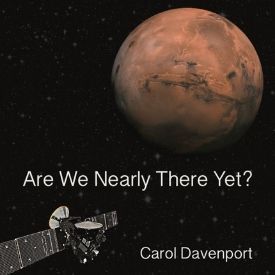
She decided to write the book, ‘Are We Nearly There Yet?’ whilst organising a series of family storytelling sessions funded by the UK Space Agency. Although there were books for young children on human space exploration, she couldn’t find a book on the robotic exploration of space aimed at pre-school children. Determined to give parents and children a well-rounded perspective, Dr Davenport decided to write her own story for them to use.
‘Are We Nearly There Yet?’ tells the story of Rosie the Rover, a robot rover who is travelling through space to reach Mars, imagining the adventures she will have when she arrives and learning about other robotic space missions along the way.
Rosie is based on Rosalind Franklin, a real space probe that is part of the ‘ExoMars’ mission, a joint initiative of the European Space Agency and the Russian Roscosmos State Corporation. It is due for launch this summer and will land on Mars in March 2021 to search for life on the red planet.
The picture book is aimed at pre-schoolers and has become part of two projects at NUSTEM, where each child that takes part receives a copy of it to take home and read with their parents. The feedback so far has been very positive, with parents describing it as “the perfect introduction to space”.
Dr Davenport explained: “I decided to write the book because we couldn’t find a children’s storybook about the robotic exploration of space. I knew the Mars Rover would be launching in the not too distant future, so it seemed like a good way to link something that was happening in real life with a subject we wanted to share with pre-school children. We designed it in a picture book format so that parents and carers can read the book with their children. We’re thrilled with the response we have had to it so far – one parent emailed me to say she had just read it four times over with her two-year-old – and I hope that this helps to ignite a real interest in robots and space in young children.
NUSTEM was launched six years ago and since then, Dr Davenport and the team have worked with than 40,000 children, teachers and family members in activity sessions and community events designed to inspire future generations of scientists and engineers.
‘Are We Nearly There Yet?’ has been published by Explaining Science Publishing and is available for purchase on their website (hardback or paperback) or on Amazon (paperback only).
Latest News and Features
.png?modified=20261006102851)
International design competition to grow the colour of the future
Researchers at Northumbria University and Imperial College London have launched an international…

Northumbria graduates celebrated at North East Business Awards
Graduate entrepreneurs from Northumbria University are celebrating after winning recognition…

How facial recognition failures harm people with facial differences
Researchers at Northumbria University's Centre for Responsible AI are working with Face Equality…

New Master Research Agreement strengthens commitment to cutting-edge research and innovation
Northumbria University and Lockheed Martin Space UK have signed a new Master Research Agreement,…

Speeding glaciers drive half a century of polar ice loss
The longest satellite record ever assembled shows that Greenland and Antarctica have lost 11.3…

Northumbria physicist elected Fellow of the Institute of Physics
Dr Juna Sathian, an Associate Professor at Northumbria University, has been elected a Fellow…

Northumbria helps shape national plan to boost graduate employability
Northumbria University has played a key role in shaping a new national plan designed to help…

Northumbria researcher joins appeal to Downing Street on free school meals and holiday support
A Northumbria University academic, whose research has played a key role in bringing breakfast…
More events
Upcoming events

Specialist Teaching Assistant Degree Apprenticeship - In-person Information Session
Coach Lane Campus
-

Next Stop Northumbria
Europa Hotel
-
The Past We Inherit. The Future We Build: Better Decisions Happen Together
The Great Hall, Sutherland Building
-
Next Stop Northumbria
Manchester Marriott Hotel Piccadilly
-
