
A groundbreaking discovery in Romania has dramatically pushed back the date of early human ancestors’ arrival in Europe.
Dr Vasile Ersek, from Northumbria University’s Department of Geography and Environmental Sciences, was part of an international team of researchers who have uncovered clear evidence of early hominin presence in Europe at least 1.95 million years ago - nearly two hundred thousand years earlier than previously documented.
Hominins are closely related ancestors to humans, who migrated around the world from Africa. Until now, evidence had suggested they had ventured into Europe by 1.8 million years ago, but researchers have now been able to prove they were present in Europe around 200,00 years before then, after examining fossil bones found in Romania.
Their findings have been published in Nature Communications.
Grăunceanu is an archaeological site in Romania that was originally excavated in the 1960s.
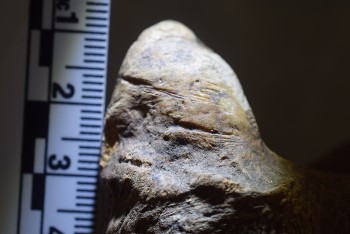
More than 5,000 bones from Grăunceanu and surrounding sites were meticulously examined. Although no hominin fossil bones were found, researchers did find evidence of cut-marks in a selection of fossilised bones, made with stone tools used to remove the flesh from animals. The team identified at least 20 bones they are confident show signs of human butchery, evidencing the presence of early human ancestors in the area.
Dr Vasile Ersek, an expert in past climate changes and human-environment interactions, who co-wrote the paper, explained: “The cut marks appear in anatomical positions consistent with deliberate removal of meat from the bones. Without the presence of human fossils from the site, we cannot determine which species of early human made these marks. It is possible they could have been made by Homo erectus, or even earlier members of our genus.”
The research team used uranium-lead dating to determine the age of the fossils, providing an average estimate age of 1.95 million years, but with some bones as old as 2.01 million years. This makes Grăunceanu the oldest well-dated site in Europe with evidence of human activity.
Prior to this discovery, the site of Dmanisi in Georgia was thought to contain the oldest evidence of hominin activity outside of Africa, dated to roughly 1.77-1.85 million years ago. Confirming the age of the marks establishes both the presence of hominins in Eurasia much earlier than previously thought, providing some of the earliest evidence of hominin activity in this area.
Using fossil horse teeth also found at the site, Dr Ersek was able to reconstruct the climate during this period in Northumbria University’s Stable Isotope Laboratory. He said: “The isotope analysis showed that while winters were mild enough to support warm-adapted animals like pangolins and monkeys, the climate was markedly more seasonal than in Africa. This demonstrates that these early humans had adapted to live in a climate with distinct wet winters and dry summers.”
Faunal analyses led by other members of the international team also show they would have encountered a range of new fauna, including woolly rhinos, sabre-tooth cats, pangolins and mammoths.

Dr Ersek added: “The findings have implications beyond revising historical dates and tell us that early humans were remarkably adaptable and capable of surviving in seasonal European environments much earlier than previously believed.
“The combination of clear evidence for butchery activities and detailed climate reconstruction provides some fascinating insight into the lives of these ancient pioneers.”
The study involved researchers from Ohio University, the University of Arkansas and the Emil Racoviţă Institute of Speleology in Bucharest.
Northumbria was ranked second in the UK for research power in Geography and Environmental Studies, with over 90% of research outputs rated as world-leading or internationally excellent in the 2021 Research Excellence Framework.
FURTHER INFORMATION:
Visit the Northumbria University Research Portal to find out more about Dr Vasile Ersek’s work.
Hominin presence in Eurasiaby at least 1.95 million years ago was published in Nature Communications.
This is the place to find all the latest news releases, feature articles, expert comment, and video and audio clips from Northumbria University

Geography At Northumbria University Encompasses All Of Our Work In Physical And Human Geography, Environmental Science And Management, Health & Safety, And Disaster Management.
Northumbria University News is packed full of news and features covering everything from research projects and business partnerships to student and staff awards.
Latest News and Features

UK network to accelerate the development of sustainable surface technologies
A new national network led by Newcastle University and Northumbria University, in partnership…

Criminologist wins acclaimed Philip Leverhulme Prize to pioneer a new criminology of the offshore world
A Northumbria University criminologist has been awarded a Philip Leverhulme Prize, one of the…

New platform maps charity support for the Armed Forces community
Pioneering data platform maps where the Armed Forces community receive support from charities

Northumbria co-leads study on fairer support for families
A major study co-led by Northumbria University will test whether attachment assessments lead…

New AHRC research shows how community innovation can power the next phase of devolution.
New research published today by the AHRC Creative Communities programme provides fresh evidence…

Free sessions to help families navigate the SEND system
Northumbria University's award-winning Student Law Office is launching SEND Decoded, a series…

New Doctoral Training Programme will tackle key polar science questions with a reduced carbon footprint
The Net Zero Polar Science (NZPS) Doctoral Training Programme (DTP) has welcomed its first…

New Student Health Hub brings joint health and wellbeing support
A new drop-in service is bringing health and wellbeing support for students at both Newcastle…
More events
Upcoming events

Next Stop Northumbria
Manchester Marriott Hotel Piccadilly
-

-
Magnetospheric Multiscale Science Working Team Meeting
Sutherland Building

Christmas Market and Tree lighting
Northumbria University
-
