
-
Study
-
Quick Links
- Open Days & Events
- Real-World Learning
- Unlock Your Potential
- Tuition Fees, Funding & Scholarships
- Real World Learning
-
Undergraduate
- Application Guides
- UCAS Exhibitions
- Extended Degrees
- School & College Outreach
- Information for Parents
-
Postgraduate
- Application Guide
- Postgraduate Research Degrees
- Flexible Learning
- Change Direction
- Register your Interest
-
Student Life
- Students' Union
- The Hub - Student Blog
- Accommodation
- Northumbria Sport
- Support for Students
-
Learning Experience
- Real-World Learning
- Research-enriched learning
- Graduate Futures
- The Business Clinic
- Study Abroad
-
-
International
International
Northumbria’s global footprint touches every continent across the world, through our global partnerships across 17 institutions in 10 countries, to our 277,000 strong alumni community and 150 recruitment partners – we prepare our students for the challenges of tomorrow. Discover more about how to join Northumbria’s global family or our partnerships.
View our Global Footprint-
Quick Links
- Course Search
- Undergraduate Study
- Postgraduate Study
- Information for Parents
- London Campus
- Northumbria Pathway
- Cost of Living
- Sign up for Information
-
International Students
- Information for International Students
- Northumbria and your Country
- International Events
- Application Guide
- Entry Requirements and Education Country Agents
- Global Offices and Regional Teams
- English Requirements
- English Language Centre
- International student support
- Cost of Living
-
International Fees and Funding
- International Undergraduate Fees
- International Undergraduate Funding
- International Masters Fees
- International Masters Funding
- International Postgraduate Research Fees
- International Postgraduate Research Funding
- Useful Financial Information
-
International Partners
- Agent and Representatives Network
- Global Partnerships
- Global Community
-
International Mobility
- Study Abroad
- Information for Incoming Exchange Students
-
-
Business
Business
The world is changing faster than ever before. The future is there to be won by organisations who find ways to turn today's possibilities into tomorrows competitive edge. In a connected world, collaboration can be the key to success.
More on our Business Services-
Business Quick Links
- Contact Us
- Business Events
- Research and Consultancy
- Education and Training
- Workforce Development Courses
- Join our mailing list
-
Education and Training
- Higher and Degree Apprenticeships
- Continuing Professional Development
- Apprenticeship Fees & Funding
- Apprenticeship FAQs
- How to Develop an Apprentice
- Apprenticeship Vacancies
- Enquire Now
-
Research and Consultancy
- Space
- Energy
- AI and Tech
- CHASE: Centre for Health and Social Equity
- NESST
-
-
Research
Research
Northumbria is a research-rich, business-focused, professional university with a global reputation for academic quality. We conduct ground-breaking research that is responsive to the science & technology, health & well being, economic and social and arts & cultural needs for the communities
Discover more about our Research-
Quick Links
- Research Peaks of Excellence
- Academic Departments
- Research Staff
- Postgraduate Research Studentships
- Research Events
-
Research at Northumbria
- Interdisciplinary Research Themes
- Research Impact
- REF
- Partners and Collaborators
-
Support for Researchers
- Research and Innovation Services Staff
- Researcher Development and Training
- Ethics, Integrity, and Trusted Research
- University Library
- Vice Chancellors Fellows
-
Research Degrees
- Postgraduate Research Overview
- Doctoral Training Partnerships and Centres
- Academic Departments
-
Research Culture
- Research Culture
- Research Culture Action Plan
- Concordats and Commitments
-
-
About Us
-
About Northumbria
- Our Strategy
- Our Staff
- Our Schools
- Place and Partnerships
- Leadership & Governance
- University Services
- Northumbria History
- Contact us
- Online Shop
-
-
Alumni
Alumni
Northumbria University is renowned for the calibre of its business-ready graduates. Our alumni network has over 253,000 graduates based in 178 countries worldwide in a range of sectors, our alumni are making a real impact on the world.
Our Alumni - Work For Us
Academics at Northumbria University, Newcastle, are evaluating Rapid Response Services to improve end-of-life care in new research funded by Marie Curie.
When people reach the end of their lives, it is important that they can choose their place of death. This could be at home, surrounded by friends and family, in a hospice or perhaps in hospital.
However, consistent evidence has shown that there is a mismatch between people’s preferences for where they would like to die and their actual place of death.
Research indicates that the majority of people would prefer to die at home; yet, prior to the pandemic, nearly half of deaths took place in hospitals.
Fulfilling patient preferences for dying at home depends on the appropriate support and care being available in the community. Rapid Response Services are one way of enabling people to die at home – but there has been very little research about their effectiveness for patients, carers and the cost implications of these services.
There is therefore a need to better understand what people require at the end of their lives, when they need it and how health and social services can support them. To address some of the gaps in research, academics from Northumbria University are conducting a much-needed study to evaluate Rapid Response Services.
Funded by Marie Curie, the two-year project will enable the team to make recommendations regarding further implementation of Rapid Response Services. This will help to influence policy and the ways in which end-of-life care is commissioned, planned and delivered.
Professor of Nursing Amanda Clarke, who is co-leading the research, said: “It is essential that the services delivering end-of-life care are available at a time and place when the patient and their family need support. Contributing to the evidence that shows us how best to do this is of great importance; we have just one chance to get it right at the end of people’s lives.”
Sabine Best, Head of Research at Marie Curie said: “For every person we care for at the end of their life, there are many more missing out on the conversations, support and care they rightly deserve. We know that the most important knowledge gap in palliative and end of life research is about how to best provide palliative care outside of working hours, avoiding crises, and helping people stay in their place of choice. This research will help us gain a better understanding of the part Rapid Response Services play in end of life care and enable us to make recommendations and influence change where it is so vitally needed.
“For those who die within the community, we must ensure there is suitable care and support available and sadly the pandemic has indicated this isn’t always the case. We know that a negative end of life experience has a detrimental impact to those left behind and can make an already challenging time in someone’s life, even harder to get through.”
Gaining a better understanding
As part of the new study, the team will evaluate two different Rapid Response Services in the North of England, to find out if and how each service helps patients and their families, how they work with other community teams and the costs of the services for the NHS.
By looking at contrasting approaches to these services, the team will be able to highlight what works best, for who, in what circumstances and why.
The researchers will conduct interviews and focus groups to ask staff involved in delivering end-of-life care how the service supports people and, importantly, they will speak to carers and patients about their experiences of using the service and whether it has made a difference to them and, if so, in what way.
A growing need, intensified by the pandemic
The demand for palliative and end-of-life care was already set to increase rapidly, with the country’s ageing population meaning more people are living for longer with multiple and complex conditions, but the Covid-19 pandemic has exacerbated the need for evidence-based solutions for end-of-life care.
While the number of people dying at home has increased significantly since the onset of the pandemic, survey results published by Marie Curie in April 2021 suggested that as many as 76% of people whose loved one died at home during the pandemic felt they were not offered all the care and support they needed as carers.
In addition, recent research by Public Health England shows that existing health and social inequalities have continued or even worsened during the pandemic, for example amongst people over the age of 80, men and certain ethnic groups.
The research team will therefore also examine the impacts of the Covid-19 pandemic on Rapid Response Services. The findings should enable a better understanding about how to develop Rapid Response Services to support patients and their carers during the pandemic and beyond.
Project Co-lead Dr Joanne Atkinson, Head of the Department of Social Work, Education and Community Wellbeing, said: “Covid-19 has seen death and dying placed at the forefront of our consciousness. We need to make a difference in meaningful ways, evaluating Rapid Response Teams in end-of-life care allows us to explore how we support people to die in their own homes in familiar surroundings, beside the people that matter to them.”
Here at Northumbria we are at the forefront of high quality professional education, innovation and research. In this discipline we cover social work, social care, education, lifelong learning, public health and community welbeing.
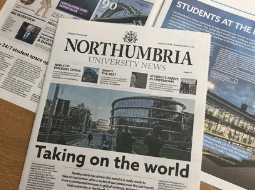
This is the place to find all the latest news releases, feature articles, expert comment, and video and audio clips from Northumbria University

Northumbria’s research in Allied Health Professions, Dentistry, Nursing and Pharmacy, led from our Faculty of Health & Life Sciences, has a broad range of activity reflecting our wide discipline base, with two major thematic areas.

Northumbria has submitted 1096 staff across thirteen Units of Assessment (UoA) to the Research Excellence Framework (REF) 2021. This submission reflects our research across four Faculties and nineteen Departments, incorporating traditional disciplines, such as English and Engineering, modern disciplines, such as Business and Design, and professional disciplines, such as Architecture and Nursing.
Latest News and Features

Northumbria University to co-host fifth Newcastle Climate Change Forum
Northumbria University, in collaboration with Newcastle University and Newcastle City Council…
Northumbria students gain policymaking experience through Civil Service challenge
Students from Northumbria University have gained valuable insight into government policymaking…
New funding to catalyse devolved cultural policy making
The AHRC Creative Communities programme based at Northumbria University has today announced…
Newcastle United kit given new life in unique sustainability collaboration
Fashion items made from recycled Newcastle United shirts have gone on display in Eldon Square…
Northumbria Social Work students gain global perspective on 4,000km South African placement
Five MA Social Work students from Northumbria University (Alice Henderson, Ava Lister, Avi…
Arts centre with a difference – Northumbria launches new series of public exhibitions
Northumbria University's School of Design, Arts and Creative Industries has announced the launch…
National Fellowship honours Northumbria nursing leader
A leading academic in palliative and end-of-life care at Northumbria University has been recognised…
£1.3m national study launches to evaluate changes to police involvement in mental health crisis responses
A major new research project will examine how changes to police involvement in mental health…
Upcoming events
On Weaving
Gallery North
Viruses of Microbes-UK (VoM-UK) Conference 2026
Northumbria University
Holocaust Memorial Day 2026 - Bridging Generations: Generational Voices and Silences
The Great Hall
-
Commercialising SHAPE Innovations and Impact
Northumbria University
-
