The Solar-Terrestrial Science group has a long-term research programme to investigate how the Sun drives space weather (a term describing a series of phenomena originating from the Sun). Improved monitoring and prediction of space weather is critical to reduce the significant risks that exist to our global infrastructure, including risks to our communications systems, power grids, pipelines and satellites. Understanding and forecasting these space weather events is vital to help us plan and build resilience. Research in this group includes atmospheric physics and chemistry, upper atmosphere processes, geospace, solar studies, and solar-terrestrial physics.
Our research in measurement and forecasting of solar radiation, satellite radiation risk and associated ground effects aims to improve global space weather predictions and directly inform UK government risk holders through the collaborative NERC and STFC Programme SWIMMR. Space Weather appears on the National Risk Register (under Environmental Hazards) and we are actively involved in multiple aspects of SWIMMR (specifically N1, N4 and S4).
Northumbria’s long-standing expertise in Solar-Terrestrial Science has been supported with core funding from NERC and STFC, as well as funding from EU Horizon 2020, European Space Agency (ESA), UK Space Agency, the US Air Force, the National Solar Observatory (USA), the Leverhulme Trust, and the Royal Astronomical Society. Group members sit on various national and international panels including the STFC Education, Training and Careers Committee; STFC Solar System Advisory Panel; STFC Astronomy Grants Panel; STFC Project Peer Review Panel; UK Space Agency’s Space Programme Advisory Committee; and ESA’s Space Science Advisory Committee.
Projects and Collaborations
Revealing the Pattern of Solar Alfvénic Waves
This Future Leader Fellowship project aims to advance our understanding of the Sun and its impact on the planets within our solar system. The research will explore phenomena such as the Sun’s powerful solar winds and the giant, planet-sized concentrations of magnetic fields known as sunspots. Advanced mathematical techniques and cutting-edge computer simulations will be used to create models of the Sun to provide new insight into the physics behind its activity.
This area of our research is led by Dr Richard Morton, who recently won the Royal Astronomical Society’s 2021 Fowler Prize for Geophysics.
The Cool Alter-Ego of the Hot Solar Corona
The outer atmosphere or ‘corona’ of the Sun is over 200 times hotter than its surface, at a temperature of several million degrees. The corona is diverse and also holds a large amount of cold material, creating cycles of heating and cooling similar to what we have on Earth, even causing ‘coronal rain’. This STFC Ernest Rutherford Fellowship project will investigate the mechanisms underlying these processes using cutting edge equipment and modelling to better understand the processing of heating and cooling of the Sun’s corona.
Flare Likelihood and Region Eruption Forecasting (FLARECAST)
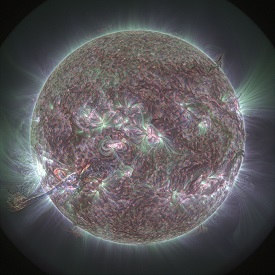
Solar flares are bursts of brightness on the Sun’s surface which cause huge amounts of energy to build up and then be released into space. Solar flares are the main drivers of space weather near Earth and can cause geomagnetic and solar radiation storms resulting in radio blackouts and disrupting satellite operations, aviation and communication technologies. FLARECAST is a fully automated system developed to forecast and predict the likelihood of solar flares. It is part of an international EU Horizon 2020-funded effort to build a comprehensive system to better predict space weather and its impact on Earth.

 News
News
 News
News
 News
News