
Senior Lecturer in Physical Geography, Dr Bronwen Whitney, contributes to an article discussing Hydroelectric dams threatening Brazil’s mysterious Pantanal for The Conversation.
The Pantanal in central South America may not be as globally famous as the Amazon rainforest, but it has the continent’s highest concentration of wildlife. Now, however, the region’s endangered plants and animals, along with its still undiscovered secrets, may be wiped out in return for cheap hydroelectricity.
The Pantanal is the world’s largest tropical wetland and covers an area slightly larger than England. It lies mostly on a huge floodplain at the foot of Brazil’s southwestern highlands, but a fraction also spills over into Bolivia and Paraguay. In the wet season, from October to April, water washes down from those highlands bringing with it nutrients and fish and leaving most of the region underwater. When the rains finish, and the ground dries up, the landscape changes once again.
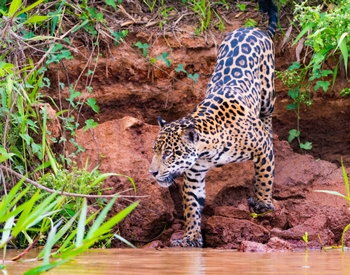
Seasonal variation on such a massive scale means the Pantanal contains a diverse range of plants and animals that have adapted to thrive in standing water or waterlogged soil. The region is home to more than 1,000 bird species and 300 mammals including the jaguar, capybara, giant otter and tapir.
Yet the Pantanal is now threatened by Brazil’s thirst for hydroelectricity. We are part of a group of researchers investigating the state of Mato Grosso, where the rush to build dams is particularly apparent. Mato Grosso holds the upper reaches of the Pantanal, but is probably more famous for the Amazon rainforest in the north of the state and the enormous “fazendas” (large farms) on its fringes which produce soya, beef and cotton.
This mixture of natural resources and fertile land means Mato Grosso has a long history of environmental issues. However, if the state today is recognised as a deforestation hotspot, soon it may be known for its dams. This is because the height difference between the rainy plateau in the north of the state and its southern plains means there is lots of hydroelectric potential.
Mato Grosso is following a nationwide trend. After a series of major blackouts in 2001 which highlighted Brazil’s energy insecurities, the country turned to hydroelectricity. Since then, a wave of dams have been, or are planned to be, constructed to satisfy the ever increasing demand for energy.
Over the past few years, Brazil’s growth acceleration programme has allowed for the increased construction of hydroelectric dams in the state, while also removing or weakening some environmental laws.
There are already 38 operational hydroelectric plants in the Paraguay river’s upper basin, the region that drains into the Pantanal. A further 94 are due to be built in coming years.
In Brazil, dams are classified in two categories: those that are able to produce more than 30MW of energy, and small hydroelectric plants (SHP) with a capacity of less than 30MW and a reservoir of less than 13km². These small plants are seen as more environmentally friendly and are commonly constructed as part of a chain along the length of the river.
In the Amazon, the impacts of the bigger dams have been well documented. Fish numbers are down, and irregular floods have exposed dry land that had previously been submerged during the wet season.
Less research has been conducted in the Pantanal basin but the few reports that have investigated dams there report similar results. Additionally, one larger dam led to river depth fluctuating by several metres over weekly or even daily periods, confusing fish and affecting water quality. Less is currently known about the impacts of the smaller hydroelectric dams but, as they still store some water in the reservoir in order to produce energy at peak times, especially in low-flow rivers, they thus also affect the river’s daily fluctuations.
What we do know is that too many dams on the rivers that feed the Pantanal would disrupt the natural rhythm of the wetland. Large-scale cattle ranchers, soy farmers and city dwellers drive year-round demand for water and energy, which would put the seasonal flood “pulse” at risk. In this scenario, species that have adapted themselves over thousands of years to life in an on-off wetland may find themselves thrown out of sync.
Even several small plants close to each other can produce new patches of still surface water, fragmenting ecosystems and affecting ecological relationships. Meanwhile, those whose livelihoods are dependent on these cycles, mainly traditional fishing communities, may find they can no longer survive.
As the impacts of hydroelectric dams become apparent in the Amazon, it is crucial that we do not forget the Pantanal. If the wetland is going to survive, it will take a concerted effort from all actors who use its resources to work together. The Pantanal is a complex ecosystem where society and the environment clash on a number of issues. With the increasing demand for electricity and solar and wind options being little investigated in Mato Grosso, it is important the full impacts of hydroelectric generation are known.
This article was originally published on The Conversation. Read the original article
Latest News and Features

New platform maps charity support for the Armed Forces community
Pioneering data platform maps where the Armed Forces community receive support from charities

Northumbria co-leads study on fairer support for families
A major study co-led by Northumbria University will test whether attachment assessments lead…

New AHRC research shows how community innovation can power the next phase of devolution.
New research published today by the AHRC Creative Communities programme provides fresh evidence…

Free sessions to help families navigate the SEND system
Northumbria University's award-winning Student Law Office is launching SEND Decoded, a series…

New Doctoral Training Programme will tackle key polar science questions with a reduced carbon footprint
The Net Zero Polar Science (NZPS) Doctoral Training Programme (DTP) has welcomed its first…

New Student Health Hub brings joint health and wellbeing support
A new drop-in service is bringing health and wellbeing support for students at both Newcastle…

Researchers aim to grow optical fibres using biology instead of machinery
A new project led by Northumbria University aims to grow optical fibres using proteins, mimicking…

Training the next generation of space scientists
Northumbria University has hosted a major international workshop, bringing together leading…
More events
Upcoming events

Next Stop Northumbria
Europa Hotel
-
The Past We Inherit. The Future We Build: Better Decisions Happen Together
The Great Hall, Sutherland Building
-
Next Stop Northumbria
Manchester Marriott Hotel Piccadilly
-
