
Scientists from Northumbria University are part of a team of researchers who have captured images of bright auroral activity on Neptune, using NASA’s James Webb Space Telescope.
 Auroras occur when energetic particles, often originating
from the Sun, become trapped in a planet’s magnetic field and eventually strike
the upper atmosphere. The energy released during these collisions creates the
signature glow.
Auroras occur when energetic particles, often originating
from the Sun, become trapped in a planet’s magnetic field and eventually strike
the upper atmosphere. The energy released during these collisions creates the
signature glow.
In the past, astronomers have seen tantalizing hints of auroral activity on Neptune, for example, in the flyby of NASA’s Voyager 2 in 1989. However, imaging and confirming the auroras on Neptune has long evaded astronomers, and despite successful detections on Jupiter, Saturn, and Uranus – Neptune had been the missing piece of the puzzle when it came to detecting auroras on the giant planets of our solar system.
Launched in December 2021, the James Webb Space Telescope uses infrared radiation to look deep into space, meaning it can observe the first stars and even the formation of the first galaxies. Using data captured by Webb, researchers were for the first time able to capture images of auroras occurring on Neptune, as well as discovering a surprising change in the gas and ice planet’s temperature over the last 30 years. Their findings have been published in the journal Nature Astronomy.
 Lead author Dr Henrik Melin, of Northumbria University,
explains: “It turns out, actually imaging the auroral activity on Neptune was
only possible with Webb’s near-infrared sensitivity. It was so stunning to not
just see the auroras, but the detail and clarity of the signature really
shocked me.”
Lead author Dr Henrik Melin, of Northumbria University,
explains: “It turns out, actually imaging the auroral activity on Neptune was
only possible with Webb’s near-infrared sensitivity. It was so stunning to not
just see the auroras, but the detail and clarity of the signature really
shocked me.”
The data was obtained in June 2023, using Webb’s Near-Infrared Spectrograph. In addition to the image of the planet, astronomers obtained a spectrum to characterize the composition and measure the temperature of the planet’s upper atmosphere (the ionosphere). For the first time, they found an extremely prominent emission line, signifying the presence of the trihydrogen cation (H3+), which can be created in auroras. In the Webb images of Neptune, the glowing aurora appears as splotches represented in cyan.
Heidi Hammel of the Association of Universities for Research in Astronomy is a Webb interdisciplinary scientist and leader of the Guaranteed Time Observation program in which the data were obtained. She explains: “H3+ has a been a clear signifier on all the gas giants – Jupiter, Saturn, and Uranus – of auroral activity, and we expected to see the same on Neptune as we investigated the planet over the years with the best ground-based facilities available. Only with a machine like Webb have we finally gotten that confirmation.”
 The auroral activity seen on Neptune is also noticeably
different from what we are accustomed to seeing here on Earth, or even Jupiter or Saturn. Instead
of being confined to the planet’s northern and southern poles, Neptune’s
auroras are located at the planet’s geographic mid-latitudes – around where
South America is located on Earth.
The auroral activity seen on Neptune is also noticeably
different from what we are accustomed to seeing here on Earth, or even Jupiter or Saturn. Instead
of being confined to the planet’s northern and southern poles, Neptune’s
auroras are located at the planet’s geographic mid-latitudes – around where
South America is located on Earth.
This is due to the strange nature of Neptune’s magnetic field, originally discovered by Voyager 2 in 1989, which is tilted by 47 degrees from the planet’s rotation axis. Since auroral activity is based where the magnetic fields converge into the planet’s atmosphere, Neptune’s auroras are far from its rotational poles.
The ground-breaking detection of Neptune’s auroras will help us understand how Neptune’s magnetic field interacts with particles that stream out from the Sun to the distant reaches of our solar system, a totally new window in ice giant atmospheric science.
From the Webb observations, the team also measured the temperature of the top of Neptune’s atmosphere for the first time since Voyager 2’s flyby. The results hint at why Neptune’s auroras remained hidden from astronomers for so long.
“I was astonished — Neptune’s upper atmosphere has cooled by several hundreds of degrees,” Dr Melin said. “In fact, the temperature in 2023 was just over half of that in 1989.”
Through the years, astronomers have predicted the intensity of Neptune’s auroras based on the temperature recorded by Voyager 2. A substantially colder temperature would result in much fainter auroras. This cold temperature is likely the reason that Neptune’s auroras have remained undetected for so long. The dramatic cooling also suggests that this region of the atmosphere can change greatly even though the planet sits over 30 times farther from the Sun compared to Earth.
Equipped with these new findings, astronomers now hope to study Neptune with Webb over a full solar cycle, an 11-year period of activity driven by the Sun’s magnetic field. Results could provide insights into the origin of Neptune’s bizarre magnetic field, and even explain why it’s so tilted.
“As we look ahead and dream of future missions to Uranus and Neptune, we now know how important it will be to have instruments tuned to the wavelengths of infrared light to continue to study the auroras,” added Leigh Fletcher of Leicester University, co-author on the paper. “This observatory has finally opened the window onto this last, previously hidden ionosphere of the giant planets.”
These observations, led by Fletcher, were taken as part of Hammel’s Guaranteed Time Observation program 1249.
Planetary scientists from Northumbria University’s Solar and Space Physics peak of research excellence have been involved in a number of research projects using data from Webb, specifically exploring the upper atmospheres of our solar system’s giant gas planets – Jupiter, Saturn, Uranus and Neptune.
- Unveiling Jupiter’s upper atmosphere
- Uranus aurora discovery promises new riches from James Webb Space Telescope
- Telescope to provide insight into Solar System light shows
- Telescope reveals unexpected activity above Jupiter’s Great Red Spot
Visit the Northumbria University Research Portal to find out more about Dr Melin’s work.
The James Webb Space Telescope is the world's premier space science observatory. Webb is solving mysteries in our solar system, looking beyond to distant worlds around other stars, and probing the mysterious structures and origins of our universe and our place in it. Webb is an international program led by NASA with its partners, ESA (European Space Agency) and CSA (Canadian Space Agency).
Image credit: NASA, ESA, CSA, STScI, Heidi Hammel (AURA), Henrik Melin (Northumbria University), Leigh Fletcher (University of Leicester), Stefanie Milam (NASA-GSFC)
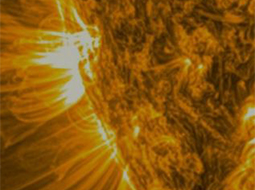
Northumbria University is powering the next generation of space innovation. Learn more about our expert academics, world class research and state of the art facilities.
Our North East Space Skills and Technology Centre will be a state of the art £50M facility developed by Northumbria, with investment from the UK Space Agency and the space and satellite division of industry giant Lockheed Martin.
Department of Mathematics, Physics and Electrical Engineering
This department encompasses all of our work in Mathematics, Statistics and Physics including Astrophysics, Electrical and Electronic Engineering, Energy, Smart Materials, Microelectronics and Communications.

Space brings together research from multiple fields including engineering (electrical, mechanical, information technology, communications, power, propulsion, aerospace), and science (physics, chemistry, biology, materials) to stimulate new ideas, enhance excellence and drive innovation in the exploration and use of space for humankind.


This is the place to find all the latest news releases, feature articles, expert comment, and video and audio clips from Northumbria University

Northumbria University News is packed full of news and features covering everything from research projects and business partnerships to student and staff awards.
Latest News and Features

UK network to accelerate the development of sustainable surface technologies
A new national network led by Newcastle University and Northumbria University, in partnership…

Criminologist wins acclaimed Philip Leverhulme Prize to pioneer a new criminology of the offshore world
A Northumbria University criminologist has been awarded a Philip Leverhulme Prize, one of the…

New platform maps charity support for the Armed Forces community
Pioneering data platform maps where the Armed Forces community receive support from charities

Northumbria co-leads study on fairer support for families
A major study co-led by Northumbria University will test whether attachment assessments lead…

New AHRC research shows how community innovation can power the next phase of devolution.
New research published today by the AHRC Creative Communities programme provides fresh evidence…

Free sessions to help families navigate the SEND system
Northumbria University's award-winning Student Law Office is launching SEND Decoded, a series…

New Doctoral Training Programme will tackle key polar science questions with a reduced carbon footprint
The Net Zero Polar Science (NZPS) Doctoral Training Programme (DTP) has welcomed its first…

New Student Health Hub brings joint health and wellbeing support
A new drop-in service is bringing health and wellbeing support for students at both Newcastle…
More events
Upcoming events

Next Stop Northumbria
Manchester Marriott Hotel Piccadilly
-

-
Magnetospheric Multiscale Science Working Team Meeting
Sutherland Building

Christmas Market and Tree lighting
Northumbria University
-
