
Researchers at Northumbria University and the University of Edinburgh are developing a new way to protect aircraft wings, wind turbines and other critical structures from ice, without the use of fluorinated chemicals known as PFAS – or forever chemicals.
 The team of scientists are
developing a hybrid approach that combines a very slippery coating with
technology that uses vibrations to break ice away.
The three-year project is funded by the Engineering and Physical Sciences Research Council (EPSRC), part of UK Research and Innovation.
It brings together two complementary approaches. The University of Edinburgh team, led by Professor Glen McHale, has developed a liquid-like surface treatment.
This forms an ultra-thin layer that is chemically bonded to a surface yet so slippery that water runs off and ice struggles to stick.
Most existing water-repellent coatings rely on fluorinated chemicals, or PFAS, which do not break down in the environment and face growing regulation.
This new coating is free from PFAS, making it a long-term, environmentally friendly alternative.
 The Northumbria University
team, led by Professor Richard Yongqing Fu, bring expertise in acoustic wave
technology.
They will work to develop a smart hybrid protective layer which could be applied to the surface of an aircraft wing or turbine.
This active layer can be driven by electrical signals which create surface acoustic waves with tiny mechanical vibrations that crack the ice and shake it free.
Treating a surface alone is unlikely to be enough over the long term, so the team will investigate how the coating and the acoustic technology can work together effectively.
Professor Fu said: “A passive coating alone isn’t enough for long-term ice protection, so we need to combine it with an active method. We have shown acoustic waves can crack ice, and the Edinburgh team has a non-fluorinated surface that ice struggles to grip. The challenge, and the novelty, is making the two work together.”
Early studies in these new technologies have used materials such as glass and silicon, which are not widely used in industry.
The team will now apply the coatings to aluminium and epoxy-based composites, studying how to treat these materials and whether acoustic wave technology can be integrated with them.
Northumbria has already shown the acoustic approach can remove ice in an icing wind tunnel, including on a model aircraft wing leading edge.
 The researchers will test
the hybrid system at the INTA icing wind tunnel in Madrid, building on earlier
collaboration through the EU Sound of Ice project.
The team also believes the approach could use far less energy than conventional active methods, such as electrothermal heating, and has published research supporting this.
Aircraft wings are a key potential application, but the team will also explore wind energy and other sectors where ice causes safety and performance problems.
The team also hopes to explore wireless power delivery, similar to technology used in electric vehicles, so devices would not need a physical connection to a power source.
Professor McHale of the University of Edinburgh said: “The risks from the build-up of ice on external surfaces from energy transmission structures to wind turbines and aircraft wings, presents real and substantial dangers. I am delighted our team will be able to address this challenge while using hybrid approaches which seek to minimise the risk to the environment from forever chemicals.”
The team is working with industry partners including CAV Ice Protection, NDT Consultants and Jesmond Engineering, who are helping shape the research and supporting wind tunnel testing. The Offshore Renewable Energy Catapult and the EU Sound of Ice project are also involved.
Professor Hamdi Torun and Dr Prashant Agrawal from Northumbria University, and Professor Dipa Roy and Dr Gary Wells from the University of Edinburgh, complete the research team.
Professor Fu added: “This is still early-stage research, and many ice protection technologies are being developed around the world, from electrothermal to photothermal approaches. Ours is a new direction, and there are still many challenges, but working with industry from the start means we are focused on what they actually need.”

At Northumbria Engineering, Physics and Mathematics are co-located in one ambitious, future-facing school.
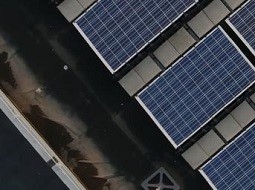
Our energy materials and systems research uses fundamental physics, chemistry and engineering to develop new ways to generate and store renewable energy - to help deliver a cleaner and greener future.
This is the place to find all the latest news releases, feature articles, expert comment, and video and audio clips from Northumbria University
Latest News and Features

Three Northumbria University pioneers named among the UK's 50 Future Innovators
An energy efficient cooling system, fully recyclable wind turbine blades and a new breast imaging…

New coatings could keep aircraft wings ice-free
Researchers at Northumbria University and the University of Edinburgh are Ice coating research…

Cricket coach turned social entrepreneur named on national ‘ones to watch’ list
A Northumbria University graduate who turned his love of cricket into a social enterprise supporting…

Pathbreaking mock trials to test how AI evidence affects justice
Researchers at Northumbria University, Newcastle University, and the University of Glasgow…

North-East pupils tackle real space research through award winning Orbyts programme
A Northumbria University-backed programme giving North-East pupils the chance to do real space…

New dementia risk tool designed for the countries that need it most
An international team led by Northumbria University has developed and validated a simple five-factor…

UK network to accelerate the development of sustainable surface technologies
A new national network led by Newcastle University and Northumbria University, in partnership…

Criminologist wins acclaimed Philip Leverhulme Prize to pioneer a new criminology of the offshore world
A Northumbria University criminologist has been awarded a Philip Leverhulme Prize, one of the…
More events
Upcoming events

Christmas Market and Tree lighting
Northumbria University
-
What can an engineering education in the North East lead to?
Durrant Hall
-
Snow Problem? Why Arctic Snow Matters in a Warming World
Lecture Theatre 003, Business & Law Building
-

Northumbria University Carol Service 2026
Newcastle Cathedral
-
