International Business Management MSc
2 Years Full-Time | September Start
Option for Placement Year
Option for Study Abroad

International
View our Global FootprintBusiness
Northumbria University is proud to offer a range of Professional, Statutory and Regulatory Body (PSRB) approved & accredited courses and programmes. Explore our list of courses and programmes under our Education and Training page.
More on our Business ServicesResearch
Northumbria is a research-rich, business-focused, professional university with a global reputation for academic quality. We conduct ground-breaking research that is responsive to the science & technology, health & well being, economic and social and arts & cultural needs for the communities
Discover more about our ResearchAlumni
Northumbria University is renowned for the calibre of its business-ready graduates. Our alumni network has over 253,000 graduates based in 178 countries worldwide in a range of sectors, our alumni are making a real impact on the world.
Our AlumniIf you’d like to receive the latest updates from Northumbria about our courses, events, finance & funding then enter your details below.
* At Northumbria we are strongly committed to protecting the privacy of personal data. To view the University’s Privacy Notice please click here
Option for Placement Year
Option for Study Abroad

Are you looking for a clear understanding of global business, from both a theoretical and practical perspective? This two-year course with advanced practice will give you the edge with transnational organisations, in recruitment and opportunities for promotion.
There is a focus on the global business environment, an emphasis on managing international organisations, and special attention to the cultural challenges of extending operations across multiple countries. The course culminates in either a master’s dissertation or if you prefer, a consultancy project where you will tackle an issue faced by a real client.
The course attracts students from around the world, creating a global perspective within the classroom. You will be developed as a leader and manager while expanding upon your research skills.
Newcastle Business School is accredited by the prestigious Association to Advance Collegiate Schools of Business (AACSB). According to AACSB, “Approximately 6% of the world's schools offering business degree education have achieved AACSB accreditation, demonstrating a commitment to high-quality, rigorous standards, innovation, and continuous process improvement”. Read more about our 'double' AACSB Accreditation.
Please be aware that all Advanced Practice with investigative consultancy project routes are similar to many of our 1-Year MSc with consultancy project routes, while 2-year Advanced Practice course spends more dedicated time in the Business Clinic, reflected on the total assessment input for the two 60 credit modules.
![]()
Are you looking for a clear understanding of global business, from both a theoretical and practical perspective? This two-year course with advanced practice will give you the edge with transnational organisations, in recruitment and opportunities for promotion.
There is a focus on the global business environment, an emphasis on managing international organisations, and special attention to the cultural challenges of extending operations across multiple countries. The course culminates in either a master’s dissertation or if you prefer, a consultancy project where you will tackle an issue faced by a real client.
The course attracts students from around the world, creating a global perspective within the classroom. You will be developed as a leader and manager while expanding upon your research skills.
Newcastle Business School is accredited by the prestigious Association to Advance Collegiate Schools of Business (AACSB). According to AACSB, “Approximately 6% of the world's schools offering business degree education have achieved AACSB accreditation, demonstrating a commitment to high-quality, rigorous standards, innovation, and continuous process improvement”. Read more about our 'double' AACSB Accreditation.
Please be aware that all Advanced Practice with investigative consultancy project routes are similar to many of our 1-Year MSc with consultancy project routes, while 2-year Advanced Practice course spends more dedicated time in the Business Clinic, reflected on the total assessment input for the two 60 credit modules.
Level of Study
Postgraduate
Mode of Study
2 years Full Time with Advanced Practice
2 other options available
School
Newcastle Business School
Location
City Campus, Northumbria University
City
Newcastle
Start
September or January
Fees
Fee Information
Modules
Module Information
Discover the funding options available to you.

Scholarship Search Tool
Discover our available funding options.

Alumni Discount
Receive up to 20% off your course fees.

The Postgraduate Loan
More about the UK Government Loan.
At NBS we’re Business, but not as usual. Discover more.

Newcastle Business School

Real-World Learning: Consultancy Project
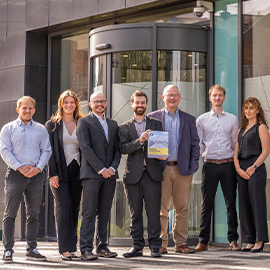
Students gain invaluable work experience with EY Newcastle, helping to drive apprentice recruitment
Read MoreNorthumbria business students develop branding strategy for OddBalls Apparel.

Read the news story.Team Northumbria Wins the 12th Greggs Marketing Challenge.

Read the news story.Northumbria named as a Principles for Responsible Management Education Champion.
Read the news story.Entrepreneurial student launches marine-based skincare products.

Read the news story.Your tutors will use a variety of teaching methods including lectures, seminars, workshops and tutorials. As this is a master’s course there is a major element of independent learning and self-motivated reflection.
Teaching is backed up by a well-designed support system that helps ensure a successful learning journey. We make sure that extensive feedback, from both tutors and peers, is built into the course.
During the second year you will have the opportunity to undertake a consultancy project for a whole semester. You will follow this up with an Applied Management Work Investigation Report that will critically analyse an issue related to your practical experience.
This course also includes a residential day for the leadership and team-building event, which is aimed at strengthening skills in team working, emotional and cultural intelligence, self-reflection, independent learning and critical thinking.
Our assessment strategy is based on our understanding that everyone has different needs, strengths and enthusiasms. Assessment methods include assignments, presentations and the master’s dissertation or consultancy project.
Highly acclaimed by clients as successful, as students get to the root of the problem, and results in a detailed report and presentation of their recommendations.
Our academic teaching teams comprise experienced management practitioners and researchers who continue to be actively engaged in professional practice. To maintain their professional profile, our staff are actively engaged in consultancy, enterprise, organisational consultancy and research in areas such as supporting workforces through global crises, financial crime, ageing workforce, organisational psychology, social entrepreneurship, business ethics and corporate social responsibility. Our academics are also members of signature research groups that include digital business, strategic innovation and entrepreneurial leadership, and responsible business.
The involvement of our academics in these activities directly informs the content of modules we teach offering the chance to develop up-to-the-minute understanding of the challenges of complex, global workplaces.
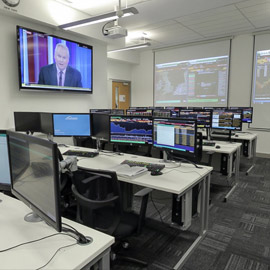
The University has also invested heavily in IT labs and facilities. Business software includes ARIS Express Business Process Modelling, various SAS applications, Microsoft Project, specialist decision-making software, and Google Analytics.
Technology Enhanced Learning (TEL) is embedded throughout the course with tools such as the ‘Blackboard’ eLearning Portal and electronic reading lists that will guide your preparation for seminars and independent research. Our use of lecture capture software will help you revise challenging material.
There will be plenty of opportunities to put your learning into practice. The Student Engagement Centre promotes all types of experiential learning, including volunteering. The Business Clinic enables our students to participate in a ‘consultancy firm’ to provide advice for our region’s businesses.
If you decide on a master’s consultancy project, rather than a dissertation, you’ll still undertake primary and desk research. Through your reading, reflection and research, you’ll be expected to show a deep understanding of the issues that are involved in the client brief.
Throughout your course you’ll be an active participant in the on-going research agenda that’s at the heart of Newcastle Business School. With conferences and research events regularly taking place, and with staff discussing their own research as it relates to the topics you’ll study, there’s a strong emphasis on engaging in up-to-date enquiry-based learning.
As part of this, the course includes two modules that are focused on developing global management competencies and international human resource management. Topics during these modules include emotional intelligence, cultural awareness and the ability to work in diverse groups and teams, as well as project management and decision making.
A further module, ‘Academic and Professional Development’, has a specific focus on self-development. It includes formal sessions with our Careers and Employment Service which offers a range of workshops, one-to-one advice, and networking opportunities.
In the second year of the course you will have the chance to put your new learning into practice. You will develop a track record of achievement that will help you stand out from other job applicants. We will help you find a project that matches your interests and career aspirations, building on Newcastle Business School’s very successful background in placing students.
A master’s course that takes two years, instead of just one, will carry particular weight with employers. They will understand that you’ll have a deeper understanding of topics as well as more hands-on practical experience.
Our graduates typically go into graduate positions with multinational companies or smaller businesses with operations and supply chains in several countries. A number of graduates have gone on to work in their family business.
Some employers require completion of a two-year master’s degree and this course will meet their requirement.
The course could also lead you to a postgraduate research degree such as an MPhil, PhD and Professional Doctorate.
Whatever you decide to do, you will have the transferable skills that employers expect from a master’s graduate from Northumbria University. These include the ability to tackle complex issues through conceptualisation and undertaking research, the ability to contribute to new processes and knowledge, and the ability to formulate balanced judgements when considering incomplete or ambiguous data.
Take a look at what Northumbria has to offer and discover what studying with us can do for you.
Full UK Fee: £14,250
Tuition fees in the academic year 2027/28* will be £10,050. Fees are set in line with the UK Government's tuition fee cap. The University may increase fees in subsequent years in line with any changes to the tuition fee cap. Increases will be linked to inflation. For example, increases may be linked to RPIX (Retail Price Index excluding mortgage interest payments) Students will be notified of any increase ahead of it taking effect. Student fee loans rise in line with the tuition fees cap.
*if your course is longer than one year
Full International Fee: £24,500
This is the tuition fee for your first year of study. You should expect to pay tuition fees for every year of study. The University may increase fees in the second and subsequent years of your course at our discretion in line with any inflationary or other uplift. Students will be notified of any increase ahead of it taking effect.
Scholarships and Discounts
ADDITIONAL COSTS
TBC
* At Northumbria we are strongly committed to protecting the privacy of personal data. To view the University’s Privacy Notice please click here
We are currently reviewing modules which provide opportunities to work with industry to gain real experience. Modules will be updated in due course.
Module information is indicative and is reviewed annually therefore may be subject to change. Applicants will be informed if there are any changes.
BM9718 -
Research Methods and Analytics for Business Practice (Core,20 Credits)
In this module you will learn about a comprehensive range of research methods and business analytics techniques. This will equip you with the knowledge and practical skills necessary for you to conduct research at Masters’ level and prepare you to complete a Master’s Dissertation, Consultancy Project or Management Enquiry. By the end of the module you will know how to apply both quantitative and qualitative data collection and business analysis techniques. In quantitative techniques you will learn about sampling, questionnaire design, statistical inference, and hypothesis testing while qualitative techniques covered will include methods such as interviewing and focus groups. Analysis methods such as content analysis and thematic analysis will also be covered. In addition, you will gain some understanding of research philosophy (positivism and interpretivism) and research ethics and you will be able to write a research proposal to bring these ideas together.
Furthermore, this module will provide clear, critical, and analysis of data, you will also be able to consider the use of analytics implementation skills, where you will be introduced to analytics software such as SPSS. SPSS statistics analysis is one of the powerful solutions that is designed to help businesses and researchers to solve problems by various methods (geospatial analysis, predictive analytics and hypothesis testing).
MK9709 -
Global Consumers and Marketplaces (Optional,20 Credits)
Owing to changing migration patterns and digital media, we live in an increasingly global society. Whilst posing many opportunities for business, the decision to internationalise a company’s offering involves as range of complex business decisions. In this module, you will explore how marketing practices can be applied to global business, and in doing so develop a thorough commercial appreciation of the complexities of marketing across nations.
The module is broadly composed of three themes:
• The Global Consumer: Consumers across the globe differ on a wide range of factors, including education levels, cultural norms, religious beliefs and wider lifestyle preferences. You will be introduced to some of these core differences, explore how cultural values differ across regions and the emergence of a global consumer culture. You will also explore how consumers tend to favour products from certain countries based on principles of country-of-origin and national identity.
• International Marketing Strategy: This theme will introduce you to the various market entry strategies utilised by organisations, including export, intermediate and hierarchical modes. Here you will explore the complexities of the global marketing environment (encapsulating political and economic differences) and developing international buyer-seller relationships.
• Global Marketing Decisions: Once an organisation chooses to internationalise, you will explore the range of marketing decisions that need to be made, including queries over product, pricing, marketing communications and branding. As part of this, you will be introduced to the ‘standardisation versus adaptation’ debate, which considers whether organisations should offer identical offerings across markets or implement a more tailored approach.
MO9700 -
Global Supply Chain and Operations Improvement (Optional,20 Credits)
This module addresses global contemporary operations and supply chain issues, challenges, strategies and tools and will develop you as an active learner. The mission of this module is three-folded:
1. This module aims to provide you with an underpinning knowledge about supply chain and operations improvement, whilst investigating the ongoing developments in theory and practice within the global context. You will learn strategic theories and gain knowledge associated with performance improvement inside, outside and beyond the organisations that enable value chain strategies to be put in place. The key themes include:
• Global Operations and Supply Chain Strategy
• Quality Management Models, Strategies and Systems
• Industry 4.0
• Robotic Process Automation
• Service Operations Improvement
• Performance Measurement and Benchmarking
• Process Improvement strategies
• Lean Management
• Location Management
• Supplier Development
• Global Supply Chain issues
• Process and product Design
• Postponement
• Global Logistics and Transport
2. This module aims at developing your practical problem solving skills in the global operations and supply chain context by analysing contemporary issues through interactive case study analysis in each of the weekly seminars. You will have opportunity to analyse cases relevant to the various theoretical themes and discuss with your tutor, fellow students and team members to answer the relevant questions with the facilitation of your seminar tutor. Your development in linking theory into practice is supported by regular seminar-based analysis of contemporary case studies that align to the different theoretical themes presented in the modules through the lectures. This practical seminar work further supports your development in team-based research and underpins the module’s assessment activities.
3. This research-informed module also aims at developing your research skills. You will have opportunity to learn more about critical reading and writing of peer reviewed academic journal articles individually and with your seminar group. You will develop your team-based research skills including collaboration, research framework development and oral presentation.
On completing this module, you will be able to demonstrate your developed capability to analyse global operations and supply chain issues, underpinned by relevant knowledge and be able to implement suitable improvement strategies and tools.
SC7000 -
Skills for Academic Success in a UK University (Core – for International and EU students only,0 Credits)
You will develop your understanding of academic conventions in UK higher education aligned to your level of study, including expectations around critical analysis, structure, argumentation, evidencing, and referencing. The module focuses on developing communication strategies that will help you express your ideas clearly and coherently in written assignments and spoken activities. You will also reflect on your current academic and language skills and develop strategies for development ahead of your assessments.
More informationSM4008 -
International Business: Contexts and Challenges (Core,20 Credits)
This module examines worldwide integration of economic, political, and socio-cultural aspects of business in order to explore and understand the impact of globalisation on countries, organizations, and individuals. You will develop a world-view of the global marketplace. You will learn how knowledge and understanding of the global environment affect business functions. Special consideration is given to key issues in ethics, global social responsibility and technology. You will also gain essential knowledge of international business management and will learn how to evaluate challenges of organisational functioning in the global economy. You will be engaged in the analysis of the wider impact of individual and organisational decision making with respect to the business environments in major world markets. The aim of the module is to introduce you to the main International Business (IB) theories relating to external environment analysis and demonstrate how they can be used to inform strategic decisions.
You will also engage with key issues pertinent to the global business environment today, particularly as it pertains to recognising global shifts in political and culture as well as developments in emerging economies and least developed countries.
SM4022 -
Globalisation, Innovation and Sustainability (Core,20 Credits)
This 20-credit core module is delivered during the first semester of the MSc International Business Management and is aimed at you if you have prior business and management academic experience.
The aim of the module is to build on your prior academic knowledge of business management and explores the new post-recession economic and business environment. It aims to develop your academic knowledge and professional skills in evaluating sustainable strategic options for international organisations seeking competitive advantage through innovation. Contemporary but also traditional strategy formulation theoretical frameworks are presented within the module to develop you as critical thinkers and future practitioners.
The module is designed around five pillars: (i) developments in the new (post-global recession) economic and business environment; (ii) strategic options for international growth; (iii) innovation; (iv) leadership and change within an international/global business model; and (v) sustainability and corporate social responsibility (CSR).
SM4023 -
Contemporary Issues in Entrepreneurship (Optional,20 Credits)
This is a 20-credit module running in the second semester of the MSc Business with programme and is developed for those of you who have prior awareness of entrepreneurship and seek a deeper understanding of contemporary issues of entrepreneurship and small business subjects. The aim of the module is to introduce you to the main theoretical concepts of entrepreneurship and small business – Entrepreneurship Characteristics; Creativity; Risk and Strategic Options; Technology Innovation; Networks; Sustainability; Orientation – and show how each can contribute to the activities, success or otherwise of entrepreneurship. On completion of the module you will be able to demonstrate critical thinking skills suitable for strategic leadership roles adept at organisational change and innovation and utilise oral, written and communication skills. The content of the module comprises of a range of components which are listed below.
Entrepreneurship
Introduction to the module; Entrepreneurship; context; entrepreneurial revolution; influences; Differences between entrepreneurs & owner-managers’; characteristics and traits, skills; stakeholders; models of entrepreneurship and critical thinking & summative assessment guidance.
Strategies & Models of Entrepreneurship
The Entrepreneurial Environment, Entrepreneurial Strategies; Objectives and Competitive Advantage; Entrepreneurial Productivity & Performance.
Characteristics and Activities of Entrepreneurship
Entrepreneurship Traits and Behaviour; Motivations and Values; Growth & Skills; Entrepreneurial Leadership Skills; Corporate Entrepreneurship; Culture; Structure & Control; Types of Entrepreneurs including Social and Civic Entrepreneurs.
Entrepreneurship Technology & Innovation
Role of technology innovation & Change; Technology Industries Leadership; High Tech; HEI-SME knowledge interactions; Entrepreneurial State; Benefits & Limitations of Open Innovation and Business Clusters, Creativity and Knowledge; Diffusion and Adoption.
Entrepreneurial Networks and Open Innovation
Understanding Social Networks and their contribution to Entrepreneurship. Weak and Strong Ties; Enterprise Partnerships & Policy; Public Entrepreneurship; Business Ventures; Motivation & Engagement.
Public Sector Entrepreneurship
Social Innovation; Public Sector Entrepreneurs; Regional Policy.
International Entrepreneurship
Globalisation & International Entrepreneurship; International Start-up; Models of Internationalisation; Influence of Networks and Learning Theories.
Entrepreneurial Orientation
Entrepreneurial Synergies ; Psychological Orientation ; Gender in Entrepreneurship.
Critical Thinking Skills
The module seeks to foster your critical thinking, analytical, synthesis and reflection skills through developing your awareness of contemporary issues of entrepreneurship and small business to ensure a critical appreciation of the entrepreneurship and small business field of study.
SM9714 -
International Trade and Finance (Optional,20 Credits)
In this module, you will gain a detailed understanding of international trade and the economic environment within which international businesses operate. The module will provide you with the opportunity to review both traditional and modern theories of international trade, discuss sources of international finance and analyse the impacts of international trade and finance in diverse contexts. In addition, this module aims to provide you with the skills necessary to discuss and critically appraise policy issues related to these issues. The module will cover relevant theories of trade and you will be supported in investigating their application to real world contexts. This will be combined with analyses of international and domestic trade flows, institutions governing trade, exchange rates and finance flows. By the end of the module, you will be able to apply the acquired skills to discuss and critically appraise policy issues related to the international trade of goods and services.
SM9728 -
Strategic Frameworks for International Business (Optional,20 Credits)
The module provides students with an understanding of concepts, theories, and frameworks that are relevant to strategic decision making, the dynamics of global strategy, and enhanced performance in international business. The module combines theoretical and managerial insights on international business strategy to provide knowledge and understanding of what happens in complex international business settings. The module content will cover core international business concepts, and strategic options available to managers. It will also cover strategic decision making in relation to functional areas and how to improve business performance across borders. Students will develop knowledge and ability to critically analyses and apply models of international business strategy to cross-border operations.
More informationSM9729 -
International Business and Development Impacts (Optional,20 Credits)
In this module, students will analyse the organisation of international business activities across countries and consider how these global connections shape development in host / home markets. The module focuses on key business actors, including multinational enterprises (MNEs), governments, SMEs and multilateral institutions operating across borders. In the module, students will critically examine the processes and impacts of foreign direct investment and trade; explore the theoretical foundations of international businesses as policy and development actors; evaluate how MNEs and other international business actors can profitably harness opportunities in host economies and contribute towards addressing vital development challenges.
More informationSM9730 -
The Rise of the Global Economy (Optional,20 Credits)
The module overviews the past three hundred years of global economic and business history and in providing students with the context necessary to acquire an in-depth understanding of the global business environment, is related to some of the key themes explored within the rest of the International Business Management course. In particular, we will examine various political economic systems – capitalism, socialism, colonialism and imperialism – and their divergent experiences of economic development. We will also examine the evolution of the governing institutions of the global economy such as the International Monetary Fund, the World Bank and the World Trade Organisation – understanding the origins of these institutions is key to understanding how they function today – and how business has interacted with national and supra-national entities.
Through the course’s Learning and Teaching activities, students will become familiar with interpreting a varied range of quantitative and qualitative evidence, and to synthesise them into coherent analysis. A research-rich module is underpinned by the faculty’s world-leading research in business and economic history.
SM9731 -
Placemaking and Cultural Consumption (Optional,20 Credits)
In this module, you will study the concept of place, culture and creativity in cities worldwide.
Our contention is that people make places, and to an extent, places make people. In the module, students explore how spaces become meaningful places for leisure and consumption around the world as a result of what people (tourists, entrepreneurs, residents, policymakers, captains of industry) do. Students will be introduced to concepts on place-making, including the creation of contemporary bohemia / neo-bohemian cultural quarters aimed at the and day to night-time economy alongside creative and heritage industries, and cultural performances. Some of the themes to be studied include the significance of placemaking as cultural production and consumption, from the glossy, large-scale mega-development of event spaces, concert halls and sports grounds to more grass-roots community engaged bohemian entrepreneurs and sole operators.
SM9742 -
Developing Leadership Capability in an Intercultural Context (Core,20 Credits)
This module engages you in personal and professional development in order that you develop and hone your teamworking, management and leadership skills, capabilities and attributes, and in so doing, enhance your employability. On this module, you will not only prepare for your first job after you graduate but also kickstart your commitment to life-long personal and professional learning. In the first part of the module, you will be supported in a self-analysis by a range of activities, including the completion of self-administered tool-kits to demonstrate an increased self-awareness and self-understanding. This will also involve applying theoretical frameworks and researching contemporary literature for a more in-depth understanding of self. A key outcome of this process is how you will be able to exploit this development in order to lead, and manage, more effectively in your future careers. The second part of the module contains activities which enable you to build on your self-analysis and explore further your strengths, weaknesses and areas for development in the context of your career development plans. . Furthermore, you will use your understanding of self to help you to understand the key issues and specific challenges that you face, with your skills profile, in relation to your employability prospects in your target profession/industry/sector. This will also include the development of knowledge into the global graduate market, (including routes such as self-employment and developing your career with an existing employer) drawing upon local, national and international examples.
More informationNX0470 -
Applied Management Work Investigation (Optional,60 Credits)
You will undertake a group consultancy project within the Business Clinic during the first semester of your second year of Masters’ study (NX0479). Through your work-based experience, you will develop ability as a problem solver with valued investigative, theoretical and practical business skills. This will last the length of the semester and involve the examination of a complex organisational problem or commercial opportunity. This second semester module will involve the development of the client oriented management report and presentation alongside an individual literature review and personal reflection.
The content of the management report will be unique. The nature and scope of the area of your investigation will be defined and agreed in collaboration with the organisation and the University supervisor. The syllabus will include:
• Conducting research in organisations.
• Identifying researchable questions.
• Consultancy and project management skills.
• Research methods and doing a literature review
• Presentation, communication and report writing skills.
• Analysing findings.
• Writing recommendations and action plans.
• Reflecting on work based experiential learning.
In undertaking this project based module, you will critically reflect and evaluate upon organisational practices and their relation with academic theory, and in doing so, provide practical and actionable recommendations through an investigative management report.
The assessment for your module consists of a Group Consultancy Report (7,000 words) and Final Client Presentation, weighted at 60%, alongside an Individual Assignment comprising a Literature Review (4000 words) and a Reflective Learning Statement (2,000 words), weighted at 40%.
NX0479 -
Business Clinic PG Group Consultancy Project (Core,60 Credits)
As a student enrolled on one of the 2-year Advanced Practice Programmes you may undertake a group consultancy project within the first semester of your second years of Masters’ study. Through your work-based experience, you will develop abilities as a problem solver with valued investigative, theoretical and practical business skills. This work-based experience will last the length of the semester and involve the examination of a complex organisational problem or commercial opportunity. By undertaking this module, you will have enhanced your individual skills, knowledge, effectiveness and employability by locating learning and development within a work-based context and will have critically reflected and evaluated upon organisational practices and the relation with academic theory.
The content of the work-based experience will be unique to you as a group of participants. The nature and scope of the area of student investigation will be defined and agreed in collaboration with the organisation and the University supervisor. The syllabus will include:
• Conducting research in organisations.
• Identifying researchable questions.
• Consultancy and project management skills.
• Research methods and doing a literature review
• Presentation, communication and report writing skills.
• Analysing findings.
• Writing recommendations and action plans.
• Reflecting on work based experiential learning.
Assessment will be both formative and summative and incorporate self, peer, and tutor evaluation. You will present your work-based findings to academic mentors (oral presentation) and an interim report written on behalf of the host organisation or sponsoring project client. In the follow-up module (NX0470), you will provide a substantial management investigation report on the business related issue emerging from this consultancy, alongside a personal reflective statement.
*Those students who do not achieve a mark 80% or more will not progress to NX0470 but will progress to the Masters Dissertation or Management Enquiry Module.
NX0480 -
The Newcastle Business School Masters Dissertation (Optional,60 Credits)
In this module you will gain an understanding of the academic skills that are required to produce a Masters Dissertation. By the end of the module you will have written a 15000 word Masters dissertation. The areas included are:
• Justification for the choice of topic
• Appropriate understanding, awareness and critical analysis of existing and up to date literature evidenced by a comprehensive and well-referenced literature review with an extensive reference list
• Selection, justification and application of an appropriately rigorous methodology - including limitations of the approach selected
• Clear statement of the findings of the research
• Critical analysis of the findings
• Explicit links between the analysis and the conclusions supported by critical argument
• Evidence of original work or thought for example in the form or context of the data collected, analytical process or application of findings
NX9734 -
Masters' Management Enquiry (Optional,60 Credits)
The Masters’ Management Enquiry module is a student-led individual project that enables you to undertake a significant piece of assessed
work commensurate with a capstone module and is offered as an alternative to the Masters’ Dissertation and Masters’ Consultancy Project.
The module aims to provide you with an opportunity to demonstrate an authentic engagement with managers and/or professionals in your
discipline (this enquiry has to be discipline specific), and to integrate the knowledge you have developed during your programme to explore
the theory in practice. The learning on this module is experiential and problem based, where the focus is upon you discovering, probing and
questioning key practice-based issues. Through the module you will be offered the opportunity to develop and enhance key transferable
employability skills including; time management, project management, communication (written, aural and verbal), negotiation, persuasion and
influence, discovery, initiative, problem-solving and analysis.
The module has five thematic areas; explore, review, engage, reflect and connect. These form the key elements of the assessed submission
which is a single 15,000 word report.
Part A (35%, 5,000-5,500 words)
Explore: Interviewing a manager and/or professional in your discipline. In this interview you will either explore a key issue which you feel the
discipline is facing or, alternatively, explore with the manager or professional the key issues that they feel they are facing in practice. It is
expected that you will apply non-verbatim documented conversation and provide evidence of the key ideas emerging within the submitted
enquiry report (e.g. within the appendices).
Review: Critically examining the academic and practitioner literature to support the exploration, displaying an ability to critically assess and
appraise the knowledge of your discipline related to a specific key issue arising from your exploration.
Part B (65%, 9,500-10,000 words)
Engage: Displaying an authentic engagement with the discipline problem/issue identified in Part A, by collecting/generating and analysing
further live data (beyond the initial interview) regarding the discipline problem/issue. This live data may be primary data (e.g. further interviews
with, or questionnaire to, managers and/or professionals in practice) or secondary data (e.g. industry data). Application of appropriate,
ethically-considered, research methods and appropriate qualitative or quantitative data analysis.
Reflect and Connect: Demonstrating an ability to critically evaluate and reflect on the issues arising from the Management Enquiry.
Demonstrating how you have connected and fed-back to the participants of the Enquiry (usually the manager and/or participants) your key
findings to provide clear prioritised, well-justified, practical and actionable recommendations for change/enhancement/improvement to existing
practice to show how the recommendations would potentially affect workplace professional decision making.
The following alternative study options are available for this course:
Sep start
Jan start
To start your application, simply select the month you would like to start your course.
Our Applicant Services team will be happy to help. They can be contacted on 0191 406 0901 or by using our Contact Form.
Full time Courses are primarily delivered via on-campus face to face learning but could include elements of online learning. Most courses run as planned and as promoted on our website and via our marketing materials, but if there are any substantial changes (as determined by the Competition and Markets Authority) to a course or there is the potential that course may be withdrawn, we will notify all affected applicants as soon as possible with advice and guidance regarding their options. It is also important to be aware that optional modules listed on course pages may be subject to change depending on uptake numbers each year.
Contact time is subject to increase or decrease in line with possible restrictions imposed by the government or the University in the interest of maintaining the health and safety and wellbeing of students, staff, and visitors if this is deemed necessary in future.
Northumbria University is committed to developing an inclusive, diverse and accessible campus and wider University community and are determined to ensure that opportunities we provide are open to all.
We are proud to work in partnership with AccessAble to provide Detailed Access Guides to our buildings and facilities across our City, Coach Lane and London Campuses. A Detailed Access Guide lets you know what access will be like when you visit somewhere. It looks at the route you will use getting in and what is available inside. All guides have Accessibility Symbols that give you a quick overview of what is available, and photographs to show you what to expect. The guides are produced by trained surveyors who visit our campuses annually to ensure you have trusted and accurate information.
You can use Northumbria’s AccessAble Guides anytime to check the accessibility of a building or facility and to plan your routes and journeys. Search by location, building or accessibility feature to find the information you need.
We are dedicated to helping students who may require additional support during their student journey and offer 1-1 advice and guidance appropriate to individual requirements. If you feel you may need additional support you can find out more about what we offer here where you can also contact us with any questions you may have:
Page last updated 05/08/26
If you’d like to receive the latest updates from Northumbria about our courses, events, finance & funding then enter your details below.
* At Northumbria we are strongly committed to protecting the privacy of personal data. To view the University’s Privacy Notice please click here