
Mathematical theories underpinning different classes of phenomena possess a universal character, with the same mathematical equations appearing to govern phenomena of different nature. The Mathematics of Complex and Nonlinear Phenomena can therefore be seen as the seed for cross-fertilisation between different research areas and disciplines.
Complexity and nonlinearity are often concomitant features of real-world phenomena that are commonly associated to the notion of disorder and chaos.
Unexpectedly, disordered structures and chaotic behaviours observed from fluid dynamics, classical and quantum physics to biological systems, economic and social sciences can be related, under suitable conditions, to the emergence of beautiful ordered and stable structures, as well as coherent, cooperative or cyclic behaviours.
The formation of tsunamis and rogue waves, laser pulses, turbulence of accretion disks around black holes, phase transitions from ordered to disordered states of matter are just some examples where disorder/chaos and order/coherence arise as two sides of the same coin.
Most amazingly, mathematical theories underpinning such different classes of phenomena turn out to possess a universal character so that the same mathematical equations appear to govern phenomena of (seemingly) different nature. Hence, the Mathematics of Complex and Nonlinear Phenomena (MCNP) can be seen naturally as the seed for cross-fertilisation between different research areas and disciplines.
Northumbria’s MCNP Research Group conducts interdisciplinary research aiming at impacting on challenges posed by a fast-changing world. It is engaged in ground-breaking research in the hottest areas of modern Mathematics, Physics, Biology and other sciences, including multiple international collaborations with other leading experts.
MCNP research activity focuses mainly on the advancement of mathematical methods for the extensive study of nonlinear partial differential equations and dynamical systems. This ranges from their classification to the development of analytical and numerical techniques to calculate or extract qualitative and quantitative information on their solutions, e.g. asymptotic methods, multiscale analysis, nonlinear stability analysis, bifurcation theory and methods of integrable systems.
The findings of the MCNP research group are concerned with the study of mechanisms for the formation and propagation of nonlinear classical and quantum waves, coherent and localised structures, dynamic emergence of instabilities and singularities under different regimes of dispersion and dissipation, diffraction, interference, delays, phase transitions, classical and quantum chaos, geometric structures associated to differential equations and Riemann surfaces.
Applications that are currently under investigation include the solutions of models for ferromagnetic nanostructures, topological insulators, climate components, magnetohydrodynamics, biological phenomena as cyclic rhythms in glucose regulation, liquid crystals and complex networks.
The MCNP research group has successfully received funding from EPSRC, Leverhulme Trust, London Mathematical Society.
Group leadership and contacts
Group leader: Prof. Emiliano Renzi.
Deputy group leader: Dr Matteo Sommacal.
Academic Staff
- Dr. Costanza Benassi
- Prof. Alexey Burluka
- Dr. Thibault Congy
- Dr. Remy Dubertrand
- Prof. Gennady El
- Dr. Benoit Huard
- Dr. Yiping Ma
- Dr. Antonio Moro
- Dr Mohammad Rahmati
- Prof. Emiliano Renzi
- Dr. Giacomo Roberti
- Dr. Matteo Sommacal
Postdocs
- Dr Chun Leung
Visiting scholars
Postgraduate researchers
- Michael Armstrong
- David Martin
- Adnan Shamaoon
Publications
The list of recent publications can be accessed here.
Conferences
Newton Institute satellite programme: Emergent phenomena in nonlinear dispersive waves (for details https://www.newton.ac.uk/event/pdw/)
The group is part of the organising committee of a month-long thematic programme on Emergent phenomena in nonlinear dispersive waves to be held at Northumbria and Newcastle Universities, 22 July - 16 August 2024.Special Interest Group Meeting: Mathematical Challenges of Nonlinear Waves and Interfacial Dynamics
A two-day event on wave and interfacial dynamics held at Northumbria University. Our SIG is lead by Northumbria University and co-lead by Loughborough University, University of Newcastle and Imperial College London. We develop and promote new mathematical approaches and techniques to model complex phenomena in waves and interfacial dynamics. Our strong interdisciplinary expertise offers a unique opportunity to interact with a UK group of excellence in research on nonlinear waves and interfacial phenomena, from microscopic to macroscopic scales.For more details: https://sites.google.com/view/sig2024/home?pli=1.
Mathematics of delayed phenomena: Theory, applications and numerics
A two-day workshop on the dynamics of time-delay systems at Northumbria. 22-23 March 2023. Supported by the London Mathematical Society. For more details: https://sites.google.com/view/mdp2023/home.Newton Institute: Dispersive Hydrodynamics (see press release here)
The group is part of the organising committee of a 6-month programme on Dispersive hydrodynamics: mathematics, simulation and experiments, with applications in nonlinear waves to be held at the Newton Institute in Cambridge, 4 July - 16 December 2022.The scientific program is organised around four themes:
- Modulation theory and dispersive shock waves
- Analysis of dispersive systems
- Statistical mechanics, integrability and dispersive hydrodynamics
- Physical applications
New horizons in dispersive hydrodynamics
Virtual bridging workshop aims at exploring novel, cross-disciplinary connections of dispersive hydrodynamics within the four main themes of the above forthcoming 6-month programme at the Newton Institute. Will be held 21st June to 2nd July 2021.Details at https://www.newton.ac.uk/event/hydw08.
4th IMA Conference on Nonlinearity and Coherent Structures
Online conference on nonlinearity in applied Mathematics, mathematical Analysis, fluid dynamics, engineering and physics. To be held 7 - 9 July 2021.Details at https://ima.org.uk/15373/4th-ima-conference-on-nonlinearity-and-coherent-structures/.
Research seminars
Research themes
Dispersive hydrodynamics

Dispersive hydrodynamics has emerged as a unified mathematical framework for the description of multiscale nonlinear wave phenomena in dispersive media, encompassing both dynamic and stochastic aspects of wave propagation. Recent theoretical and experimental developments have opened up new areas for research, with intriguing open issues in both theory and applications. These include the understanding of fundamental regularisation mechanisms of hydrodynamic singularities via the generation of dispersive shock waves (DSWs) and related phenomena. Physical examples of dispersive hydrodynamic phenomena include undular bores on rivers, in the ocean and atmosphere, nonlinear diffraction patterns in optics and quantum fluids, turbulence in fibre lasers and superfluids.
The dispersive hydrodynamics research in the MCNP group is centred around four major themes:- Dispersive shock waves in integrable and non-integrable systems
- Integrable turbulence and soliton gas
- Extreme nonlinear wave phenomena
- Physical applications in fluid mechanics and nonlinear optics
Lead by: Gennady El
Key publications:- G. A. El and A. Tovbis, arXiv:1910.05732 (2019)
- M. D. Maiden, D. V. Anderson, N. A. Franco, G. A. El, and M. A. Hoefer, Phys. Rev. Lett. 120, 144101 (2018)
- G. A. El and M. A. Hoefer, Physica D 33, 11-65 (2016)
- G. A. El, E. G. Khamis, and A. Tovbis, Nonlinearity 29, 2798-2836 (2016)
Integrability and Complexity

Integrability and Complexity are often viewed as antinomic concepts. The notion of Integrability is associated to systems that exhibit some form of regularity and therefore are "simple enough" to be solved analytically. The idea of Complexity arises in a variety of contexts where a system shows features such as chaos, disorder, instability, randomness.
The modern theory of integrable systems demonstrates that it is indeed possible to use analytical techniques to capture and describe complex behaviours in nonlinear and many-body systems. The research focuses on the method of differential identities as a unified approach to the solution of a general class of statistical mechanical systems, from classical "simple" systems, which exhibit Ising type phase transitions, to systems where complex behaviours emerge. Key features of a variety statistical mechanical models, e.g. critical and collective behaviours, scaling properties, can be understood and explained in terms of scaling properties and regularisation mechanisms of singularities of nonlinear integrable systems. Main research topics are:- Partition functions of statistical mechanical systems, random graph and random matrix models.
- Singular limits of nonlinear integrable partial differential equations and multiscale asymptotics.
- Classical and dispersive shocks of order parameters.
- Classification of nonlinear integrable partial differential equations and normal forms.
Lead by: Antonio Moro
Key publications:- C. Benassi and A. Moro, Phys. Rev. E 101, 052118 (2020)
- G. De Matteis, F. Giglio, and A. Moro, Annals of Physics 396 386-396 (2018)
- B. Dubrovin, T. Grava, C. Klein, and A. Moro, J. Nonlinear Sci., 25 631-707 (2015)
- A. Moro, Annals of Physics. 343 49-60 (2014)
Classical-to-quantum correspondence for many-body systems
This research aims to understand the transition from a classical system to its quantum analogue. This fundamental research domain, sometimes dubbed 'quantum chaos', has had numerous connections ranging from physics (nuclear physics, microwave cavities, transport in quantum dots) to mathematics (number theory, spectral theory, dynamical systems). In the physics community, there has been recently a renewed attention to apply these techniques for quantum systems composed of interacting particles, under the name of 'many-body quantum chaos'. I am interested in the more fundamental questions, which are raised when studying a quantum many-body system/model using a semiclassical perspective.Lead by: Rémy Dubertrand
Key publications:- R. Dubertrand and S. Müller, New J. Phys. 18, 033009 (2016)
- I. García-Mata, O. Giraud, B. Georgeot, J. Martin, R. Dubertrand, and G. Lemarié, Phys. Rev. Lett. 118, 166801 (2017)
Metamaterials and geophysics dynamics
- Nonlinear waves in optical and mechanical topological insulators
- Localized pattern formation in driven dissipative systems
- Mathematical models of meltwater features in cold environments
Key publications:
- D. D. J. M. Snee and Y.-P. Ma, Ext. Mech. Lett. 30, 100487 (2019)
- Y.-P. Ma, I. Sudakov, C. Strong, and K. M. Golden, New J. Phys. 21, 1367-2630 (2019)
- Y.-P. Ma and E. Knobloch, Physica D 337, 1-17 (2016)
Modulation of nonlinear waves and dispersive shock waves
The Whitham modulation theory describes intermediate and long-time dispersive hydrodynamics, and has proved particularly effective in the determination of nonlinear waves such as the celebrated dispersive shock wave (DSW) solution. My research explores new developments and applications of the modulation theory, with the description of:- DSWs in non-integrable systems (e.g. Serre fully nonlinear shallow water equations)
- New wave structures in systems with nonconvex dispersion (e.g. Benjamin-Bona-Mahony equation)
- Interactions between nonlinear waves within the framework of wave-mean flow interaction
Lead by: Thibault Congy
Key publications:- T. Congy, G. A. El, and M. A. Hoefer, J. Fluid Mech. 875, 1145-1174 (2019)
- T. Congy, G. A. El, M. A. Hoefer, and M. Shearer, Stud. Appl. Math. 142, 241-268 (2019)
- S. K. Ivanov, A. M. Kamchatnov, T. Congy, and N. Pavloff, Phys. Rev. E 96, 062202 (2017)
Nonlinear dynamics in delayed feedback systems
Cyclic rhythms are crucial for the proper functioning and robustness of many biological systems. These are often described using nonlinear differential equations which incorporate feedback mechanisms with inherent delays of various types. The characterisation of periodic solutions in such systems provides markers of accuracy for these rhythms as well as pathways for restoring them. A particular emphasis given to the glucose-insulin regulation system.Lead by: Benoit Huard
Key publications:- A. Bridgewater, B. Huard, and M. Angelova, J. Nonlinear Sci. 30, 737-766 (2020)
- B. Huard, A. Bridgewater, and M. Angelova, J. Theor. Biol. 418, 66 - 76 (2017)
- B. Huard, M. Angelova, and J. Easton, Commun. Nonlinear Sci. 26, 211 - 222 (2015)
Nonlinear waves and complex dynamics
- Nonlinear waves in ferromagnetic systems: Localised, propagating magnetic structures in 1- and 2-dimensional ferromagnetic systems at the nanometre length-scale. Classical, continuous Heisenberg ferromagnet equation. Landau-Lifshitz equation with uni-axial and bi-axial anisotropy.
- Integrability and linear stability of nonlinear waves: Linear stability analysis of scalar and multi-component, nonlinear partial differential equations of integrable type. Manakov system. Vector nonlinear Schrödinger equation. Three waves resonant interaction equation.
- Complex dynamics and Riemann surfaces: Understanding complex dynamics by means of an associated Riemann surface. Circular flow on a compact Riemann surface. Landen transformations. Slow chaos and parabolic dynamical systems.
Lead by: Matteo Sommacal
Funding: LMS, Research in Pairs - Scheme 4, "Instabilities of nonlinear waves by means of elementary algebraic-geometry", Grant Ref. 41808 (2019). LMS, Research in Pairs - Scheme 4, "Propagating, localised waves in ferromagnetic nanowires", Grant Ref. 41622 (2017).Phase transitions in spin systems and random matrix models
Statistical mechanics is the field of mathematical physics describing the collective behaviour of macroscopic systems from the aggregated features of their microscopic components. A typical phenomenon observed in this context in various physical models is phase transitions, an abrupt change in the qualitative features of the system when its parameters (e.g. temperature, magnetic field) are tuned. In my research I focus on the investigation of phase transitions in various models, specifically lattice spin systems and random matrix models. Lattice spin systems provide a simplified description of the magnetic behaviour of solid materials, and some of them can be investigated using their relationship with a class of probabilistic models describing interacting random loops. Random matrix models present very distinctive phase transitions, and can be explored exploiting their underlying integrable structure and the tools provided by dispersive hydrodynamics.Lead by: Costanza Benassi
Key publications:- C. Benassi and A. Moro, Phys. Rev. E 101, 052118 (2020)
- C. Benassi and D.Ueltschi, Commun. Math. Phys. doi:10.1007/s00220-019-03474-9 (2019)
- C. Benassi, J. Fröhlich, and D. Ueltschi, Ann. Henri Poincaré 18, 2831-2847 (2017)
Research relationships
This group is a part of the University’s multi-disciplinary research into the theme of Extreme Environments.
To view research papers emanating from this group, please click here to view Northumbria Research Link, our open access repository of research output from Northumbria University.



Get an insight into life at Northumbria with videos and 360 panoramas of the Department of Mathematics, Physics and Electrical Engineering

+
With a wide range of undergraduate, postgraduate and distance learning Mathematics, Physics & Electrical Engineering courses, whatever you want to get out of university, let us show you why you want Northumbria University, Newcastle!

+
Our Mathematics, Physics & Electrical Engineering students learn from the best – inspirational academic staff with a genuine passion for their subject. Our courses are at the forefront of current knowledge and practice and are shaped by world-leading and internationally excellent research.

+
Looking to study in with us in September? Our Undergraduate Open Day Events are the perfect opportunity for you to find out as much as you can about our wide range of courses and world-class facilities.
Latest News and Features

Northumbria's world-leading research showcased to UK's national science funders
The governing body of UK Research and Innovation (UKRI) has visited Northumbria University…

Northumbria University appoints new Deputy Vice-Chancellor and Provost
Northumbria University has announced that Professor Andy Dougill will become its new Deputy…
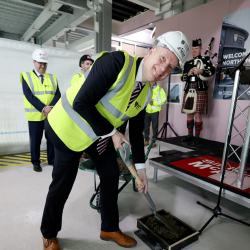
NESST topping out ceremony attendees receive traditional tankards to celebrate build milestone
Topping out ceremony marks pivotal moment for centre backed by £50 million investment set to…
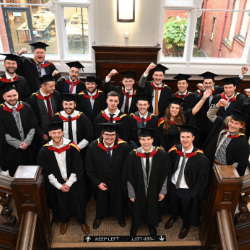
First cohort of Civil Engineering Degree Apprentices graduate from Northumbria
The inaugural cohort of Civil Engineering degree apprentices have graduated from Northumbria…
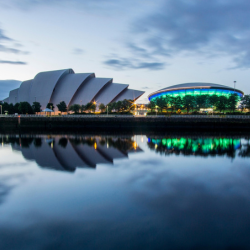
Space sector growth in the UK under spotlight at major industry event
The role the space sector is playing in driving economic growth in the UK was highlighted this…
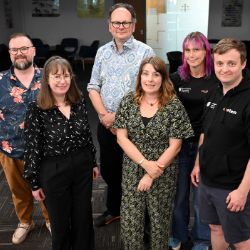
Northumbria University STEM outreach project wins Institute of Physics award
Researchers from an outreach group at Northumbria University are celebrating after winning…
Social
More events
Upcoming events

Christmas Market and Tree lighting
Northumbria University
-
Snowball 2026
Northumbria University
-

Northumbria University Carol Service 2026
Newcastle Cathedral
-
