
Tamsin Saxton, Senior Lecturer in Psychology at Northumbria, writes about attraction for The Conversation.
Have you ever thought there was an uncanny family resemblance between your friend and her partner? Or wondered for a fleeting moment whether the pair walking down the road were husband and wife, or brother and sister? You might not be imagining things. Animals of many species “learn” what a suitable mate looks like based on the appearance of their parents, and so, it seems, do humans.
Scientists have long known that species including birds, mammals and fish pick mates that look similar to their parents. This is known as positive sexual imprinting. For example, if a goat mother looks after a sheep baby, or a sheep mother looks after a goat baby, then those babies grow up to try to mate with the species of their foster mother, instead of their own.
It seems humans also “learn” from our parents in a similar way. When you ask people to judge the similarities between heterosexual couples and their parents from photos, a fascinating picture emerges. Women tend on average to pick partners whose faces look a bit like their fathers', while men often choose partners who slightly resemble their mothers. Resemblance doesn’t stop at faces – you can also see subtle similarities on average between partner and parent height, hair colour, eye colour, ethnicity and even the degree of body hair.
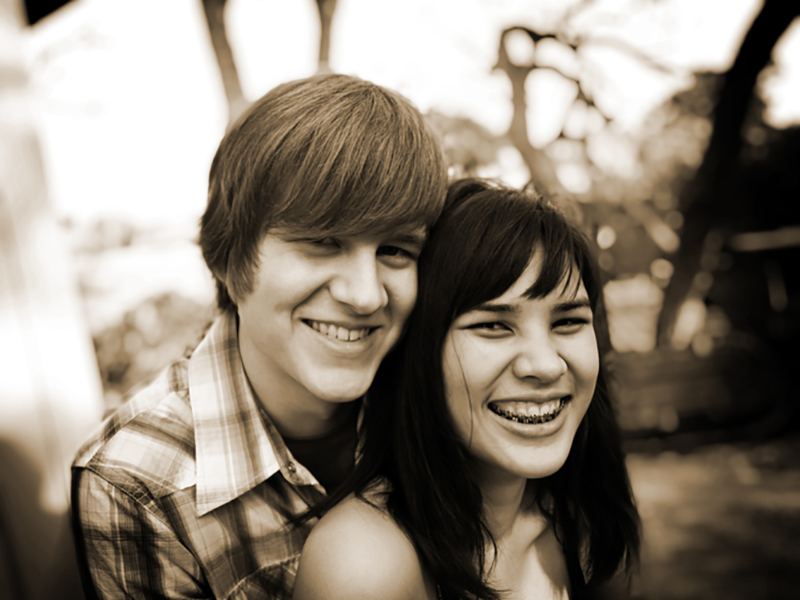
We also know that, in general, heterosexuals are more attracted to those who resemble their opposite-sex parent than their same-sex parent. What’s more, research has shown that it’s not merely appearance that matters: it’s also about your relationship with that parent. People who report more positive childhood relationships with a parent are more likely to be attracted to partners who resemble that parent.
Aversion versus attraction
This isn’t Freud’s Oedipus complex revisited. Freud believed that children have a suppressed desire for their parents. But this branch of research doesn’t in any way show that we secretly desire our parents, just that we simply tend to be attracted to people who resemble them to some extent.
If anything, we seem to find our immediate family members unattractive. For instance, people find the very idea of sexual relationships with their siblings deeply unappealing. This aversion seems to develop automatically through two distinct processes. One process turns off attraction to those that we spend a lot of time with during childhood. The other turns off attraction to any infants that our mother looks after a lot. Sexual aversion to siblings might be nature’s way of ensuring we don’t try to reproduce with someone who is too closely related to us and reproduction with close relatives is linked to an increased likelihood of genetic disorders in any resulting offspring. This aversion to close relatives is known as negative sexual imprinting. However, genetic sexual attraction can occur between siblings that have been separated and meet first as adults.

But when do we develop these preferences? Perhaps we learn that our parents looks are attractive early in life, and then tuck that learning away – only to let it reemerge when we’re ready for adult relationships. Or perhaps more recent experiences override earlier learning? To test this, I asked heterosexual adult women about their relationships with their parents at different ages during their development, and I assessed how much their current preferences matched up with the appearance of their parents.
I found that the women who reported a better relationship with their parents after puberty were more likely to be attracted to partners with similar eye colour to them. In contrast, if a woman was close to her parents earlier in life, she was actually less likely to prefer the eye colour of her parents in a partner. In science, we always like to see replications with different samples, methodologies and research groups before we generalise findings too much. So far though, the intriguing pattern of this early study suggests that there may be complex developmental patterns underlying how we construct our idea of an ideal partner. Perhaps we are seeing the actions of both positive and negative sexual imprinting at work.
But one question remains. If we’re finding preferences for parental resemblance across different populations, then what is the biological explanation for this behaviour? It turns out that coupling up with a distant family member seems to be the best bet, biologically, to produce a large number of healthy children. One possibility is that if you are attracted to people who look like your parents, then chances are you may get a crush on distant relatives. This might give you better chances of more healthy children, and so this behaviour persists.
Despite this research, if you were to tell me that your partner doesn’t look anything like your parents, then I wouldn’t be surprised. Parental resemblance probably isn’t at the top of anyone’s wish list. Like most people, you probably want a partner who is kind, intelligent and attractive. But if all else is equal, then that comfortable feeling of familiarity might be enough to get a relationship underway, or to maintain feelings of trust in a relationship.
This article was originally published on The Conversation. Read the original article.
Latest News and Features

UK network to accelerate the development of sustainable surface technologies
A new national network led by Newcastle University and Northumbria University, in partnership…

Criminologist wins acclaimed Philip Leverhulme Prize to pioneer a new criminology of the offshore world
A Northumbria University criminologist has been awarded a Philip Leverhulme Prize, one of the…

New platform maps charity support for the Armed Forces community
Pioneering data platform maps where the Armed Forces community receive support from charities

Northumbria co-leads study on fairer support for families
A major study co-led by Northumbria University will test whether attachment assessments lead…

New AHRC research shows how community innovation can power the next phase of devolution.
New research published today by the AHRC Creative Communities programme provides fresh evidence…

Free sessions to help families navigate the SEND system
Northumbria University's award-winning Student Law Office is launching SEND Decoded, a series…

New Doctoral Training Programme will tackle key polar science questions with a reduced carbon footprint
The Net Zero Polar Science (NZPS) Doctoral Training Programme (DTP) has welcomed its first…

New Student Health Hub brings joint health and wellbeing support
A new drop-in service is bringing health and wellbeing support for students at both Newcastle…
More events
Upcoming events

Next Stop Northumbria
Manchester Marriott Hotel Piccadilly
-

-
Magnetospheric Multiscale Science Working Team Meeting
Sutherland Building

Christmas Market and Tree lighting
Northumbria University
-
