
New research published in Nature provides evidence from Siberian caves on the essential role that summer sea ice in the Arctic Ocean plays in stabilising permafrost and its large store of carbon.
Permafrost is ground that remains frozen throughout the year and covers nearly a quarter of the Northern Hemisphere’s land. The frozen state of permafrost enables it to store large amounts of carbon; about twice as much as in the atmosphere. The rate and extent of future thawing of permafrost, and consequent release of its carbon, is hard to predict from modern observations alone.
However, a new study has discovered a crucial past relationship between summer sea ice in the Arctic and permafrost. This has significant implications for the future as observations show Arctic sea ice has decreased in recent years.
A team of international researchers, including Dr Sebastian Breitenbach from Northumbria’s Department of Geography and Environmental Sciences, have found that times when permafrost melted in the past did not simply match up with times when the Earth was at its warmest.
The new research relies on challenging fieldwork to discover and explore Siberian caves. Caves are a powerful recorder of periods when permafrost was absent in the past.
Why are caves important?
Stalagmites, stalactites and flowstones can only form when there is liquid water, and therefore do not form when overlying land is permanently frozen. The presence of stalagmites in caves under permafrosted land therefore demonstrates that there were periods when permafrost was absent in the past.
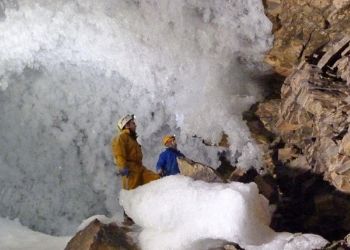
The researchers used new approaches to date the formation of stalagmites using the decay of natural uranium to lead. This allows them to assess the timing of periods when permafrost was absent over the last one and a half million years.
They found that stalagmites in Siberian caves grew intermittently from 1.5 million to 400,000 years before the present day and have not grown since, due to the overlying land being frozen.
The timing of stalagmite formation during the absence of permafrost does not relate simply to global temperatures in the past but was notably more common when the Arctic Ocean was free of summer sea-ice.
The researchers say that several processes may lead to the relationship between Arctic sea-ice and permafrost.
How does sea-ice affect permafrost?
The absence of sea ice leads to an increase in heat and moisture transfer from ocean to atmosphere, meaning warmer air is transported far overland into Siberia. Moisture transport also increases snowfall over Siberia during the autumn months. This blanket of snow insulates the ground from the extreme cold of winters leading to an increase in average annual ground temperatures which destabilises the permafrost.
Consequently, in regions with increased snow cover and insulation, permafrost will start to thaw, releasing carbon dioxide that was trapped for millenia.
Dr Breitenbach is a newly appointed Vice-Chancellor’s Senior Fellow who has worked with teams at the University of Oxford; Geological Survey of Israel and Russia’s Institute of the Earth’s Crust and Speleoclub Arabica on this study for more than a decade.
He has joined Northumbria to establish a new laboratory for geothermometry research which will use new techniques to estimate and reconstruct temperatures over the last million years. He said that the past relationship between summer sea ice in the Arctic and permafrost, discovered in this study, has implications for the future.
The future implications of these findings
“Significant decreases of Arctic sea ice have been observed in recent years, and the Arctic is expected to be free of summer sea ice in the coming decades,” he said. “Such loss of sea ice is likely to lead to an acceleration of thawing of permafrost in Siberia and to consequent release of carbon.”
Dr Breitenbach said the most striking thing about the findings was the complexity of how permafrost is affected.
“For me, the most important finding is the fact that it is not simply the temperature that affects permafrost. A warmer world does not immediately equate to less permafrost. It is actually a much more intricate process.
“This is very important for us as society because it means global warming acts not only in direct ways but in contingent ways that remind us of the Gaia hypothesis, the idea proposed by James Lovelock that everything is linked to everything. This is nature and it is beautiful, but also a stark reminder that we have to treat nature with great care.”
Gideon Henderson, Professor of Earth Sciences at the University of Oxford who co-authored the study, said: “This discovery about the past behaviour of permafrost suggests that the expected loss of Arctic sea ice in the future will accelerate the melting of the permafrost presently found across much of Siberia.”
Find out more
You can read the paper, titled Palaeoclimate evidence of vulnerable permafrost during times of low sea ice, in Nature.
Dr Breitenbach is a member of Northumbria’s renowned Cold and Palaeo-Environment group which carries out ground-breaking research in the areas of past climate and environment; and ice, snow and permafrost.
Geography At Northumbria University Encompasses All Of Our Work In Physical And Human Geography, Environmental Science And Management, Health & Safety, And Disaster Management.
This is the place to find all the latest news releases, feature articles, expert comment, and video and audio clips from Northumbria University
Geography At Northumbria University Encompasses All Of Our Work In Physical And Human Geography, Environmental Science And Management, Health & Safety, And Disaster Management.
This is the place to find all the latest news releases, feature articles, expert comment, and video and audio clips from Northumbria University
Latest News and Features

Researchers aim to grow optical fibres using biology instead of machinery
A new project led by Northumbria University aims to grow optical fibres using proteins, mimicking…

Training the next generation of space scientists
Northumbria University has hosted a major international workshop, bringing together leading…
.png?modified=20261006102851)
International design competition to grow the colour of the future
Researchers at Northumbria University and Imperial College London have launched an international…

Northumbria graduates celebrated at North East Business Awards
Graduate entrepreneurs from Northumbria University are celebrating after winning recognition…

How facial recognition failures harm people with facial differences
Researchers at Northumbria University's Centre for Responsible AI are working with Face Equality…

New Master Research Agreement strengthens commitment to cutting-edge research and innovation
Northumbria University and Lockheed Martin Space UK have signed a new Master Research Agreement,…

Speeding glaciers drive half a century of polar ice loss
The longest satellite record ever assembled shows that Greenland and Antarctica have lost 11.3…

Northumbria physicist elected Fellow of the Institute of Physics
Dr Juna Sathian, an Associate Professor at Northumbria University, has been elected a Fellow…
More events
Upcoming events

Next Stop Northumbria
Europa Hotel
-
The Past We Inherit. The Future We Build: Better Decisions Happen Together
The Great Hall, Sutherland Building
-
Next Stop Northumbria
Manchester Marriott Hotel Piccadilly
-
