
-
Study
-
Quick Links
- Open Days & Events
- Fixed Block Degrees
- Real-World Learning
- Unlock Your Potential
- Tuition Fees, Funding & Scholarships
- Discover The Bridge
- Clearing 2026
-
Undergraduate
- Application Guides
- UCAS Exhibitions
- Extended Degrees
- School & College Outreach
- Parents & Guardians
-
Postgraduate
- Application Guide
- Postgraduate Research Degrees
- Flexible Learning
- Change Direction
- Register your Interest
-
Student Life
- Students' Union
- The Hub - Student Blog
- Accommodation
- Northumbria Sport
- Support for Students
-
Learning Experience
- Real-World Learning
- Research-enriched learning
- Graduate Futures
- The Business Clinic
- Study Abroad
-
-
International
International
View our Global Footprint-
International Students
- Northumbria and your Country
- International Student Events
- Application Guide
- Entry Requirements and Education Country Agents
- Global Offices and Regional Teams
- English Requirements
- English Language Centre
- International student support
- Cost of Living
-
International Fees and Funding
- International Undergraduate Fees
- International Undergraduate Funding
- International Masters Fees
- International Masters Funding
- International Postgraduate Research Fees
- International Postgraduate Research Funding
- Useful Financial Information
-
International Partners
- Agent and Representatives Network
- Global Partnerships
- Global Community
-
International Mobility
- Study Abroad
- Information for Incoming Exchange Students
-
-
Business
Business
Northumbria University is proud to offer a range of Professional, Statutory and Regulatory Body (PSRB) approved & accredited courses and programmes. Explore our list of courses and programmes under our Education and Training page.
More on our Business Services-
Business Quick Links
- Contact Us
- Business Events
- Research and Consultancy
- Education and Training
- Workforce Development Courses
- Join our mailing list
-
-
Research
Research
Northumbria is a research-rich, business-focused, professional university with a global reputation for academic quality. We conduct ground-breaking research that is responsive to the science & technology, health & well being, economic and social and arts & cultural needs for the communities
Discover more about our Research-
Quick Links
- Research Peaks of Excellence
- Academic Departments
- Research Staff
- Postgraduate Research Studentships
- Research Events
-
Research at Northumbria
- Interdisciplinary Research Themes
- Research Impact
- REF
- Partners and Collaborators
-
Support for Researchers
- Research and Innovation Services Staff
- Researcher Development and Training
- Ethics, Integrity, and Trusted Research
- University Library
- Vice Chancellors Fellows
-
Research Degrees
- Postgraduate Research Overview
- Doctoral Training Partnerships and Centres
- Academic Departments
-
Research Culture
- Research Culture
- Research Culture Action Plan
- Concordats and Commitments
-
-
About Us
-
About Northumbria
- Our Strategy
- Our Staff
- Our Schools
- Place and Partnerships
- Leadership & Governance
- University Services
- Northumbria History
- Contact us
- Online Shop
-
-
Alumni
Alumni
Northumbria University is renowned for the calibre of its business-ready graduates. Our alumni network has over 253,000 graduates based in 178 countries worldwide in a range of sectors, our alumni are making a real impact on the world.
Our Alumni - Work For Us
Supporting a diverse future for engineering
Northumbria University’s NUSTEM initiative is supporting global engineering companies, including Airbus, BP and Nissan, to develop the engineering workforce of the future by engaging more effectively with young people from diverse backgrounds.
Established in 2014, NUSTEM has worked with more than 115,000 young people along with their families and teachers, encouraging them to consider careers in Science, Technology, Engineering or Maths (STEM).
With significant expertise in this field, NUSTEM has worked with Engineering UK to support the launch of its Tomorrow’s Engineers Code, which aims to increase the diversity and number of young people entering engineering careers.
Organisations signing up to The Code agree to four pledges about their approach to funding, designing, delivering, and learning from engineering-inspiration activities.
To support signatories in implementing each of the pledges, NUSTEM has developed an evidence-based, practical guide, including short, medium and long-term suggestions and activities, applicable to engineering companies of all sizes.
Dr Carol Davenport is Director of NUSTEM and sits on the advisory board of the Tomorrow’s Engineers Code. Speaking about the project she said: “It is recognised right across the engineering sector that we all need to do more to encourage young people to consider a career in STEM, and to encourage greater workforce diversity. The Code promotes collaboration between engineering organisations to achieve this shared goal.
“The role of NUSTEM has been to take our seven years of experience in public engagement in this field and distil that down to develop a practical guide that companies can use to help them make changes to their business which will have a lasting impact.
“It is recognised that the issue of diversity in engineering can’t be solved by one organisation alone, but thanks to Engineering UK, the Tomorrow’s Engineers Code means we are now all working together, sharing ideas, with clear vision of how to achieve our aim.”
Launched last October, the Tomorrow’s Engineers Code already has support from over 120 organisations, including engineering companies such as Toyota and Siemens, as well as universities, and institutions such as the Royal Academy of Engineering, Ministry of Defence, Institute of Mechanical Engineers and Institute of Physics.
The four pledges within the Tomorrow’s Engineers Code are:
- Ensuring public engagement and learning programmes contribute to a sustained and rich STEM journey for all young people.
- Ensuring all young people have opportunities to engage in engineering-inspiration activities, so that no one is left behind.
- Promoting a positive, compelling and authentic view of engineering, and showcasing the breadth of opportunities.
- Improving the monitoring and evaluation of programmes and activities to develop a shared understanding of what works.
For each of the four, NUSTEM has provided examples of work which could be carried out to achieve the pledge, as well as real-life examples from NUSTEM’s work with young people in the North East of England.
The recommendations include a strong focus on working with children from young age, engaging with their families and teachers, and ensuring activities are accessible to families without a science background.
As Dr Davenport explains: “One way to increase the diversity of an organisation is to encourage young people from traditionally under-represented areas. However, research shows that children make gendered and career limiting choices before the age of eight. If engagement work is to eventually increase the number of people entering STEM employment, we must therefore work with, and understand the needs of, younger children.
“Children are heavily influenced in their career choices by those around them – their families, communities and teachers. Not only is it important to include these influencers in STEM engagement activities, but it’s also more effective.
“Increasing the diversity and number of young people who want to work in STEM is a very complex problem comprising multiple societal and economic challenges. Employers must collaborate to forge a sector which is truly welcoming to people from diverse backgrounds. Doing so will require that, together, we improve the quality, focus and effectiveness of our STEM engagement activities.”
Department of Mathematics, Physics and Electrical Engineering
This department encompasses all of our work in Mathematics, Statistics and Physics including Astrophysics, Electrical and Electronic Engineering, Energy, Smart Materials, Microelectronics and Communications.
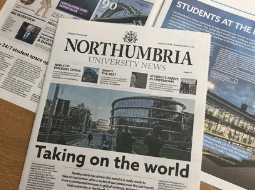
This is the place to find all the latest news releases, feature articles, expert comment, and video and audio clips from Northumbria University

Northumbria has submitted 1096 staff across thirteen Units of Assessment (UoA) to the Research Excellence Framework (REF) 2021. This submission reflects our research across four Faculties and nineteen Departments, incorporating traditional disciplines, such as English and Engineering, modern disciplines, such as Business and Design, and professional disciplines, such as Architecture and Nursing.
Latest News and Features
Record year for Northumbria as three academics named National Teaching Fellows
Three Northumbria University academics from across education, sport and the built environment…
Northumbria designers recognised at UK's biggest graduate showcase
Innovative designers and makers from Northumbria University have won a string of awards and…
Building bridges between science and Westminster: a Northumbria researcher's view from Parliament
The impact of research and technical expertise at Northumbria University has been highlighted…
Rare Norman Cornish painting donated to Northumbria University
A rare early painting by celebrated North East artist Norman Cornish has been donated to Northumbria…
Northumbria brings Westminster together to confront the nationwide opportunity gap
Northumbria University convened parliamentarians, policymakers, employers and sector leaders…
Students support growth of County Durham community hub
Students from Northumbria University’s Business Clinic are helping a County Durham church to…
Northumbria researcher takes Indian cinema legend to major international showcases
A Northumbria University academic curated a major retrospective of one of India's most influential…
New partnership will bridge the gap and open doors for adult learners at Northumbria University
Northumbria University is launching The Bridge, a flexible route into higher education for…
Upcoming events
NU-NHSA Launch Event
Northumbria University
-