Business and Analytics (Extended Degree) BSc (Hons)
 Option for Placement Year
Option for Study Abroad

Option for Placement Year
Option for Study Abroad

Data analysts are curious. When presented with information they think critically, extensively explore all possibilities, and offer human interpretation alongside automated analytics.
Our Business and Analytics BSc (Hons) course provides you with the opportunity and skills to explore these techniques, identifying patterns, interpreting trends and ultimately informing business development and decision making.
You will learn in a diverse environment, building cultural and ethical awareness, important in the field of analytics where issues such as data privacy are vital.
Supplemented with broad business modules, you will gain interdisciplinary skills which will help you interpret data within a range of business contexts – from marketing to finance. This double-sided approach is valuable for tasks which you may encounter during employment; for example, forecasting sales when entering new global markets or assessing brand performance online to help inform digital marketing strategies. Having this knowledge of business and analytics together will ultimately help you stand out in your future career.
You’ll be introduced to broad business principles, shared with other students across the business school. Then, your focus turns to analytical skills where you explore modules such as Tools and Techniques for Data Analytics, Business Intelligence and Information Systems, Predictive Analytics, and Analytics and Visualization for Management.
You’ll learn through a variety of teaching methods including lectures, seminars, problem-based workshops, webinars, case discussions, practical activities, group work and tutorials. To help you develop your independent learning skills, you’ll also complete directed tasks – assignments you undertake in your own time.
We back up all our teaching with well-designed support systems to help you get the most from your opportunities. And we make sure that we build extensive feedback, from both tutors and peers, into the course. Throughout your studies, you’ll be able to discuss any academic or personal issues with your Personal Tutor.
Assessments involve applying business principles to solve problems and then demonstrating your thinking through reports, presentations, portfolios and more. In the final year, you’ll complete an assessed dissertation, management enquiry or consultancy project. After this course you can look into one of our postgraduate courses such as our Business Analytics MSc
With employability at its heart, this research-informed degree provides you with the skills to enter an industry where Business Analysts are in high demand. Developing technical skills in areas such as data visualisation, forecasting and project management, you will be well equipped to be successful in your career.
Alongside this, you will learn skills which will be transferable to any career path. For example, you’ll learn how to communicate analytics in an accessible manner, work in teams, and present findings.
You will also have multiple opportunities to apply your knowledge to organisational contexts as you are tasked with offering creative solutions to real-world business problems. In your final year, you may also work on a Business Consultancy project, whereby you help real business solve real problems through our Business Clinic.
After this course you can look into one of our postgraduate courses such as our Business Analytics MSc or check out all of our available Business Courses.
See other similar courses you may be interested in: Business and Marketing BA
This extended degree provides an alternative route to higher education and supports those who don’t meet the standard entry requirements for an undergraduate degree. It includes a foundation year that gives you the chance to establish a strong academic foundation while exploring a wide range business issues, ranging from strategy and marketing to entrepreneurship and responsible management.
This first year of this course will introduce you to the key concepts of human resource and marketing management and the concept of strategic and contemporary management. It will provide you with a broad context of knowledge and development of the essential skills required for industry. You will then learn how to apply key theoretical themes in an end of year project.
The foundation year of the course delivered at level 3 which develops your ability to study in Higher Education is not accredited. Subsequent levels and years are accredited and deliver the knowledge, competencies, and skills required to meet the specific course accreditation requirements that relate to the approved accredited award title.
UCAS Code
Z021
Level of Study
Undergraduate
Mode of Study
4 years Full Time or 5 years with a placement (sandwich)/study abroad
School
Newcastle Business School
Location
City Campus, Northumbria University
City
Newcastle
Start
September 2027
Fees
Fee Information
Modules
Module Information
At NBS we’re Business, but not as usual. Discover more.
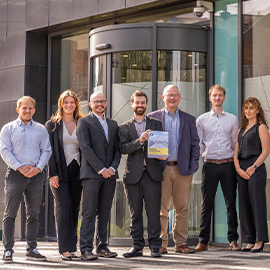
Students gain invaluable work experience with EY Newcastle, helping to drive apprentice recruitment
Read More
Northumbria business students develop branding strategy for OddBalls Apparel.
Read the news story.
Team Northumbria Wins the 12th Greggs Marketing Challenge.
Read the news story.
Northumbria named as a Principles for Responsible Management Education Champion.
Read the news story.
Entrepreneurial student launches marine-based skincare products.
Read the news story.Highly acclaimed by clients as successful, as students get to the root of the problem, and results in a detailed report and presentation of their recommendations.
You will learn from the best inspirational academic staff with a genuine passion for their subject.

Dr Colin Richardson

Prof. Dilek Onkal
Professor of Business Information Systems and Analytics and Head of the Analytics Subject Group.
Read More
Dr Sinan Donul
Newcastle Business School delivers first class teaching in a world class environment.
At the heart of each Northumbria campus, our libraries provide a range of study space and technology to suit every learning style.
Standard Offer 72 UCAS Tariff Points
From a combination of acceptable Level 3 qualifications which may include: A-level, T Level, BTEC Diplomas/Extended Diplomas, Scottish and Irish Highers, Access to HE Diplomas, or the International Baccalaureate.
Find out how many points your qualifications are worth by using the UCAS Tariff calculator: www.ucas.com/ucas/tariff-calculator
Contextual Admissions 56 UCAS Tariff points
Northumbria University is committed to supporting all individuals to achieve their ambitions and we understand that every applicant’s circumstances can be different, which is why we take a flexible approach and assess your individual circumstances and potential when reviewing your application.
To find out more, review our Northumbria Entry Requirement Essential Information page for further details www.northumbria.ac.uk/entryrequirementsinfo
GCSE Requirements:
Applicants will need Maths, Statistics, or Physics and English Language at minimum grade 4/C, or equivalents.
International Qualifications:
We welcome applicants with a range of qualifications which may not match those shown above.
If you have qualifications from outside the UK, find out what you need by visiting www.northumbria.ac.uk/yourcountry
English Language Requirements:
International applicants should have a minimum overall IELTS (Academic) score of 6.0 with 5.5 in each component (or an approved equivalent*).
*The university accepts a large number of UK and International Qualifications in place of IELTS. You can find details of acceptable tests and the required grades in our English Language section: www.northumbria.ac.uk/englishqualifications
UK Fee in Year 1: £5,760
The UK tuition fee for 27/28 is £10,050 and is set in line with the UK Government's tuition fee cap. The University may increase this fee in subsequent years in line with any changes to the tuition fee cap. Students will be notified of any increase ahead of it taking effect. The remaining fees for 27/28 are to be confirmed and relate to the International Soccer Academy and accommodation fees. Accommodation fees may increase in subsequent years. Students will be notified of any increase ahead of the re-issuing of tenancy agreements. The University may increase tuition fees in the second and subsequent years of your course at our discretion in line with any inflationary or other uplift, as decided by the UK Government, up to the maximum amount for fees permitted by UK law or regulation for that academic year. To give students an indication of the likely scale of any future increase, the UK government has suggested that increases may be linked to RPIX (Retail Price Index excluding mortgage interest payments). If the University intends to exercise this right to increase tuition fees, notification will be communicated with all students affected by the end of June in the academic year before the one in which we intend to exercise that right. Student fee loans have risen in line with the level of uplift decided by the UK Government. Extended Degrees: Students will pay the applicable Foundation Year fee in Year 0. Tuition fees will follow the Year 1 (Level 4) cap in the first year of Undergraduate study, with tuition fees in subsequent years increasing as per the above information. * Fees subject to annual increases over the course of the period of study. Students will be liable for payment of any/all tuition fees which are not sponsored by their employer or other third party.
International Fee in Year 1:
This is the tuition fee for your first year of study. You should expect to pay tuition fees for every year of study. The University may increase fees in the second and subsequent years of your course at our discretion in line with any inflationary or other uplift. Students will be notified of any increase ahead of it taking effect.
Tuition fees in the academic year 2027/28* will be £10,050. Fees are set in line with the UK Government's tuition fee cap. The University may increase fees in subsequent years in line with any changes to the tuition fee cap. Increases will be linked to inflation. For example, increases may be linked to RPIX (Retail Price Index excluding mortgage interest payments) Students will be notified of any increase ahead of it taking effect. Student fee loans rise in line with the tuition fees cap.
This is the programme fee for your first year of study. The programme fee includes the international tuition fee, International Soccer Academy and accommodation fees. Accommodation fees may increase in subsequent years. Students will be notified of any increase ahead of the re-issuing of tenancy agreements.
ADDITIONAL COSTS
"There are various books that are recommended for purchase throughout the duration of this course, with costs being approximately £200. A number of these books will also be available in the library, in either hard and/or electronic format. "
* At Northumbria we are strongly committed to protecting the privacy of personal data. To view the University’s Privacy Notice please click here
Module information is indicative and is reviewed annually therefore may be subject to change. Applicants will be informed if there are any changes.
NX9308 -
Professional Development for Responsible Management Practice (Core,20 Credits)
Your learning is achieved via a combination of weekly workshops, seminars and fortnightly group and/or individual tutorials. The aim of all sessions is to create a friendly, interactive and inclusive learning environment. Indicative topics include (but are not limited to):
• Researching and referencing reliable sources of information
• How to thinking critically and analytically
• Time management for professional development
• Presentation skills – visual, verbal and written
• Team work – how to work with and influence others
• Professional skills in business leadership and management
• Introduction to Emotional Intelligence
• Introduction to Career Planning
NX9309 -
Business Environment and Functions (Core,20 Credits)
How are business organisation organised in order to deliver on their strategic mission and prosper in an increasingly competitive globalised environment? This module is designed to develop your understanding of business practice and the key strategic concerns of senior managers. In doing, this module will provide through the exploration of the functions of a business, the foundation for your later career as a manager.
Contemporary business operations are dependent on the efficient and effective application of certain key functions, namely Strategy, Marketing, and Human Resource Management. You will explore how each contributes to organisational performance, as well as how these all are inter-related and mutually dependent. In your study of Strategy, you will explore the idea of strategic positioning and choice, which is so important for businesses in setting out their intended direction of travel. In your study of Human Resource and Management you will think about what human capital means and what are competencies. In your exploration of marketing, you will consider how businesses engage in market segmentation and promotional strategies. These activities may appear very different but in reality, these all contribute to the business as a whole.
In this module you will be assessed by the submission of Professional Report. You will be guided on how to construct the report in lectures and seminars.
NX9310 -
Business Information Management (Core,20 Credits)
In this module, you will learn about the practical challenges faced by organisations in creating business information and communicating this information in an understandable way. You will learn about business data, its key sources and how this can be created for specific project purposes through survey design and associated data collection. You will learn how to undertake primary data collection in an ethically appropriate way and how to handle, prepare and analyse your data using analytical tools e.g. Excel. The importance of communication to your business audience is reinforced through verbal and written presentation of your study findings.
Within this module, you will cover the following topics:
• Introduction to Business Information.
• Data and Information Management: sources; types; storage; accessibility.
• Data Collection: survey design and distribution, taking account of the different types of data we might want to collect.
• Ethical aspects of data collection.
• Data Preparation - extracting and importing data to analytical tools e.g. Excel; preparing data for analysis.
• Data Analysis and Presentation with analytical tools: converting data into business information and intelligence.
• Communicating the Information and Intelligence – using reports and presentations.
As an integral part of your learning, you will use “real” data, which you will subsequently learn to manage, prepare and analyse. You will learn how to present your work in verbal and written formats, leading to the development of a 2,000 word individual report for your summative assessment.
NX9311 -
Entrepreneurship and Innovation (Core,20 Credits)
This module examines how our business organisations are organised in order to deliver on their strategic mission in an increasingly competitive globalised environment. This module is designed to develop your understanding of business practice and the key strategic concerns of senior managers. This module will provide, through the exploration of the functions of a business, the foundation for your later career as a manager.
In this module you will be assessed by a Project that involves a presentation and a project whilst working in a team. You will be guided on how to approach this examination in lectures and seminars.
NX9312 -
Introduction to Responsible Business (Core,20 Credits)
Your learning is achieved via a series of coherent lectures & seminars. The aim is to create a friendly, highly interactive and inclusive learning environment including a range of diverse learning activities. Indicative topics include (but are not limited to):
• Sustainability Literacy
• Global Environmental Issues
• Sustainable Development Goals
• Business and Society
• Contemporary Business Issues
• Introduction to Business Ethics
• Responsible Business Models
• Sustainable Business Theories
• Sustainable Business Innovation
In addition to knowledge generation this approach will enable you to further develop transferable skills essential for success at both university and in the world of work: personal confidence, teamwork & collaboration, self-management and independent learning. You will be assessed through a combination of debates/presentations and coursework, which will equip you with the transferable skills required for your programme and future employment. Above all, this module will stimulate your curiosity as to how business can be a force for good in making the world a better place.
NX9313 -
Leadership and Management in Professional Practice Project (Core,20 Credits)
How are businesses organised and who is responsible for this? How do both leaders and managers contribute in their own way to the collective performance of a business organisation?
In particular, the functions of management are to: Set objectives/targets for individuals, teams and larger work units; make day-to-day decisions, especially in relation to staff recruitment, costing projects and budgeting for the future; reviewing individual and collective performance and planning for the future.
For leaders, you will explore how their role is primarily concerned with changing the emotional state of colleagues through inspiration, concern and authentic commitment. You will also consider how poor leadership is manifested and study examples of how poor leadership impacts on others and the wider organisation. You will gain an understanding of differing views of leadership and what models (Transactional; Transformational, Authentic, Distributed) have been put forward to explain its practice in the real world.
As a result of studying this module, you will have a foundation for later study in your undergraduate degree and understand the benefits of effective leadership and management for business organisations.
AF4038 -
Financial Decision Making (Core,20 Credits)
You will learn how financial information can be used to assist managers and external user groups in their decision-making processes. You will initially look at the informational needs of outside user groups, the nature of the information they are provided with, and how this information can be analysed and interpreted in order to enhance the effectiveness of their decision making.
Topic areas will include:
• The reporting frameworks and ethical principles that underpin financial reporting
• The nature of international financial reporting standards
• Format and content of the statement of profit or loss and statement of financial position
• The statement of cash flows
• Analysis and interpretation of financial statements using ratio analysis
You will then examine how financial information can facilitate managers in making operational decisions in relation to planning and control.
Topic areas will include:
• Costing (full and variable costing)
• Cost, volume, profit analysis
• Relevant costs for decision making
• Budgeting and variance analysis
• Balance scorecards
• Working capital management
Finally, you will explore the motivations for entrepreneurial activity and techniques that can be used to appraise investment decisions.
Topic areas will include:
• Investment appraisal techniques (payback, accounting rate of return, net present value and internal rate of return)
• Practical aspects of investment appraisal (inflation and capital rationing)
• Risk and uncertainty
BM9403 -
Business Analysis for Decision Making (Core,20 Credits)
In this module, you will develop the knowledge and skills in applying a variety of quantitative data analysis techniques to support business decision making. You will be introduced to business modelling using appropriate analytical tools, and your learning will cover a range of techniques to help business forecasting and data presentation.
In this module you will be exposed to a range of data analysis tools and skills, including:
• Business Analysis and Modelling: management of complex and varied data sets; building spreadsheet models.
• Data Trends and Associations e.g. identifying relationships between business variables.
• Business Forecasting and Predictive Modelling – analysing factors and trends for business planning.
• Business and Dashboard reporting – consolidation, interpretation and presentation of data for professional output.
• Data distribution, data presentation and using summary statistics – handling a range of data for statistical analysis.
• Gaining an understanding of the overlap between business and research data and the selection of appropriate tools for management of both types of data.
Working with these analysis tools, you will learn to develop confidence in dealing with a wide range of data sets. You will become familiar with the role of modelling as an aid to problem solving and will build skills which enable you to interpret data and present your findings to a range of audiences. Very importantly, you will gain a good understanding of the crucial role that analysis of data and interpretation of results plays in the decision-making arena.
BM9404 -
Analytics Study and Consultancy Skills (Core,20 Credits)
As part of your business analytics education, it is vital you develop competencies such as business analytical skills, interpersonal skills, creative thinking, problem solving, communication and time management. This module will prepare you for your degree and the graduate marketplace by equipping you with the skills required to tackle a wide range of business challenges, and to appreciate how information/data can guide decision making.
This hands-on module will provide you with an introduction to experiential learning, where you create knowledge through experience. You will work on live business projects and collaborate in teams to develop solutions to real business problems. A core part of this process is reflection: appreciating your own skills, how they complement those of other group members and identifying areas for your own future development.
This module will complement ‘Business Analysis for Decision Making’, where you will be focused on learning the core principles of business analysis. In this module you will apply these principles to business cases and whilst developing research, communication and consultancy skills that are crucial to your future analytics modules. The module will also provide you with an introduction to prescriptive statistics, which can be used by organisations to predict the outcomes of future business decisions.
HR9409 -
Preparing for Professional Practice (Core,20 Credits)
Your programme aims to ensure that you are learners for business, not just of business, upon graduation. This module starts you on this journey by supporting your professional development. It aims to increase your awareness of and sensitivity to personal and employability/entrepreneurship/enterprise skills. It does this by focusing on programme-specific graduate career opportunities that require you to work on projects similar to those that graduates within your field will undertake once in employment. You are taking an experiential, team-focussed, project/problem-based approach. The module will support you in identifying and developing the essential skills, behaviours, and understanding required to sustainably and responsibly manage organisations and their people. These might include generic areas such as leadership, project management, management, resilience, empathy and professional judgment, and discipline-specific capabilities.
You will use this understanding to evaluate, practise, develop and re-evaluate your capabilities in these skills, behaviours and acumen areas, enabling you to build your own graduate identity. This approach underpins your successful future employability, entrepreneurship or enterprise activity. In addition, the activities provide you with authentic insights into the importance and challenges of team-working within organisations as you work to address real organisations’ issues.
Learner/team-led, tutor-guided sessions aim to support you in enhancing your employability and upon building your graduate identity. During the practical development of the key attributes and behaviours central to your future success within your chosen profession within a project-based environment, you will receive support from the programme team. In addition, by documenting and reflecting upon your progress towards achieving your own team defined KPIs, you will enhance your skills, behaviours, capabilities, and understanding.
In short, at the end of this module, you will:
• Have an understanding and increased awareness of, and sensitivity to, those personal skills and attributes which are central to your future employability in your chosen profession or future entrepreneurial or enterprise activity
• Be better prepared to understand the skills and qualities required by graduates in your field to secure future employment or engage in enterprise activity
Have practical experience of working on a real-life business project appropriate to your programme area, improving your project management, research, employability and collaboration skills
HR9412 -
Business, Economy and Society (Core,20 Credits)
Governments and society are increasingly expecting business organisations to step up and assist in building cohesive societies through the application of more sustainable forms of capitalism. This module introduces you to the global economic, societal, technological and environmental challenges of the 21st century, and identifies how, through greater alignment of business interest with that of society and the economy, business can be a “force for good” as well as best prepared to ‘Take on Tomorrow’. You will focus on how contemporary businesses, broadly defined to include public, voluntary, not-for-profit and social enterprise, interact the economy and society though examination of topical news stories and events. In doing so, you will develop a deep understanding of the relationships between business, the economy and society and the global challenges we all face. You will explore a range of cultural, governmental and ethical issues that arise from current and developing global and national contexts through the lens of the Sustainable Development Goals (SDGs). Key issues include business ethics, the role of business in society, green issues, stakeholder theory, capitalist variants, the nature of globalisation at firm, economic and societal level and the interrelationship between business and government. By the end of the module you will be able to evidence critical thinking and analysis skills while bringing your own experiences as a citizen into your discussion and inquiry.
More informationMK9414 -
Introduction to Marketing (Core,20 Credits)
This module will introduce you to the business philosophy and practice of marketing. It will examine how organisations can analyse and segment markets to improve performance and profitability by building long-term relationships with their customers. A wide range of marketing decisions is studied together with the influence of the changing marketing environment on these decisions.
Main lectures will introduce the basic theories of marketing:
• The Marketing Environment
• Consumer & Organisational Behaviour
• Target Marketing & Segmentation.
• Marketing Information Systems & Research.
• Dimensions of a Product, Branding and Product Life Cycle.
• Pricing Theory; strategies and tactics.
• The Promotional Mix: Advertising, PR, Direct & e-Marketing.
• Marketing channels
Whilst seminars and topical lectures will apply marketing theory to different case scenarios:
• Service Marketing
• Not for profit Marketing
• Food marketing
• Digital Marketing
• Environmental Marketing
• Sustainable Marketing
SC5000 -
Skills for Academic Success in a UK University (Core – for International and EU students only,0 Credits)
You will develop your understanding of academic conventions in UK higher education aligned to your level of study, including expectations around critical analysis, structure, argumentation, evidencing, and referencing. The module focuses on developing communication strategies that will help you express your ideas clearly and coherently in written assignments and spoken activities. You will also reflect on your current academic and language skills and develop strategies for development ahead of your assessments.
More informationBM9501 -
Business Research and Analysis (Core,20 Credits)
In this module you will experience a comprehensive coverage of research methods and analysis that will prepare you both for work placement or study abroad opportunities alongside preparation for your final-year “capstone” research module of either Dissertation, Management Enquiry or Consultancy Project.
You will learn how to develop a research question, and linked to this, be able to choose an appropriate method of research, dovetailing both learning experiences to the development of a critical assessment of the academic literature. You will gain a basic understanding of research philosophy, whilst the coverage and importance given to research ethics will play an important part of your learning within the module and you will appreciate as part of your learning how this underpins research of quality and integrity. The role of Ethics in research will cover study design, participant selection, data collection, data handling and storage and presentation of research findings.
You will learn how to apply quantitative and qualitative methods. In the quantitative applications, you will learn about questionnaire design, sampling, presenting and summarising data, statistical inference and hypothesis testing. You will have the opportunity to use a range of appropriate software tools, such as SPSS (or an equivalent). You learn to as well appreciate the importance of survey and questionnaire piloting. In the qualitative part of the module, techniques covered will include interviewing, focus groups and visual methods to generate data, supported by appropriate analysis methods. You will learn how to execute a critical and effective analysis of your research data for both approaches,
BM9502 -
Tools and Techniques for Data Analytics (Core,20 Credits)
In this module, you will learn about how to use the fundamental statistical tools and techniques for data analytics. You will learn the necessary skills to make sure that processes run efficiently, particularly with the application of these data analytical tools in real business cases by taking into consideration all the face of opportunities and challenges arising from the worldwide reach of the business. You will gain the basic and essential knowledge in addition to practical analytical skills to think as a professional business analyst, project manager, operations analyst, digital analytics specialist or data analytics consultant in a globalised digital environment. Moreover, you will discover the basic analytical thinking of data analysis in business and put your learning into practice by applying it to real case studies which will help you to gain experience with the recent issues in business and the digital market. Data analytics tools and techniques work hand-in-hand as analytics transforms data into insights that guide intelligent business decisions. You will learn how to extract useful information from data analysis as well as data preparation, data organization, statistical analysis and other advanced analytics tools by using specialized software. This course will help you in understanding business data analysis and developing your data analysis skills while equipping you with a necessary toolbox to work in organisations and help them to achieve their digital transformation goals.
More informationBM9503 -
Business Intelligence and Information Systems (Core,20 Credits)
In this module, you will develop the knowledge and skills required for applying a variety of business intelligence techniques, and a familiarity with business intelligence software systems used to support data-driven decision-making process. Business Intelligence is invaluable in allowing businesses to make informed, trusted decisions based on reliable data. You will be introduced to the broader suite of business systems currently utilised throughout industry to enable you to understand their purpose.
In this module you will be provided with:
• An introduction to different types of data and information (specifically the distinction between structured and unstructured data)
• An ability to identify different types of business systems across industry sectors and justify their usage.
• An overview of BI tools and their purpose in support data-driven decision making
• Experience in producing a BI Digital Dashboard (using Power BI) and presenting your findings to an audience
Working with these tools, you will learn to develop confidence in dealing with a wide range of data sets, become aware of the different types of data and how this impacts your choice of system. You will become familiar with visualisation techniques to aid in the analysis of the underlying data, thus helping businesses understand complex issues in a simplified manner.
HR9516 -
Human Resource Management Essentials (Core,20 Credits)
Designed specifically for non-Human Resources specialists the HRM Essentials module will take you on a journey through the modern organisation offering you the opportunity to understand how Human Resource Management contributes to the strategic direction of organisations in varying industries and sectors. Building on the level 4 module ‘People, Management and Organisations’, this module is relevant to all those whose careers will involve dealing with and managing people in organisations. Managers are often considered the key link in ensuring the successful implementation of HR processes, and likewise, the support of the HR function is required to ensure that managers operate fairly and consistently within best practice guidelines. Managers are likely to play a key part in several core HR processes in order to ensure that they have the right people in their teams who are able to perform effectively. Thereby an understanding of Human Resources underpins effective management practice. ‘HRM Essentials’ provides a practical overview of each of these core areas, providing a broad grounding in HR practice ranging from recruitment and selection to performance and reward, and learning and development to absence and wellbeing.
This module will not only provide you with the key theoretical arguments in Human Resource Management but will also encourage you to apply this learning to practice and reflect on your own personal skill development in implementing effective HR processes which will be invaluable to you in your future graduate management role.
MK9525 -
Digital Business: Models, Marketing and Operations (Core,20 Credits)
Throughout this module you will be introduced to the opportunities and challenges posed by doing business in an increasingly digital domain. This module is designed to give you an understanding of how using online channels impacts upon different parts of the organisation, and will focus upon 3 core areas of business:
• Digital Business Models: You will develop an understanding of the cost structures associated with using digital channels and different business models (including omnichannel business strategies)
• Digital Marketing: In this part of the module you will consider how consumer behaviour has changed in the digital era, and evaluate the ever-increasing range of digital tools available for marketers online. This will include understanding Google search rankings, social media and mobile marketing.
• Supply Chain Management and Information Systems: You will also develop an appreciation of the role of supply chains in serving global markets, addressing issues such as the application of various systems to facilitate digital transactions (e.g. ERP, CRM) and issues related to web performance.
You will be encouraged to think about digital business as a cross-disciplinary issue that requires the buy-in and contribution of various business functions to truly succeed.
MO9528 -
Applied Logistics and Supply Chain Management (Core,20 Credits)
You will learn the key theories and principles of logistics and supply chain management and the knowledge and skills of applying these in real business practices. The module is delivered to you using weekly lectures and seminars, the seminars principally concentrate on the development of your discipline-specific problem solving skills and associated “soft skills”, e.g. communication and presentation competencies.
Within this module, you will cover the following main topics:
• Logistics in manufacturing and service
• SCOR model
• Order management
• Demand management
• Inventory management
• Distribution strategy
• Sourcing management
• Supply chain coordination
• Supply chain network design
• Transportation management
• Global supply chain management
• The future of supply chain management
The module will lead you to the development of supply chain management competencies and confidence in handling complex problems relating to logistics, supply chain and their inter-relationship. In doing so, it will expose you to a wide range of quantitative or qualitative models and techniques that support the analysis relating these problems. You will therefore become knowledgeable about the theory and practice of logistics and supply chain management and skilful in the use of various related tools and techniques.
On completing the module, you will be able to apply the theories and principles to analyse logistics and supply chain problems in a variety of business applications. You will be capable of identifying the root causes of various supply chain problems and be capable of proposing relevant solutions.
NX9527 -
Newcastle Business School Study Abroad Semester (Optional,60 Credits)
The Study Abroad Semester module is a semester long 60 credit module which is available on degree courses which include the option to study abroad in Semester 2 of Year 2. You will undertake a semester abroad at a partner university equivalent to 60 UK credits.
The study abroad placement is an important element of your course structure and gives you access to modules from your discipline taught in a different learning culture and so broadens your overall experience of learning.
When taken and passed the study abroad semester will be recognised in your transcript as a 60 credit Study Abroad Module. The learning and teaching on your study abroad placement will be dependent on the partner and will be recorded in the learning agreement signed by you, the host University, and the University.
NX9525 -
Newcastle Business School Work Placement Year (Optional,120 Credits)
The Work Placement Year module is a full year 120 credit module available on degree courses which include a work placement year which is taken as an additional year of study between levels 5 and 6. The placement consists of 48 weeks of full time work experience in a host organisation which is relevant to your studies.
The placement is an important element of your course structure and it will provide you with the opportunity to:
• Experience the environment of a real workplace which will help you decide the type of career you would like to follow after graduation
• Develop your organisational and interpersonal skills required to enable you to work efficiently as a member of a team
• Acquire and develop relevant technical skills associated with the nature of your work
• Identify, analyse and discuss with experienced practitioners how theoretical concepts are adapted and applied to suit practical requirements
• Apply knowledge that will help you to plan and evaluate future study and career development.
This is a Pass/Fail module and so does not contribute to your degree classification. When taken and passed, however, the Placement Year is recognised in your transcript as a 120 credit Work Placement Module and on your degree certificate in the format “Degree title (with Work Placement Year)”. The learning and teaching on your placement will be recorded in the training agreement signed by you, the placement provider, and the University.
NX9526 -
Newcastle Business School Study Abroad Year (Optional,120 Credits)
The Study Abroad Year module is a full year 120 credit module which is available on degree courses which include a study abroad year which is taken as an additional year of study between levels 5 and 6. You will undertake a year abroad at a partner university equivalent to 120 UK credits.
The study abroad placement is an important element of your course structure and gives you access to modules from your discipline taught in a different learning culture and so broadens your overall experience of learning. At the end of the module you will have adapted to and appreciated a different cultural and learning environment and developed ability. You will have developed your interpersonal and intercultural communication skills as a result of your learning in an international environment.
This is a Pass/Fail module and so does not contribute to your degree classification. When taken and passed, however, the Study Abroad Year is recognised in your transcript as a 120 credit Study Abroad Module and on your degree certificate in the format “Degree title (with Study Abroad Year)”. The learning and teaching on your study abroad placement will be dependent on the partner and will be recorded in the learning agreement signed by you, the host University, and the University.
NX9528 -
Newcastle Business School Blended Placement Year: Work Placement Semester (Optional,60 Credits)
The Work Placement Semester module is a semester long 60 credit module which is available on degree courses which include the option to take a blended placement year of Work and Study Abroad which is taken as an additional year of study between levels 5 and 6.
On this module you will undertake a semester long work placement. The placement consists of a period of full time work experience in a host organisation equivalent to a full semester of study which is relevant to your studies.
The placement is an important element of your course structure and it will provide you with the opportunity to:
• Experience the environment of a real workplace which will help you decide the type of career you would like to follow after graduation
• Develop your organisational and interpersonal skills required to enable you to work efficiently as a member of a team
• Acquire and develop relevant technical skills associated with the nature of your work
• Identify, analyse and discuss with experienced practitioners how theoretical concepts are adapted and applied to suit practical requirements
• Apply knowledge that will help you to plan and evaluate future study and career development.
This is a Pass/Fail module and so does not contribute to your degree classification. When taken and passed, however, the Placement Year is recognised in your transcript as a 60 credit Work Placement Module. The learning and teaching on your placement will be recorded in the training agreement signed by you, the placement provider, and the University. Combining this with the study abroad semester as part of the third year out of the University, this will be recognised on your degree certificate in the format “Degree title (with Study Abroad and Work Placement Year)”.
NX9529 -
Newcastle Business School Blended Placement Year: Study Abroad Semester (Optional,60 Credits)
The Study Abroad Semester module is a semester long 60 credit module which is available on degree courses which include the option to take a blended placement year of Work and Study Abroad which is taken as an additional year of study between levels 5 and 6.
You will undertake a semester abroad at a partner university equivalent to 60 UK credits.
The study abroad placement is an important element of your course structure and gives you access to modules from your discipline taught in a different learning culture and so broadens your overall experience of learning. When taken and passed the study abroad semester will be recognised in your transcript as a 60 credit Study Abroad Module. The learning and teaching on your study abroad placement will be dependent on the partner and will be recorded in the learning agreement signed by you, the host University, and the University. Combining this with the work placement semester as part of the third year out of the University, this will be recognised on your degree certificate in the format “Degree title (with Study Abroad and Work Placement Year)”.
BM9615 -
Project Management (Core,20 Credits)
In this module, you will learn about the role of a project and project manager in organisations and the concepts and techniques required to manage the core aspects of a project.
The main topics covered include the core knowledge areas outlined in A Guide to the Project Management Body of Knowledge (PMBOK) published by Project Management Institute (PMI) as well as essential fundamental theories, knowledge, and techniques required to manage a project in contemporary business settings.
These topics include:
• Defining project characteristics, lifecycle, and activities.
• Understanding how projects drive change and achieve strategic goals in organisations.
• Realising the role of the project and project manager in various organisational structures and cultures.
• Managing core project aspects, such as stakeholder relationships, scope, cost, schedule, and risk.
• Distinguishing traditional, agile, and extreme project management approaches.
Drawing on contemporary project management research and business case studies, this module will develop your knowledge, skills, and confidence in managing projects and your learning with take place though lectures and practical IT workshops. Your learning will expose you to a wide range of project management examples (successful and unsuccessful) and project management approaches (classic and contemporary) to broaden your understanding of project management in a dynamic business setting. You will be given opportunities to work as a team and develop essential project management documents for a chosen project.
On completing this module, you will be able to utilise appropriate project management techniques and technical skills to effectively and efficiently manage different projects and you will be able to critically challenge the assumptions and existing practices in project management.
BM9616 -
Predictive Analytics (Core,20 Credits)
In this module, you will develop the knowledge and skills in applying a variety of quantitative data analysis techniques to analyse data sets, identify the patterns in the data, and predict future trends to support informed decision making in business contexts.
You will be introduced to predictive analytics using appropriate analytical tools, and your learning will cover a range of techniques to perform predictive analytics. To be more specific, this module involves the following fundamental topics and techniques:
• Relationship analysis – applying correlation, linear and logistic regression analysis (and other techniques) to characterise relationships among business variables, identify patterns in data and predict future trends.
• Forecasting models on time series data – analysing trend and other components on time-based historical data, developing an understanding of various approaches in business forecasting and exploring their use on data with the language R and other software tools such as SPSS;
• Classification and clustering – developing skills to process and analyse complex data sets by using machine learning techniques such as classification trees, clustering, etc.
Working with these analysis tools, you will learn to develop confidence in dealing with a wide range of data sets. You will become familiar with the role of predictive analytics techniques to predict what might happen in the future which would help set realistic goals, perform effective planning, and avoid risks in business settings.
BM9617 -
Analytics and Visualization for Management (Core,20 Credits)
This module introduces data literacy required as a key twenty-first century skill. You will investigate the characteristics of data across different domains and learn about the concepts of data visualization by understanding, questioning, and problematizing how data are generated, analyzed, and used. In this module you will develop the skills necessary to communicate analytical results to the management team. You will learn the consulting skills critical to understand business problems and to develop solutions based upon analytics. You will be able to apply its concepts and skills to visualize your own data, interpret the findings, and examine the impacts of data-driven decisions. You will gain an understanding of how data visualization and analytics contribute towards management skills and the ways in which certain techniques can enhance the effectiveness of visualisations. These topics will build and expand on some of the foundations gained via BM9503 Business Intelligence and Information Systems.
In this module you will be exposed to a range of tools and skills, including:
• Data abstraction – the types and semantics of data.
• Review of fundamental statistical tools (including descriptive statistics, data organization, summary measures)
• Approaches to the visualization of categorical, ordinal, and numerical data.
• Essential charts and graphical toolbox for data analysis
• Business strategy maps for data visualization based on Key Performance Indicators
By the end of the module,
• you will be able to use the powerful data analysis and visualization tools to analyze and visualize your data.
• you will learn to develop confidence in visualising data sets based on strategic objectives of organizations.
• You will build skills which enable you to interpret data and present your findings to a range of audiences.
MK9625 -
Marketing Metrics (Optional,20 Credits)
This module will provide you with a comprehensive understanding of how marketers can monitor and analyse the effectiveness of their marketing activity. Whilst marketers have always attempted to assess the effectiveness of their campaigns, the digital explosion now offers an almost limitless range of data through which to measure performance.
This module will consider the most suitable metrics for both online and offline marketing activity. Specifically, the module will address the following core themes:
- Overall Marketing Metrics: You will cover classic marketing metrics including return on investment and market share as a means of assessing overall marketing success. You will also consider how marketers can use external sources of market data to inform strategic marketing decisions.
- Offline Metrics: Here you will consider an array of techniques used to measure the success of traditional offline marketing channels. For example, you will utilise metrics such as brand awareness and opportunities to see (OTS) in the context of advertising and advertising value equivalent (AVE) for public relations.
- Online Metrics: You will interpret a range of online metrics used to assess digital marketing techniques. This will include an appreciation of Google Analytics and other dashboards that assess the effectiveness of email and social media marketing.
- Reporting: You will develop skills in how to interpret and present data in a way that can influence other business stakeholders.
MK9629 -
Digital and Data Driven Marketing (Optional,20 Credits)
This module is designed to develop your skills in understanding how one-to-one forms of marketing communications, across offline and online channels, can be combined into an overall campaign to generate new customers and enhance existing relationships. To do this, the module is broken into three distinct themes:
• Principles of Direct and Digital Marketing: In this part of the module you will cover the fundamental practices in the direct marketing field, which will include acquisition and retention strategies, customer profiling and segmentation, database marketing, permission marketing and personalisation, relevant legislation and campaign testing.
• Digital Media: In this section you will explore the range of communications media available, ranging from traditional offline channels (such as direct mail and telemarketing) through to the ever-growing range of digital media options (including social media, email, web design and mobile commerce).
• Campaign Planning: Here you will be introduced to the principles of campaign design, from initial context analysis and goal setting through to campaign implementation and evaluation. You will be encouraged to combine different marketing communications tools as part of an integrated campaign and consider campsign budgeting and measurement.
MO9635 -
Global Supply Network Management (Optional,20 Credits)
In this module, you will experience an extensive coverage on logistics and supply networks. The module will enhance your strategic understanding about the complexities involved in supply network design and its architecture and you will learn to manage the supply networks strategically in a global and local context.
The module provides an understanding of the physical movements of goods through supply chain networks, the networks of organisations involved, and the modes of transport used. The module will explore logistical and network solutions for real business distribution problems across both inland and overseas operations and the challenges and future opportunities of logistics providers/freight operators in the balancing of sustainability priorities. The key themes include:
Network design and architecture
Warehouse trends, design, and management
Transportation systems and Intermodality
Forecasting and Inventory management
Logistics and Distribution networks
Supply network theory
Automation and warehouse management
Industry 4.0
The module also focuses on transport as a service to the public, both domestically and internationally, examining the allied industries it supports. It also provides an appreciation of the socio-political debate surrounding the sustainability of different transport modes, industry agendas and governance frameworks, whilst considering the realities of such debates when serving and operating in local and international environments.
At the end of the module, you will be able to critically assess the strategic management of particular specialist areas of business such as logistics and supply chain management and apply and critically appraise this knowledge to relevant business and management contexts. You will learn to conduct contemporary research into logistics and supply management. In doing so, you will learn to develop your interpersonal communication skills and ability to work in teams. You will develop critical thinking and problem-solving skills that contributes to your personal and professional development.
NX9624 -
Management Enquiry (Optional,40 Credits)
The Management Enquiry module is a student-led individual project that enables you to undertake a significant piece of assessed work commensurate with a capstone module. The module aims to provide you with an opportunity to demonstrate an authentic engagement with managers and/or professionals in your discipline, and to integrate the knowledge you have developed during your programme to explore the theory in practice. The learning on this module is experiential and problem based, where the focus is upon you discovering, probing and questioning key practice-based issues. Through the module you will be offered the opportunity to develop and enhance key transferable employability skills including; time management, project management, communication (written, aural and verbal), negotiation, persuasion and influence, discovery, initiative, problem-solving and analysis.
The module has five thematic areas; explore, review, engage, reflect and connect. These form the key elements of the assessed submission.
Part A (35%, 3,500 Words)
• Explore: Interviewing a manager and/or professional in your discipline. In this interview you will either explore a key issue which you feel the discipline is facing or, alternatively, explore with the manager or professional the key issues that they feel they are facing in practice. It is expected that you will apply appropriate interview methods and provide evidence of the interview within the submitted enquiry report (e.g. within the appendices).
• Review: Critically examining the appropriate literature to support the exploration, displaying an ability to critically assess and appraise the knowledge of your discipline related to a specific key issue arising from your exploration.
Part B (65%, 6,500 Words)
• Engage: Displaying an authentic engagement with the discipline problem/issue identified in Part A, by collecting/generating and analysing further live data (beyond the initial interview) regarding the discipline problem/issue. This live data may be primary data (e.g. further interviews with, or questionnaire to, managers and/or professionals in practice) or secondary data (e.g. industry data). Application of appropriate, ethically-considered, research methods and appropriate qualitative or quantitative data analysis.
• Reflect and Connect: Demonstrating an ability to critically evaluate and reflect on the issues arising from the Management Enquiry. Demonstrating how you have connected and fed-back to the participants of the Enquiry (usually the manager and/or participants) your key findings to provide clear prioritised, well-justified, practical and actionable recommendations for change/enhancement/improvement to existing practice to show how the recommendations would potentially affect workplace professional decision making.
NX9625 -
Dissertation (Optional,40 Credits)
The dissertation module aims to equip you with the necessary intellectual and practical skills for undertaking an individual student-led, ethical investigation into an applied business (or the named degree) problem or issue. In addition, the dissertation aims to equip you with key transferable, employability skills, including: time management, project management, communication (written and verbal), negotiation, persuasion and influence, discovery, initiative, creativity and innovation in problem-solving, analysis.
The module is student-led but you are supported by, initially, weekly lectures and seminar-workshops which provide an introduction to undertaking Business-Management research followed by one-to-one or small-group supervision meetings.
The lectures and seminar-workshops will cover the following topics:
1. Developing a research aim/question (focusing and scoping the research)
2. Developing a literature review
3. Writing a research proposal
4. Researching ethically
5. Quantitative research techniques
6. Qualitative research techniques
7. Quantitative analysis techniques
8. Qualitative analysis techniques
Upon completion of the module you will be able to:
1. Conduct independent and ethical academic research involving the application and critical evaluation of appropriate theories and models,
2. Engage critically with relevant literature to establish a framework in which to analyse and synthesise the results of your primary or secondary research
3. Generate / collect relevant primary or secondary data using an appropriate and justified method
4. Analyse your data using an appropriate and justified method of analysis
5. Recognise the ethical implications of your work
6. Critically evaluate the source of your data and the method you adopted
NX9626 -
Undergraduate Consultancy Project (Optional,40 Credits)
The module aims to provide you with an opportunity to integrate the knowledge acquired during the programme and apply this to a consultancy project for a real organisation. This consultancy project provides a vehicle for participants to develop and demonstrate key employability skills, to relate theory to practice, and to undertake a significant piece of assessed work commensurate with a capstone module.
You will work on behalf of an external organisation, which has identified a business problem or question, requiring a solution, working in small group of typically 4 individuals (you will select their own team members), participating in group and individual activities. The host organisation will provide a project briefing, and review; students will be supported by appropriate academic input and guidance from Newcastle Business School in the form of a mentor and via the Business Clinic.
To start your application, simply select the month you would like to start your course.
Our Applicant Services team will be happy to help. They can be contacted on 0191 406 0901 or by using our Contact Form.
All information is accurate at the time of sharing.
Full time Courses are primarily delivered via on-campus face to face learning but could include elements of online learning.
Most courses run as described on our website and in our marketing materials. Occasionally we may need to make changes, for example due to a change in the law or regulatory requirements, requirements of a Professional, Statutory or Regulatory Body, or our quality assurance processes. Where a change is significant (in line with the Competition and Markets Authority's guidance on "substantial changes"), we will consult with affected students in advance where the change is being decided, and will explain the reason for the change and inform you at the earliest opportunity.
If we make a significant variation to your programme, you are entitled to: request a transfer to an alternative, appropriate programme; withdraw and have your tuition fees adjusted; or raise a complaint through the Student Complaints Procedure.
Optional modules listed on course pages may be subject to change depending on uptake numbers each year. Where a module you selected is withdrawn, the options above apply.
Contact time is subject to increase or decrease in line with possible restrictions imposed by the government or the University in the interest of maintaining the health and safety and wellbeing of students, staff, and visitors if this is deemed necessary in future.
The photography and video on this page are used for illustration. They may have been taken at different times and in different parts of the University, and may show facilities, equipment, staff, students or activities that are not part of this course. They are not a guarantee of the specific facilities or equipment you will use.
The course content, entry requirements and fees sections of this page, together with the Programme Specification, set out what this course includes. Our facilities are updated over time and may change during your studies.
Northumbria University is committed to developing an inclusive, diverse and accessible campus and wider University community and are determined to ensure that opportunities we provide are open to all.
We are proud to work in partnership with AccessAble to provide Detailed Access Guides to our buildings and facilities across our City, Coach Lane and London Campuses. A Detailed Access Guide lets you know what access will be like when you visit somewhere. It looks at the route you will use getting in and what is available inside. All guides have Accessibility Symbols that give you a quick overview of what is available, and photographs to show you what to expect. The guides are produced by trained surveyors who visit our campuses annually to ensure you have trusted and accurate information.
You can use Northumbria’s AccessAble Guides anytime to check the accessibility of a building or facility and to plan your routes and journeys. Search by location, building or accessibility feature to find the information you need.
We are dedicated to helping students who may require additional support during their student journey and offer 1-1 advice and guidance appropriate to individual requirements. If you feel you may need additional support you can find out more about what we offer here where you can also contact us with any questions you may have:
Page last reviewed: 15 October 2026