UK network to accelerate the development of sustainable surface technologies
A new national network led by Newcastle University and Northumbria University, in partnership…

All Northumbria programmes are built around the four pillars of ‘research rich learning’, ‘assessment for learning and achievement’, ‘employability’ and ‘technology enhanced learning’ Additionally on completion of study students will be able to demonstrate the “Northumbria Graduate Characteristics which are mapped to the programme learning outcomes expressed at the end of each year/level[1]. Modules and their associated learning modules contribute to achievement of the programme learning outcomes. Our programmes, often combined into frameworks, have been constructed to enable flexibility.
A typical fulltime undergraduate Honours programme will:
A typical fulltime Master’s programme will:
Students can directly enter the latter years/ stages of a programme, or move between programmes providing they can demonstrate that their prior learning maps to the content/level of earlier years of the chosen programme. Our regulations require that a student must undertake a minimum of 60 credits of taught study at Northumbria to gain a Northumbria award. Further detail on assessment regulations can be found here https://www.northumbria.ac.uk/sd/central/ar/qualitysupport/asspolicies/
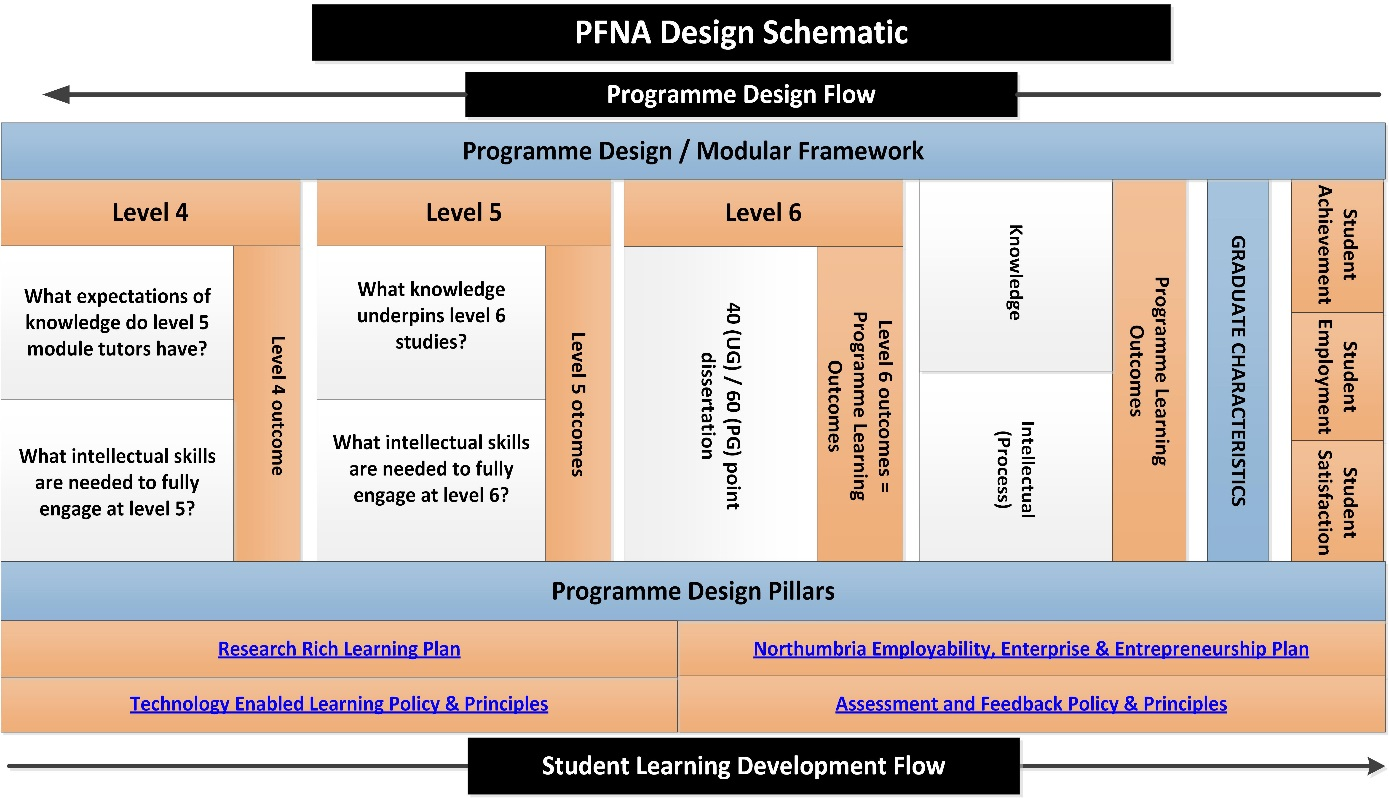
[1] Undergraduate programmes Year 1 equates to level 4, Year 2 equates to level 5, Year 3 equates to level 6 and for Master’s programmes all modules are at level 7

A new national network led by Newcastle University and Northumbria University, in partnership…

A Northumbria University criminologist has been awarded a Philip Leverhulme Prize, one of the…

Pioneering data platform maps where the Armed Forces community receive support from charities

A major study co-led by Northumbria University will test whether attachment assessments lead…

New research published today by the AHRC Creative Communities programme provides fresh evidence…

Northumbria University's award-winning Student Law Office is launching SEND Decoded, a series…

The Net Zero Polar Science (NZPS) Doctoral Training Programme (DTP) has welcomed its first…

A new drop-in service is bringing health and wellbeing support for students at both Newcastle…

Manchester Marriott Hotel Piccadilly
-

Sutherland Building

Northumbria University
-
Page last reviewed: 16 November 2022
