-
Study
-
Quick Links
- Open Days & Events
- Real-World Learning
- Unlock Your Potential
- Tuition Fees, Funding & Scholarships
- Real World Learning
-
Undergraduate
- Application Guides
- UCAS Exhibitions
- Extended Degrees
- School & College Outreach
- Information for Parents
-
Postgraduate
- Application Guide
- Postgraduate Research Degrees
- Flexible Learning
- Change Direction
- Register your Interest
-
Student Life
- Students' Union
- The Hub - Student Blog
- Accommodation
- Northumbria Sport
- Support for Students
-
Learning Experience
- Real-World Learning
- Research-enriched learning
- Graduate Futures
- The Business Clinic
- Study Abroad
-
-
International
International
Northumbria’s global footprint touches every continent across the world, through our global partnerships across 17 institutions in 10 countries, to our 277,000 strong alumni community and 150 recruitment partners – we prepare our students for the challenges of tomorrow. Discover more about how to join Northumbria’s global family or our partnerships.
View our Global Footprint-
Quick Links
- Course Search
- Undergraduate Study
- Postgraduate Study
- Information for Parents
- London Campus
- Northumbria Pathway
- Cost of Living
- Sign up for Information
-
International Students
- Information for International Students
- Northumbria and your Country
- International Events
- Application Guide
- Entry Requirements and Education Country Agents
- Global Offices and Regional Teams
- English Requirements
- English Language Centre
- International student support
- Cost of Living
-
International Fees and Funding
- International Undergraduate Fees
- International Undergraduate Funding
- International Masters Fees
- International Masters Funding
- International Postgraduate Research Fees
- International Postgraduate Research Funding
- Useful Financial Information
-
International Partners
- Agent and Representatives Network
- Global Partnerships
- Global Community
-
International Mobility
- Study Abroad
- Information for Incoming Exchange Students
-
-
Business
Business
The world is changing faster than ever before. The future is there to be won by organisations who find ways to turn today's possibilities into tomorrows competitive edge. In a connected world, collaboration can be the key to success.
More on our Business Services-
Business Quick Links
- Contact Us
- Business Events
- Research and Consultancy
- Education and Training
- Workforce Development Courses
- Join our mailing list
-
Education and Training
- Higher and Degree Apprenticeships
- Continuing Professional Development
- Apprenticeship Fees & Funding
- Apprenticeship FAQs
- How to Develop an Apprentice
- Apprenticeship Vacancies
- Enquire Now
-
Research and Consultancy
- Space
- Energy
- AI and Tech
- CHASE: Centre for Health and Social Equity
- NESST
-
-
Research
Research
Northumbria is a research-rich, business-focused, professional university with a global reputation for academic quality. We conduct ground-breaking research that is responsive to the science & technology, health & well being, economic and social and arts & cultural needs for the communities
Discover more about our Research-
Quick Links
- Research Peaks of Excellence
- Academic Departments
- Research Staff
- Postgraduate Research Studentships
- Research Events
-
Research at Northumbria
- Interdisciplinary Research Themes
- Research Impact
- REF
- Partners and Collaborators
-
Support for Researchers
- Research and Innovation Services Staff
- Researcher Development and Training
- Ethics, Integrity, and Trusted Research
- University Library
- Vice Chancellors Fellows
-
Research Degrees
- Postgraduate Research Overview
- Doctoral Training Partnerships and Centres
- Academic Departments
-
Research Culture
- Research Culture
- Research Culture Action Plan
- Concordats and Commitments
-
-
About Us
-
About Northumbria
- Our Strategy
- Our Staff
- Our Schools
- Place and Partnerships
- Leadership & Governance
- University Services
- Northumbria History
- Contact us
- Online Shop
-
-
Alumni
Alumni
Northumbria University is renowned for the calibre of its business-ready graduates. Our alumni network has over 253,000 graduates based in 178 countries worldwide in a range of sectors, our alumni are making a real impact on the world.
Our Alumni - Work For Us
There is no statutory duty to analyse or report on ethnicity pay, but in line with our determination to advancing racial equality we have committed to do so. Our Ethnicity Pay Gap analysis follows the same methodology as is required for statutory reporting of the Gender Pay Gap, including the calculation of median and mean gaps, and quartiles. Employees who have declined to disclose their ethnicity, or whose ethnicity is unknown are excluded from the analysis (including headcounts).
The University recognises the limitations of using only Black, Asian or Minority Ethnic (BAME) as a way of grouping colleagues and therefore provides data on both two and five groups of ethnicity.
- Two groups is reported as the difference between White staff and staff from a Black, Asian, or Minority Ethnic (BAME) background.
- Five groups is reported as the difference between White staff and staff from either a Black, Asian, Mixed or other background.
A positive number for a gap indicates that the mean or median pay amount is higher for White staff than for staff from other ethnic groups.
A total of 616 staff (15.4% of the total), comprising 291 women and 325 men identify with an ethnic minority group. Some 3,213 staff (80.3%) identify as ‘White’ and a further 174 (4.4%) staff have not declared their ethnicity.
Two groups analysis
The ethnicity pay gap is the percentage difference in average pay of the reference group (‘White’ employees) and comparative ethnic groups. The overall mean ethnicity pay gap at Northumbria University is 0.8% and the median ethnicity pay gap is zero. While positive, it should be noted that the median ethnicity pay gap had previously been in favor of ethnic minority staff .
Ethnicity pay gap (two groups) 2024
|
| Mean | Median |
| Ethnic minority staff | £24.35 | £22.92 |
| White staff | £24.54 | £22.92 |
| £ difference | £0.19 | £0.00 |
| Ethnicity pay gap | 0.8% | 0.0% |
Ethnicity pay gap (two groups) 2021 to 2024![]()
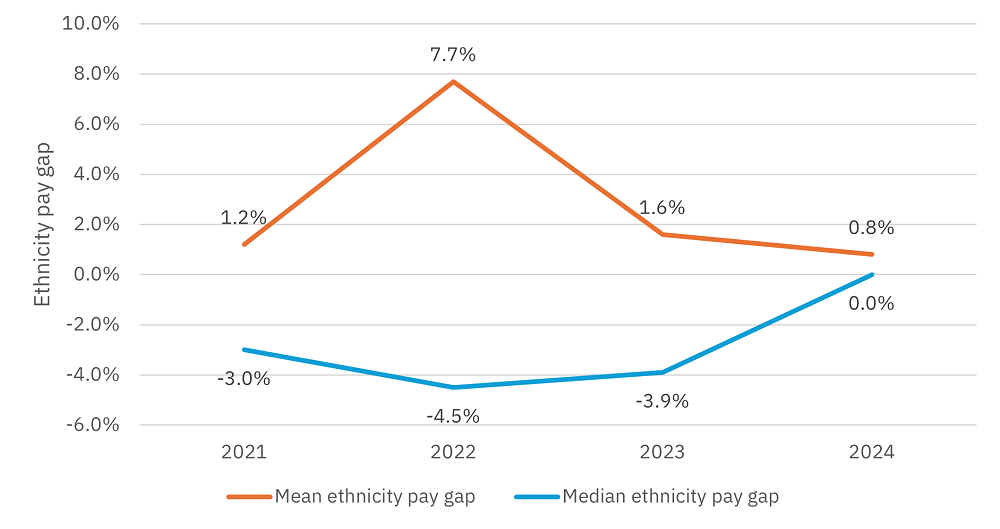
Figure 7
View alt text for above images (figures 7 - 9)
Further analysis considering the proportion of ethnic minority men and women in each pay grade, highlights that ethnic minority representation varies significantly across grades, with men generally having higher representation than women at most pay levels. The highest proportions of ethnic minority men are seen in pay grades 6, 7, and 8, with a peak at grade 8 (24.5%), whereas the highest proportion for women is at grade 6 (17.8%). At higher pay grades (9 and 10), representation drops sharply for both genders, with no ethnic minority staff reported at grade 10. This suggests that ethnic minority employees face barriers to reaching the highest pay grades, and there may be gender disparities within these groups as well.
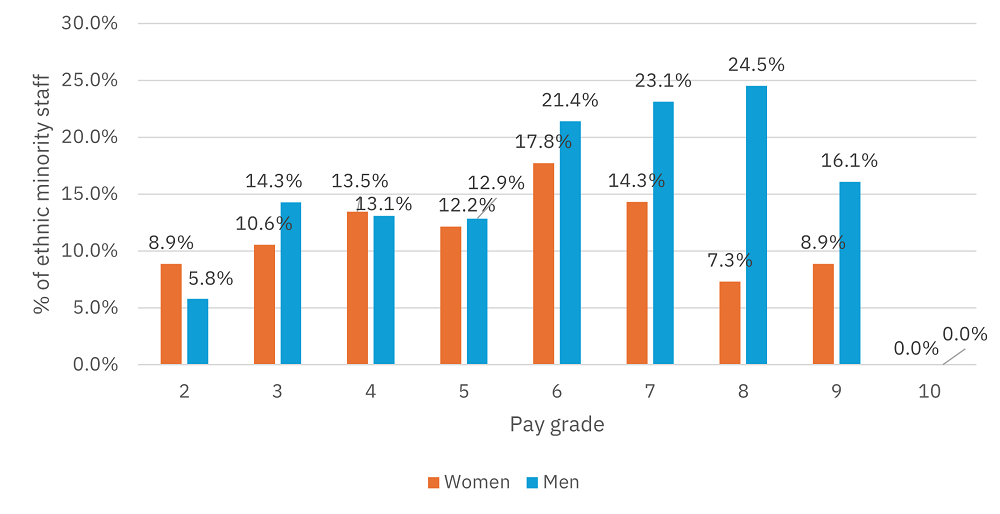
Proportion of ethnic minority men and women in each pay grade (of those that reported)
![]()
Figure 8
View alt text for above images (figures 7 - 9)
Five groups analysis
Further analysis by ethnic group shows variations among different ethnic groups, notably:
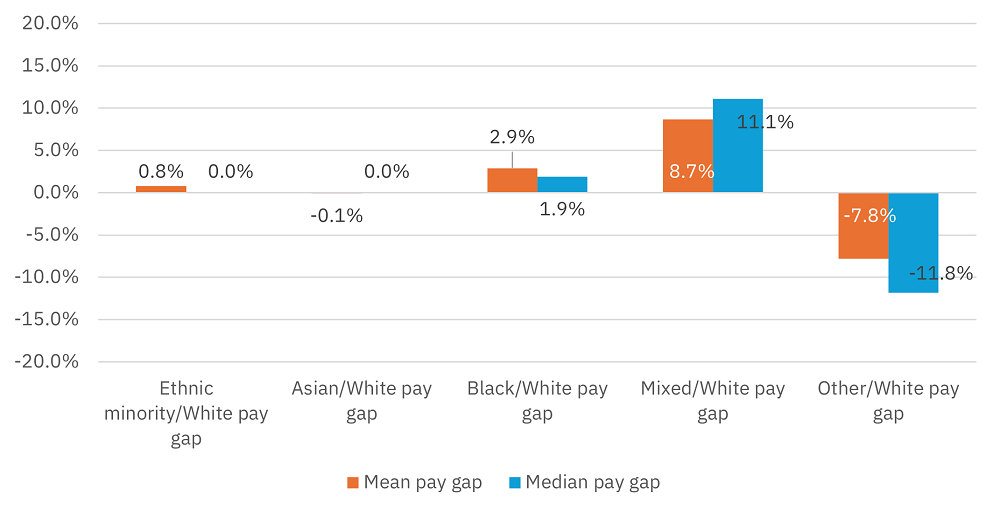
- Pay gaps are smallest for ‘Asian’ staff, with slightly higher average pay for this group than ‘White’ staff resulting in a -0.1% mean pay gap favouring ‘Asian’ staff and a zero median pay gap
- ‘Black’ staff have a moderate pay gap when their pay is compared to that of ‘White’ staff, with a 2.9% mean pay gap and a 1.9% median pay gap
- Staff in the ‘Mixed’ ethnic group experience the largest pay gap, with a 8.7% mean pay gap and an 11.1% median pay gap
- The pay gap for staff from ‘Other’ ethnic groups (the smallest group) is negative, which means their pay is on average higher than that for ‘White’ staff
Ethnicity pay gaps (five groups) 2024
![]()
Figure 9
View alt text for above images (figures 7 - 9)
Intragroup pay gap analysis
Intragroup pay gap analysis examines pay differences within the same sex by ethnicity, such as comparing pay for ethnic minority men to ‘White’ men or ethnic minority women to ‘White’ women. This approach highlights how intersectional factors operate within a particular gender group, isolating the effect of ethnicity.
If we compare average pay for ethnic minority female staff with ‘White’ female staff, we find an intergroup pay gap of 5.8% at the mean and 3.8% at the median. This is much wider on both measures than the overall ethnicity pay gap, which compares all ethnic minority staff with all ‘White’ staff. This means that on average ethnic minority women are paid less than ‘White’ and they fare worse than ethnic minority staff as a whole. A key cause is an overrepresentation of ethnic minority women in lower-paying roles with lower wages compared to ‘White’ women. Ethnic minority women face potential disadvantage in respect of pay due to both gender and ethnicity.
Intragroup pay gap for women 2024
|
| Mean | Median |
| Ethnic minority women | £22.07 | £20.38 |
| White women | £23.44 | £21.19 |
| £ difference | £1.37 | £0.81 |
| Ethnicity pay gap for women | 5.8% | 3.8% |
Table 10
Intragroup pay gap for men 2024
|
| Mean | Median |
| Ethnic minority men | £26.38 | £25.64 |
| White men | £25.97 | £23.61 |
| £ difference | -£0.41 | -£2.03 |
| Ethnicity pay gap for men | -1.6% | -8.6% |
Table 11
A further look at the ethnicity pay gap between same-gender staff by staff group shows the gap is wider for women in academic roles, while the opposite is the case for men where the ethnicity gap is larger for men in professional support roles.
Intragroup pay gap by staff group 2024
|
| White/ethnic women | White/ethnic men | ||
|
| Mean | Median | Mean | Median |
| Academic staff | 12.7% | 15.2% | 9.0% | 0.0% |
| Professional staff | 9.5% | 14.7% | 11.4% | 13.4% |
Table 12
Return to main Pay Gap Reporting 2024 page.
You might also be interested in...
Latest News and Features
£1.3m national study launches to evaluate changes to police involvement in mental health crisis responses
A major new research project will examine how changes to police involvement in mental health…
Royal Honour as leading researcher awarded Polar Medal
Professor John Woodward has been awarded The Polar Medal in recognition of his outstanding…
Report calls on the UK banking industry to consider interventions that "design out" economic abuse
Researchers have published the findings of a ground-breaking study which brought together victim-survivors…
Northumbria's ‘Banana Split: Unpeeling a New Energy Source’ project highly commended at prestigious Green Gown Awards
A Northumbria University research project has been highly commended at the 2025 Green Gown…
Northumbria ranked most sustainable university in the North East for fifth consecutive year
Northumbria University has been rated as ‘1st class’ for sustainability and is once again the…
Northumbria expert delivers training to help address victim-blaming language
A Northumbria University academic is leading pioneering training to support police forces across…
Northumbria University launches national AI challenge inviting young people to imagine a hopeful future
Northumbria University has launched the Hopeful Futures AI Challenge, a groundbreaking national…
Student volunteering partnership expands following five years of community impact
Following the success of a Law in the Community project, Northumbria University is expanding…
Upcoming events
Collaborating for Capability: Shaping the Future of Supply Chain Talent
City Campus East, Northumbria University CCE1-403
-
Archives to Action: Historical Evidence for Policy Reform
Virtual Workshop
-
Viruses of Microbes-UK (VoM-UK) Conference 2026
Northumbria University