
At Newcastle Business School we challenge the conventional wisdom of our clients. We disrupt fixed mindsets and entrenched ways of working; both of which can severely limit individual, team and organisational progress.
We inspire new ways of thinking, behaving and working for our clients through the facilitation of contagious and disruptive learning approaches that challenge accepted norms and create the enthusiasm, energy and courage required to learn and change. This is created and enabled by a passionate team with real experience – blending relevant business research with real business issues.
Psychology in coaching: Should I expect the psychiatrists couch?
An anxious coachee enters the meeting room, “OK then he says, where’s the couch? – I can’t wait to see what you come up with when you analyse what’s in my head.”
As a coach I am often reassuring clients that I am not going to “do coaching to them”. For me coaching is a collaborative relationship where we will work together on topics of importance to the coachee and their organisation using a range of strategies and approaches to facilitate development and change. However, in my view psychological mindedness is critical.
For example, investing time in building a secure and trusting working relationship is paramount to ensure the coachee feels heard in a safe, non judgemental and empathic environment. This person centred approach draws on the therapeutic counselling work of Carl Rogers but is easily applied to the coaching context. The philosophy assumes that individuals have an inherent drive to reach their full potential and contain vast untapped resources within to solve their own problems.
A second example of integrating psychological knowhow in to the conversation would be in challenging performance limiting beliefs. I listen to the language of my clients and notice the inherent assumptions and potentially unhelpful thinking when they claim “I can’t“; "I have to” or “I’m failing”. This approach is based on the premise that the way you think about things profoundly affects the way you feel about them which in turn affects how you behave and your state of well-being. Ultimately these thinking errors can affect performance. Building awareness of the impact of this thinking is the first step in helping a client to see alternative pathways.
As we develop coaching capability in our organisations it is tempting to believe that a quick fix can be achieved through some easily acquired tools and techniques. However, experience tells me that the more impactful coaches have a greater awareness of the psychological traditions underpinning their approach and integrate them mindfully in service of the coaching context and the particular coachee. To find out more about developing psychological mindedness in coaching contact Joanne James at joanne.james@northumbria.ac.uk
How did you like your soup?
In the previous article we introduced the concept of Cultural Intelligence (CQ) as a personal competence which enables you to work effectively across cultures – both national and organisational.
As a small test of your own CQ we put the following question to you:
Imagine you are in a restaurant abroad and you are served a bowl of soup with a live fish swimming in it. How would feel? Which of the following responses is closest to yours:
a) ‘I can’t eat that’
b) ‘This is different’
c) ‘This is new to me; how interesting’
The answer you chose gives some indication of your existing CQ, but in order to explain this we need to look in more detail at what we mean by CQ.
CQ is a form of intelligence which has its own characteristics and distinguishes it from other forms of intelligence such as Emotional Intelligence. CQ is most often described in the following model:
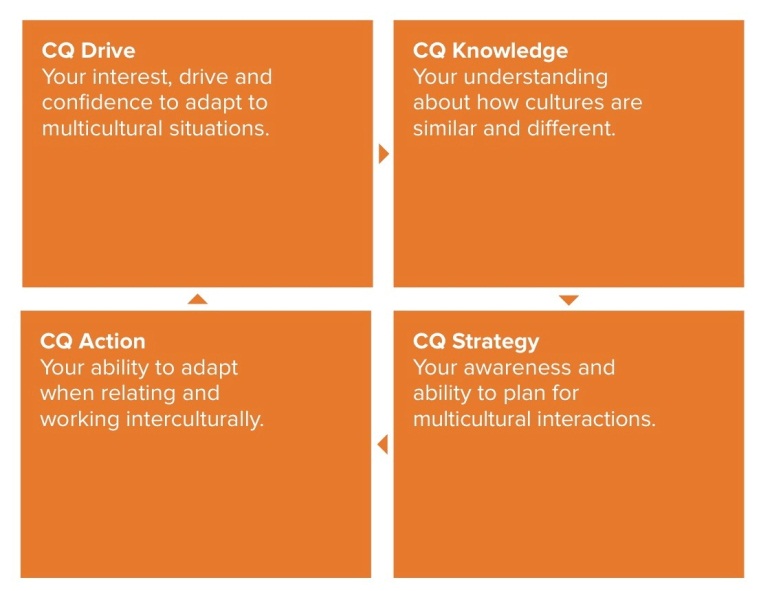
The starting point for CQ is ‘Drive’ – the curiosity you have about other cultures and the desire you have to be successful across those cultures.
Getting back to the soup if you answered a) then it seems your CQ Drive is pretty low as you have quickly made your mind up that the soup should be rejected and effectively closed the door on further discussion.
If you answered b) then your CQ Drive is moderate. You have acknowledged that the soup is different and at least left the door open for further investigation of the situation. Answer c) indicates a high level of CQ Drive and allows for a positive discussion about the cultural significance of the soup.
Rejecting the soup out of hand may have caused great offence to those offering it to you. By showing interest you enable discussion and, through this, understanding of each other’s points of view. For example it may well be that the soup is not meant to be eaten and is intended as an entertaining precursor to the meal.
Our culture drives our behaviours and also shapes our expectations of the behaviours of others. When others do things which do not meet our cultural expectations then we may see that as wrong or bad. What we often forget is that others from different cultures will see our behaviour as similarly unacceptable. Having the curiosity or drive to find out more about the differences (and similarities) between ourselves and others allows us to acquire cultural Knowledge – the second component of CQ.
We tend to form impressions about other cultures based on our senses - what we see, hear, taste etc. These impressions are what we take away from holidays and trips abroad. They may tell you something about the customs and habits of a particular culture but the behaviour of people from different cultures is determined more by their cultural values and beliefs which cannot be easily detected by our senses.
So how do we learn about the cultural values of other? Well at NBS we teach cultural values and characteristics as a core part of many programmes in order to develop our students’ CQ.
As a starting point we often look at proverbs which are a rich source of cultural values. Can you tell which country these proverbs come from?
- The squeaky wheel gets the grease
- The tallest flower in the field is the first to be cut down
- Order is half of life
- He who stirs another’s porridge often burns his own
- Even if the bridge be made of stone, make sure it is safe
The answers will be given in the next issue but in the meantime if your CQ Drive has been stimulated and you want to know more please contact Michael Green at michael.j.green@northumbria.ac.uk
What does Responsible Leadership have to do with Economic Growth?
Our last newsletter focused on the role of Responsible Leadership within organisations, we now turn to the role of Responsible Leadership across the region.
Since our last newsletter Newcastle Business School has hosted a landmark Responsible Business event to mark Business in the Community’s Responsible Business Week, bringing together key business leaders and third sector organisations from across the region. It was an opportunity for businesses, charities and other responsibly-minded organisations to collaborate, share good practice and learn from one another on what Responsible Business and Leadership means to them.
The keynote address was given by Peter Walls, BITC’s HRH The Prince of Wales’ Ambassador for Responsible Leadership in the North East and CEO of Gentoo, a large North East based social enterprise with a vision to improve the Art of Living. Brian Manning, CEO of Esh Group and Hannah Underwood, CEO of social enterprise, The Key, also spoke at the event. Eachplay a vital role in economic development across the region and beyond and crucially each panel member echoed the view that a responsible approach to business was key to financial success. Indeed, the panel posed the question of whether a more responsible approach to business was the key to economic growth across the region.
At the centre of this discussion were some interesting observations around leadership and how this manifests itself within a responsible organisation, themes around authenticity, core values and enabling action around these values emerged throughout the discussion.
Here at NBS we place self and authentic leadership at the core of our Responsible Leadership programmes and were delighted to hear from organisational leaders that this is indeed at the heart of Responsible Leadership in practise. Furthermore, through developing more responsible leaders you may also be contributing that little bit extra to the local economy.
This was the first in what we hope will be a series of Responsible Business events hosted by NBS and our partners. These events will be shaped by organisations such as yours and if you would like to get involved and be part of the conversation, or are simply curious to find out more please contact joanne.james@northumbria.ac.uk
Meeting Strategic Challenges through Partnership
The client and our team in the Corporate and Executive Development department at Newcastle Business School (NBS) came together when the client faced the biggest business challenge in its history. Fundamental changes to strategic direction and the operating structure of the organisation required an essential shift for the leadership team; particularly in their ability to lead change, take strategic decisions and manage significant projects.
An extensive individual and organisational needs analysis was conducted, using scenario planning, focus groups and interviews involving all stakeholders. This process gave the NBS team an in-depth understanding the real business issues and enabled them to familiarise themselves with the organisations’ culture and values. By involving the executive team in the interviews and the focus groups, their commitment to the programme was secured and they were also able to become involved in identifying and prioritising the learning and development needs of their managers.
From this analysis, NBS proposed and jointly implemented a management competency framework and an extensive leadership development programme spanning 2 years and culminating in the award of MA in Applied Management for 30 of the organisation’s middle and senior managers. The establishment of a project board, chaired by the Director General and comprising the Directors and Management Development Manager from the organisation, the Programme Leader from NBS, plus a number of managers/participants on the programme, enabled a partnership approach and facilitated the success of the programme in achieving the organisation’s objectives.
This group was a consultative and continuous improvement group and it was instrumental in securing the commitment of all of the major stakeholders for the on-going programme. The group was the cornerstone of the partnership as it agreed the learning priorities for the organisation and the nomination of sponsors (a Director from the Executive team) for each module of learning who also supported the NBS team with the design and delivery of the learning. This approach ensured that the programme was aligned to the strategy of the organisation, met business needs and was relevant to programme participants. This board also had a role in agreeing managers’ project topics, ensuring that real business benefit would be gained from research investigations and recommendations. The project board also became the conduit for participants’ feedback kent to the executive, on both the programme and organisational strategy. This proved invaluable to the senior team as they were able to not only gauge reaction from the management cohort, but also use the programme as a vehicle for important corporate messages.
Please contact ruth.leggett@northumbria.ac.uk for more information.
The role of a non executive director: what it is and what it isn't
On Friday 19 June over 60 business professionals met to find out more about the role of the non executive director (NED) and its importance to businesses in the North East. Hosted by Newcastle Business School in conjunction with Nigel Wright Recruitment, the event launched a new collaborative venture bringing together existing and aspiring non executive directors in the region.

From left to right: Tracey Wilson; Lucy Armstrong; Jane Turner; Philip Shrives; David Buffham
Experienced non executive directors Lucy Armstrong, chief executive of The Alchemist, and David Buffham, former agent for the Bank of England, shared their insights into this valuable role. Speaking candidly from their own experiences both considered the duties, responsibilities and legal obligations of the position. Mark Simpson, Group Executive director, Nigel Wright Recruitment, provided an overview of the recruitment landscape for non executive directors in the North East.
Professor Philip Shrives, Dr Johan Coetsee and Tracey Wilson presented the results of a recent survey to executives regarding the learning and development requirements of NEDs. The results form the basis of the new Leadership Development Programme which commences this autumn.
The Leadership Development Programme consists of a series of breakfast networking events and longer developmental sessions focusing on effective board member skills.
The Leadership Development programme is of value to both active NEDs and those seriously seeking appointments in this area. In addition, we actively encourage the involvement of North East business owners and investors who are considering or planning the appointment of a NED to their board.
For further information please email Tracey Wilson: t.wilson@northumbria.ac.uk
Latest News and Features

Speeding glaciers drive half a century of polar ice loss
The longest satellite record ever assembled shows that Greenland and Antarctica have lost 11.3…

Northumbria physicist elected Fellow of the Institute of Physics
Dr Juna Sathian, an Associate Professor at Northumbria University, has been elected a Fellow…

Northumbria helps shape national plan to boost graduate employability
Northumbria University has played a key role in shaping a new national plan designed to help…

Northumbria researcher joins appeal to Downing Street on free school meals and holiday support
A Northumbria University academic, whose research has played a key role in bringing breakfast…

Ancient wildfires near the South Pole shaped Earth's earliest peat bog
Wildfires raging through prehistoric rainforests helped create the earliest known peat bog…

Northumbria astronomer helps reveal secrets of rare interstellar visitor
A Northumbria University astronomer has helped uncover new clues about a rare icy object from…

Two Northumbria professors elected Fellows of the Academy of Social Sciences
Two leading academics from Northumbria University have been elected to the Fellowship of the…

New scientific review involving Northumbria researchers identifies Antarctic coastal blind spots limiting sea level projections
A new international, community-led, scientific review warns that major gaps in knowledge along…
More events
Upcoming events


IPE Conference 2026
Northumbria University
-

Specialist Teaching Assistant Degree Apprenticeship - In-person Information Session
Coach Lane Campus
-

Next Stop Northumbria
Europa Hotel
-
