
Katy Jenkins, Associate Professor of International Development and Co-Director of the Centre for International Development at Northumbria University, writes in Discover Society about her sociological photography project.
“We’re always saying ‘No, no, no to mining’, but we never put forward an alternative or positive proposal.” This was how one woman explained her motivation to take part in my participatory photography project, which explores women anti-mining activists’ conceptions of ‘Development’, in the context of living with proposed and actual large-scale resource extraction.
The project, funded by a Leverhulme Trust Fellowship, involves working with a group of 12 women from Cajamarca, a small city in the North of Peru, enabling them to use photography to reflect on and capture their own ways of thinking about Development, and in particular to think through alternative visions of Development that challenge the dominant Peruvian national narrative of extractive-led Development.

(Right: Gladis Chilon Gutierrez/Women, Mining and Photography Project 2017)
Yanacocha gold mine, the largest gold mine in Latin America, is owned by US Newmont Mining Corporation, Peruvian Minas Buenaventura and the World Bank’s International Financial Corporation. It has operated in the region of Cajamarca since 1993. During this time, there has been widespread and growing concern about the mine’s operation and, in particular, its environmental impact, especially in relation water quality and quantity. The city of Cajamarca has become an emblematic site in relation to socio-environmental conflicts around mining.
In 2000, local opposition to mining intensified, and gained international prominence, when a truck contracted by the mine spilt significant quantities of mercury along a stretch of road in and around community of Choropampa, with devastating health and environmental impacts. Then in the mid-2000s, protests erupted in opposition to the company’s proposed Cerro Quilish expansion, which sought to develop the Quilish mountain, which is considered a sacred place by local people, has a fragile ecosystem and is situated at the head of the watershed. The strength of community opposition and public opinion eventually forced the Minera Yanacocha company to withdraw from the Quilish concession but only after violent confrontations between protestors and the police.
Most recently, Cajamarca has been in the spotlight for vehement and prolonged opposition to the proposed Minas Conga project, a proposed multi-billion dollar expansion to Yanacocha’s existing project. Community opposition in both Cajamarca city and the wider region of Cajamarca, culminated in protests during 2011 and 2012, leaving five protestors dead, and eventually leading to the indefinite suspension of the project. Nevertheless, despite the suspension of Conga, there are ongoing tensions around actual and proposed extractive activities, personified in the now iconic figure of Máxima Acuña Chaupe – winner of the 2016 Goldman Environmental Prize – and her battle against Newmont Mining Corporation. Activist organisations continue to fiercely resist Conga and other possible new mining developments, as well as opposing the broader development model associated with this sort of large-scale resource extraction.
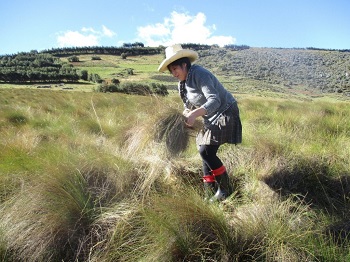
(Right: 2 Felicita Vasquez Huaman/Women, Mining and Photography Project 2017)
The region of Cajamarca has thus become internationally renowned for its opposition to large-scale mining and, over the years, there has been a steady stream of journalists, academics, PhD students, filmmakers and photographers, supporting the Cajamarquinos in their struggle and sharing it with the world. Whilst this has given international prominence to Cajamarca’s struggles, activists, such as the women those involved in this particular project, do feel quite thoroughly ‘researched’ and tend to have a well-rehearsed ‘script’ in relation to recounting their involvement in the conflict. The women activists embraced this project as an opportunity to construct and disseminate their own narratives, and to create a set of resources to enable them to actively communicate their ideas and perspectives in a distinctive way. Participatory photography provides a tool with which to achieve this, facilitating a move away from more traditional interviewer/interviewee power dynamics, and allowing participants to set the agenda and foreground the topics they deem important.
Over three months during 2017, a group of women drawn from three women’s organisations (two from Cajamarca city, and one from Celendin (a small town close to the proposed Conga development)), took part in a series of workshops and activities aimed at capturing their distinct approaches to contesting mining developments, and thinking about alternatives, using the medium of participatory photography. In the course of the project, the women took several thousand photos, reflecting on three themes they chose to work on – ‘alternatives to resource extraction’, ‘wellbeing’ and ‘community’. These were themes that the women themselves thought it important to explore, and that reflected discussions about the meaning of ‘Development’ from the initial participatory workshop.
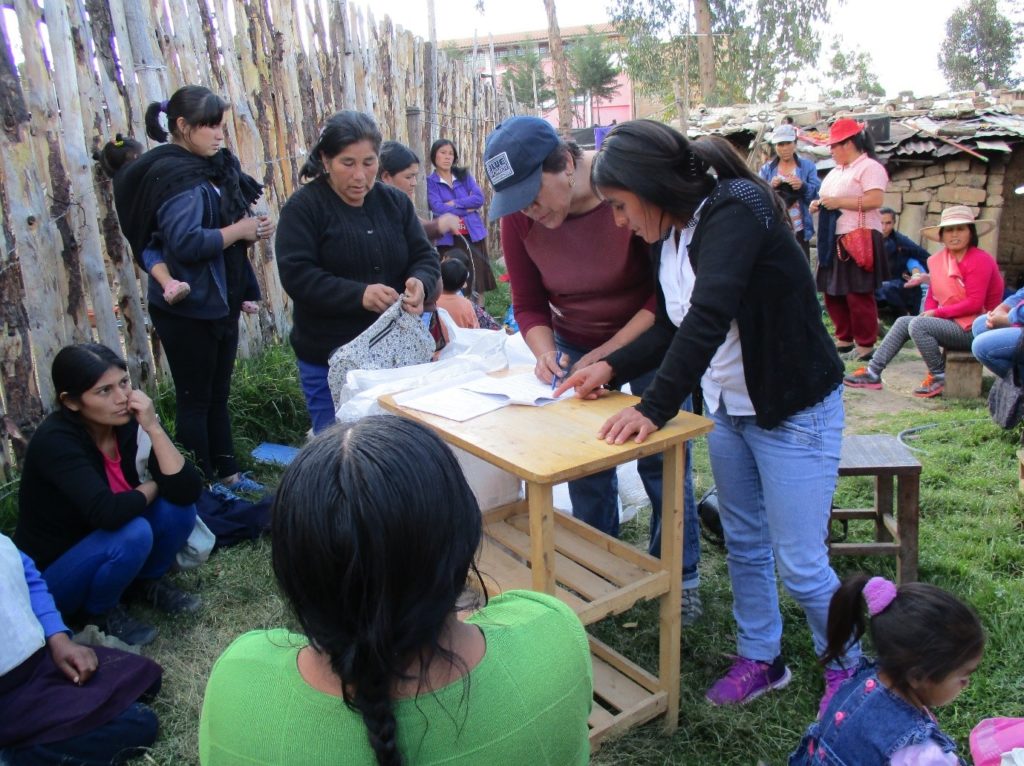
(Right: Filomila Sangay Lopez/Women, Mining and Photography Project 2017)
Drawing on their own lives and experiences, the women’s photos provide an optimistic, vibrant and rich perspective on the region of Cajamarca and their hopes for its future. Participatory photography is often used with marginalised and disadvantaged groups, and provides an opportunity for alternative voices and perspectives to come to the fore. Many of the women participants in this project had never used a camera before. For them, the most important aspect of the project is the opportunity to exhibit their work in the main plaza in Cajamarca city, enabling them and their ideas to occupy and claim (increasingly restricted) civic space, and to showcase their newly acquired skills, their creativity and visions for the future, to local people, government officials, the mining company, and organisations involved in contesting mining. This exhibition is planned for International Women’s Day, 8th March 2018.
The women’s photos reflect the importance they place on a more people-centred, human-scale Development, a strong contrast with the highly industrialised and mechanised forms of mining that they experience in their region, and strongly contest. A sense of hope permeates the women’s images, foregrounding that which they value as distinctive and meaningful, and portraying Cajamarca as a culturally, historically and naturally rich region with an abundance of resources and opportunities.
Such images and perspectives stand in stark contrast to the devastation and destruction wrought by large scale mining in the region, and across the global South. In choosing not to focus on this aspect of mining, the project aimed to open up spaces of possibility rather than capturing the already well-documented and extensive negative impacts of mining – which might also have placed the women activists in difficult or dangerous situations, and exposed them to multiple risks.
The women’s own subjectivities and positionalities as anti-mining activists have been central in the types of image they have generated. Indeed, this is an integral expectation of participant photography; there is no expectation of, or desire for, objective or values-free ‘data’. In this case, aspects characteristic of much of the campaigning narratives of the broader anti-mining movement are central to the visions put forward in the women’s photos. Food and culture, exemplifying a threatened rural way of life, were recurring themes that appeared in all twelve women’s photos, despite most of the women currently living in the city.
Many of the women had grown up in rural communities, and some self-identified as indigenous women (still relatively uncommon in much of Peru due to the continuing legacy of severe discrimination against indigenous peoples). Many women had purposely sought out images of rurality and, in particular, agricultural abundance, and used these images to emphasise the opportunities they felt small-scale agriculture presented for an alternative model of Development, not based on mineral extraction.
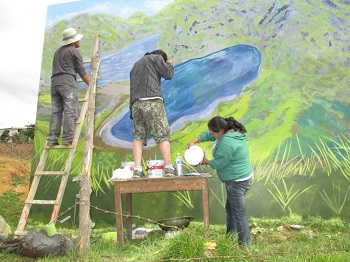
(Right: Yeni Cojal Rojas/Women, Mining and Photography Project 2017)
It should be recognised that there is an element of rose-tinted spectacles to these sorts of images, they portray an idealised vision of rural life, and for the most part do not capture poverty and inequality within their purview. Despite this caveat, they do reflect on ideas around sustainability, and self-sustenance, attesting to the women’s belief that Development should not be something imposed from outside but should emerge from within a community and a particular context.
The women’s desire to portray themselves and other women as active agents of change within their communities is also evident in many of their photos. Their images capture examples of women as micro-entrepreneurs; reflect on opportunities for the diversification of women’s livelihoods (including herbal remedies, elaboration of dairy products, soap production); and show women in myriad roles, as agriculturalists, food producers, mothers, muralists, market sellers, musicians, community organisers and activists. They portray women as integral to the functioning and survival of communities and families, and as capable, self-motivated and hard-working individuals.
Most recently, having come to the end of the active photography phase of the project, I conducted interviews with the women about the photographs they have taken – giving them an opportunity to reflect upon what photos they took and why, and also what photos they chose not to take, or were unable to take. These interviews, as well as narratives and poems written by the women about some of their photos, will be analysed over the coming months, and will provide a deeper insight into the women’s stances, motivations and aspirations, prior to the final exhibition of a selection of the women’s images and narratives in spring 2018. The project can be followed here.
Katy Jenkins is Associate Professor of International Development and Co-Director of the Centre for International Development in the Department of Social Sciences, Northumbria University. Katy’s research focuses on women’s activism and community organising in Latin America, and she is currently involved in several projects exploring women’s resistance to large scale resource extraction.
Latest News and Features

Northumbria graduates celebrated at North East Business Awards
Graduate entrepreneurs from Northumbria University are celebrating after winning recognition…

How facial recognition failures harm people with facial differences
Researchers at Northumbria University's Centre for Responsible AI are working with Face Equality…

New Master Research Agreement strengthens commitment to cutting-edge research and innovation
Northumbria University and Lockheed Martin Space UK have signed a new Master Research Agreement,…

Speeding glaciers drive half a century of polar ice loss
The longest satellite record ever assembled shows that Greenland and Antarctica have lost 11.3…

Northumbria physicist elected Fellow of the Institute of Physics
Dr Juna Sathian, an Associate Professor at Northumbria University, has been elected a Fellow…

Northumbria helps shape national plan to boost graduate employability
Northumbria University has played a key role in shaping a new national plan designed to help…

Northumbria researcher joins appeal to Downing Street on free school meals and holiday support
A Northumbria University academic, whose research has played a key role in bringing breakfast…

Ancient wildfires near the South Pole shaped Earth's earliest peat bog
Wildfires raging through prehistoric rainforests helped create the earliest known peat bog…
More events
Upcoming events

Specialist Teaching Assistant Degree Apprenticeship - In-person Information Session
Coach Lane Campus
-

Next Stop Northumbria
Europa Hotel
-
The Past We Inherit. The Future We Build: Better Decisions Happen Together
The Great Hall, Sutherland Building
-
Next Stop Northumbria
Manchester Marriott Hotel Piccadilly
-
