
One of the key topics of discussion at the COP26 climate change summit is on how we can work with nature to improve our responses to the climate emergency. Government representatives, experts and negotiators are debating ways to ensure that nature and sustainable land use are part of global action on climate change and a clean, green recovery.
As a Professor in Environmental Geography at Northumbria University, Alister Scott is one of the UK’s leading experts with research focused on mainstreaming nature in policy and decision making. He has just completed three years working as a Natural Environment Research Council Fellow.
As part of our coverage of climate related research in Northumbria University, we asked Professor Scott to share his views on the six lessons that governments and decision makers can take from his research.
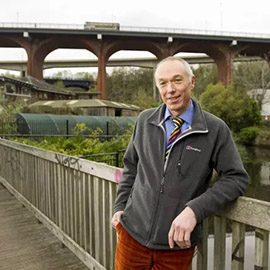
He explains: "I have spent the last three years working to improve how nature is mainstreamed in policy and decision making with a range of public, voluntary and private sector agencies and I have captured six key lessons as opportunities that should be applied in the COP26 discussions.
"However, perhaps the underlying context also needs reinforcing concerning the need for everyone to “wake up” and understand the need for URGENT ACTION now and move away from ambition, aspiration and greenwash.
Lesson 1:
The cost of ignoring the climate and nature emergencies is higher if you delay action now
Many counter narratives to urgent climate change action explain how the necessary changes involved in investing in nature or net zero are costly, impacting on profits or viability. This traditional approach to cost benefit analysis is short term in focus. It does not include the costs from flooding, wildfires, pollution, hospitalisation, illness, disease that are increasing at an alarming rate. So, for a volume house builder it makes sense to build as many houses as cheaply as possible as they are not responsible for extreme weather events down the line. If the full cost cycle was included in the planning stage it would make sense to build new houses with greywater systems and sustainable drainage for water management, as well as green spaces to help with air quality and wellbeing. The challenge is: who pays? Adopting more holistic principles as recognised by the Building with Nature accreditation or NATURE tool assessments incentivises developers and landowners to pursue multiple benefits for nature and society, but in so doing also adds value to properties and developments. A potential win-win. However, such incentives do not work well in isolation. They need also to be backed up by stronger planning regulation and policy to make sure that quality developments and interventions are undertaken in the right place. This also addresses critics of natural capital value and biodiversity and carbon offsetting markets as these interventions are measures of last resort if the mitigation hierarchy – avoid, minimize, restore and offset – is properly enforced.
Lesson 2:
We need to avoid the obsession with metrics of quantity
In my work I often see ambitious targets that all too easily become the metrics for success. Such as building 300,000 houses or planting 11 million trees. This is all fine and good but says nothing about the quality of homes that are built or whether the trees planted are managed and survive. We are starting to live in a tick box culture where we tend to value what we can easily quantify and measure, rather than measure what we most value. We need better metrics of quantity and quality. It is here that my work with Building with Nature offers some important insights in using qualitative criteria from which the quality of planned developments before and after construction are assessed, helping developers and planners understand what good green infrastructure looks like.
Lesson 3:
The climate, biodiversity, health and wellbeing and economic emergencies are all interlinked
Currently we collect evidence to diagnose and treat issues in separate silos without recognising their wider connections. Here nature delivers multiple benefits across climate, biodiversity, health and economic emergencies. But policy makers don’t work at the interfaces. There is a danger that COP26 is seen as the preserve of climate change; COP15 is seen for biodiversity and the G7 for economic challenges. From an English government perspective, how many environmental projects are explicitly working at the intersection and crossing government departments? In my view not enough and this is leading to a policy void and disintegrated policy. In making connections between these emergencies we also need to recognise that societal changes will impact the poor and vulnerable the most, which should put equity and social justice considerations at the heart of policy responses, not an afterthought. Here the Marmot review 10 years on sets the policy challenge.
Lesson 4:
We need better upfront collaboration with all relevant stakeholders including local communities to codesign better solutions and actions
Most people agree that engagement is a good thing to do and, indeed, there are statutory requirements for this. But often public engagement is seen as a burden that takes too long and slows down a given policy, plan or project. Hence, consultation can, all too easily, become tokenistic – with early input from the usual and influential suspects and consultation through quick and cheap web-based approaches. But proper engagement involves a co-design process with both usual and unusual suspects involved from the outset. It should be a conversation rather than a one-off event. Crucially, it is about realising who needs to be involved around the table to start to understand the problems and identify solutions. The innovative work of Newcastle City Futures signposts how a managed process of public engagement can lead to highly successful outcomes and projects. Equally more novel forms of engagement can lead to better insights, such as through games-based format.
Lesson 5:
We need to focus on delivery and evaluation rather than producing more and more strategy
Throughout my Fellowship I have attended a groundhog day of conference events on green infrastructure and climate change which seem to be fixed on providing evidence of the scale of the problem and challenge rather than on the delivery and evaluation phases to improve mainstreaming pathways. By focusing more on delivery we can work back to learn what has worked well – or indeed not worked well – to improve policy. Furthermore, we need to address the policy-delivery gap; there is never any shortage of strategy and plans, but there is rarely enough resource to actually deliver. Those involved in delivery must also be involved in the strategy. This is a key finding from my strategic planning for nature report.
Lesson 6:
Framing the climate change emergency positively is crucial
The words we use to frame the climate emergency are important. People naturally respond better to a positive opportunity rather than being scared by scientifically accurate doomsday narratives. Our planet and nature are in crisis for sure but the way we communicate this and translate the science to different audiences matters in terms of influencing their behaviours. Words matter and the rather obscure environmental vocabulary (e.g. ecosystem services, natural capital, green infrastructure, ecological networks, biodiversity), needs translation. As each new term has been introduced there has been little attention on trying to understand how they interrelate. They all feature in the climate change narrative, but the narrative fails to explain how they collectively contribute. There is a further problem in that many narratives see nature-based solutions as good and built development as somehow bad. A recent paper on integrating smart and biophilic narratives highlights the importance of silver, green and blue infrastructure working together in creating better quality developments. The underlying message is still clear; nature is more than something nice to have. It is essential critical infrastructure for our cities and countryside, and it is an integral part of the business case for nature.
These six lessons are not mutually exclusive. It seems to me that if we try to build these into our governance frameworks and consequential policy and practice responses for COP26 we might achieve more joined-up outcomes.
To find out more about Northumbria University's research and expertise in climate change, visit www.northumbria.ac.uk/livesustainably
Geography At Northumbria University Encompasses All Of Our Work In Physical And Human Geography, Environmental Science And Management, Health & Safety, And Disaster Management.


This is the place to find all the latest news releases, feature articles, expert comment, and video and audio clips from Northumbria University
Latest News and Features

Northumbria helps shape national plan to boost graduate employability
Northumbria University has played a key role in shaping a new national plan designed to help…

Northumbria researcher joins appeal to Downing Street on free school meals and holiday support
A Northumbria University academic, whose research has played a key role in bringing breakfast…

Ancient wildfires near the South Pole shaped Earth's earliest peat bog
Wildfires raging through prehistoric rainforests helped create the earliest known peat bog…

Northumbria astronomer helps reveal secrets of rare interstellar visitor
A Northumbria University astronomer has helped uncover new clues about a rare icy object from…

Two Northumbria professors elected Fellows of the Academy of Social Sciences
Two leading academics from Northumbria University have been elected to the Fellowship of the…

New scientific review involving Northumbria researchers identifies Antarctic coastal blind spots limiting sea level projections
A new international, community-led, scientific review warns that major gaps in knowledge along…

STEM outreach team wins prestigious Royal Society Athena Prize
Researchers from an outreach group at Northumbria University, which promotes opportunities…

Northumbria works with the Mayor's Fund for London to widen access to higher education
Northumbria University's London Campus has opened its doors to young Londoners this summer,…
More events
Upcoming events

NU-NHSA Launch Event
Northumbria University
-
Vortex Wakes of Airplanes, Helicopters, and Wind Turbines: Structure and Stability
ELA 001, Ellison Building A
-


